Malkin Robert, Howard Caroline
Department of Biomedical Engineering, Hudson 136, #90281, Duke University, Durham, NC 27708, USA.
Open Biomed Eng J. 2012;6:92-7. doi: 10.2174/1874120701206010092. Epub 2012 Sep 14.
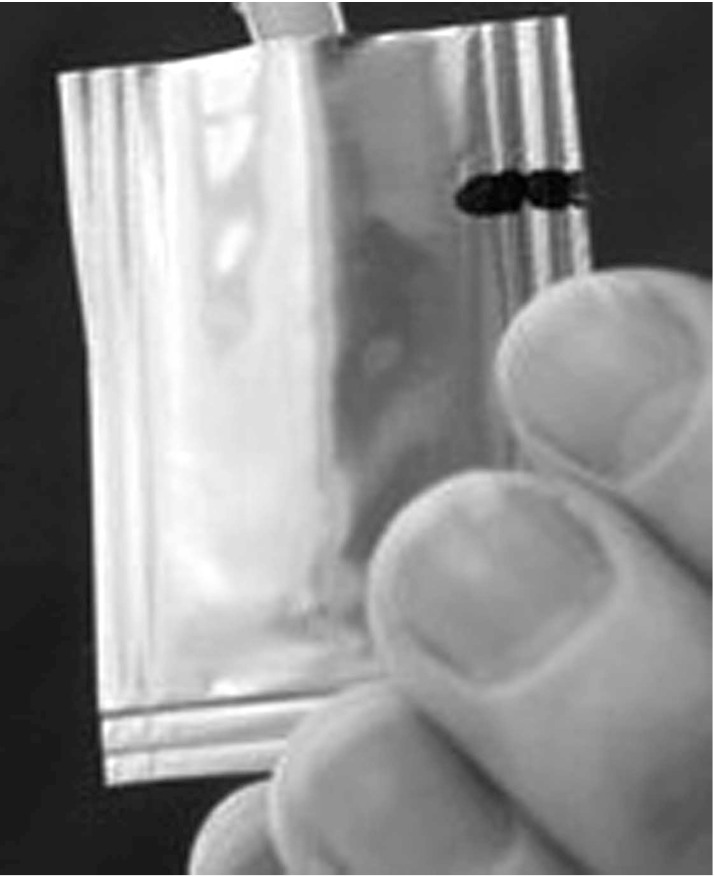
Many children become HIV+ due to mother-to-child transmission, a risk that can be largely eliminated if infants ingest antiretroviral (ARV) medications immediately after birth. As most mothers in Africa deliver at home, the ARV must be provided at their last antenatal visit, sometimes months before birth. No current drug delivery system allows the mother to store the medication at home long enough to be effective. We propose a preserving, foilized, polyethylene pouch to be pre-dosed and sealed by a pharmacist for later delivery to the newborn.Pouches were filled with 0.6 ml of Nevirapine (NVP). Thirty-three pouches were immediately studied to measure the impact of medication handling (oxygen, light, filling and sealing the pouches). The remaining samples were stored for up to one year at three storage conditions (25°C/60%RH, 30°C/65%RH, and 40°C/75%RH). Every two months, moisture loss, preservative concentration, impurity concentrations and NVP concentration were measured. Flora and fauna challenges were conducted.THE POUCH NEARLY ELIMINATED MOISTURE LOSS: pouches lost less than 0.7% of their weight over twelve months. As expected, exposing the medication to light, oxygen, and handling significantly affected the sacrificial preservative concentrations (Propyl paraben dropped 38%, Methyl paraben dropped 12% at time point zero). However, after the initial time point, preservative levels were stable in the package over twelve months under all storage conditions (4.1% average concentration drop), leaving sufficient preservatives to protect the medication. The concentration of NVP changed an average of only 1.3% over all storage conditions and times points (maximum 1.4%).We conclude that the foilized polyethylene pouch can preserve NVP, and perhaps other ARV's, for up to one year.
许多儿童因母婴传播而感染艾滋病毒,如果婴儿在出生后立即服用抗逆转录病毒(ARV)药物,这种风险在很大程度上是可以消除的。由于非洲大多数母亲在家分娩,抗逆转录病毒药物必须在她们最后一次产前检查时提供,有时是在分娩前几个月。目前没有任何药物输送系统能让母亲在家中长期储存药物以保证其有效性。我们提出一种经过保存处理的、带有箔片的聚乙烯袋,由药剂师预先定量并密封,以便日后给新生儿使用。袋子里装入0.6毫升奈韦拉平(NVP)。立即对33个袋子进行研究,以测量药物处理(氧气、光照、装袋和密封袋子)的影响。其余样本在三种储存条件(25°C/60%相对湿度、30°C/65%相对湿度和40°C/75%相对湿度)下储存长达一年。每两个月测量一次水分流失、防腐剂浓度、杂质浓度和奈韦拉平浓度,并进行微生物挑战试验。该袋子几乎消除了水分流失:在十二个月内袋子重量损失不到0.7%。正如预期的那样,将药物暴露于光照、氧气和处理过程中会显著影响牺牲性防腐剂的浓度(在时间点零时,对羟基苯甲酸丙酯下降了38%,对羟基苯甲酸甲酯下降了12%)。然而,在初始时间点之后,在所有储存条件下,十二个月内包装内的防腐剂水平保持稳定(平均浓度下降4.1%),留有足够的防腐剂来保护药物。在所有储存条件和时间点上,奈韦拉平的浓度平均仅变化1.3%(最大变化1.4%)。我们得出结论,带有箔片的聚乙烯袋可以将奈韦拉平以及或许其他抗逆转录病毒药物保存长达一年。