
不同非生物胁迫条件下大豆组织中定量 RT-PCR 归一化的候选内参基因的评估。
Evaluation of candidate reference genes for normalization of quantitative RT-PCR in soybean tissues under various abiotic stress conditions.
机构信息
Signaling Pathway Research Unit, RIKEN Plant Science Center, Yokohama, Kanagawa, Japan.
出版信息
PLoS One. 2012;7(9):e46487. doi: 10.1371/journal.pone.0046487. Epub 2012 Sep 28.
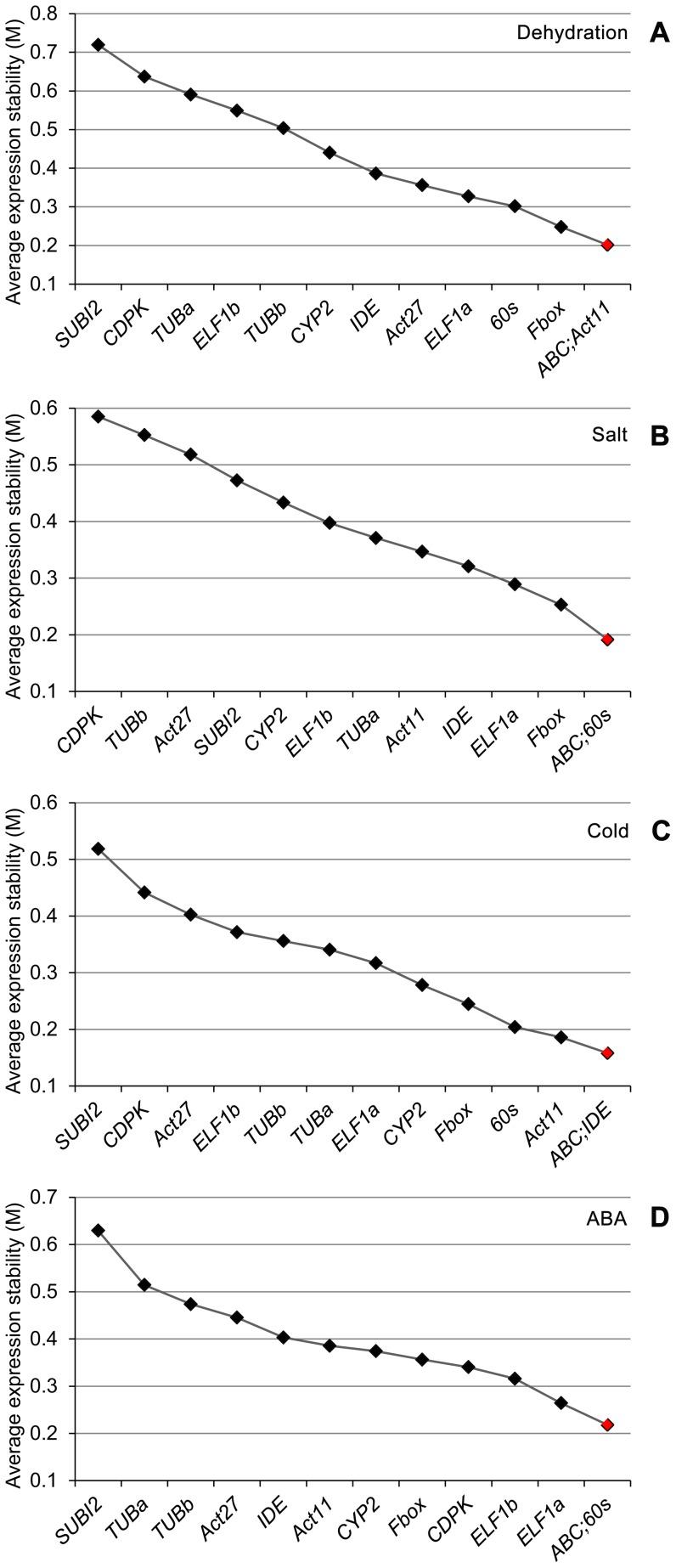
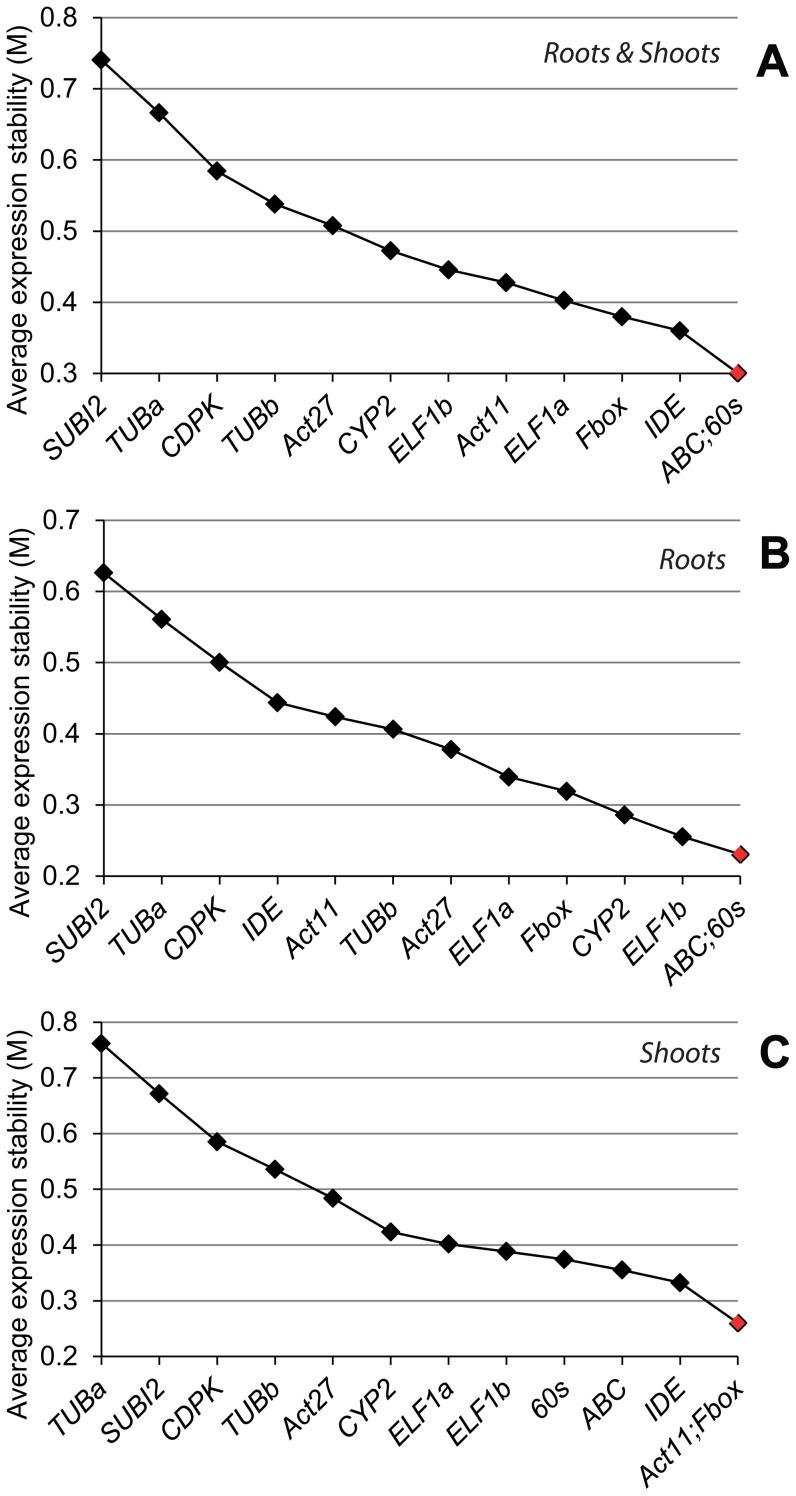
Quantitative RT-PCR can be a very sensitive and powerful technique for measuring differential gene expression. Changes in gene expression induced by abiotic stresses are complex and multifaceted, which make determining stably expressed genes for data normalization difficult. To identify the most suitable reference genes for abiotic stress studies in soybean, 13 candidate genes collected from literature were evaluated for stability of expression under dehydration, high salinity, cold and ABA (abscisic acid) treatments using delta CT and geNorm approaches. Validation of reference genes indicated that the best reference genes are tissue- and stress-dependent. With respect to dehydration treatment, the Fbox/ABC, Fbox/60s gene pairs were found to have the highest expression stability in the root and shoot tissues of soybean seedlings, respectively. Fbox and 60s genes are the most suitable reference genes across dehydrated root and shoot tissues. Under salt stress the ELF1b/IDE and Fbox/ELF1b are the most stably expressed gene pairs in roots and shoots, respectively, while 60s/Fbox is the best gene pair in both tissues. For studying cold stress in roots or shoots, IDE/60s and Fbox/Act27 are good reference gene pairs, respectively. With regard to gene expression analysis under ABA treatment in either roots, shoots or across these tissues, 60s/ELF1b, ELF1b/Fbox and 60s/ELF1b are the most suitable reference genes, respectively. The expression of ELF1b/60s, 60s/Fbox and 60s/Fbox genes was most stable in roots, shoots and both tissues, respectively, under various stresses studied. Among the genes tested, 60s was found to be the best reference gene in different tissues and under various stress conditions. The highly ranked reference genes identified from this study were proved to be capable of detecting subtle differences in expression rates that otherwise would be missed if a less stable reference gene was used.
实时定量 RT-PCR 是一种非常敏感和强大的技术,可用于测量差异基因表达。非生物胁迫诱导的基因表达变化复杂且多方面,这使得确定用于数据归一化的稳定表达基因变得困难。为了鉴定大豆非生物胁迫研究中最适合的参考基因,从文献中收集了 13 个候选基因,使用 delta CT 和 geNorm 方法评估它们在脱水、高盐、寒冷和 ABA(脱落酸)处理下表达的稳定性。参考基因的验证表明,最佳参考基因是组织和胁迫依赖性的。就脱水处理而言,在大豆幼苗的根和地上组织中,Fbox/ABC 和 Fbox/60s 基因对的表达稳定性最高。Fbox 和 60s 基因是最适合跨脱水根和地上组织的参考基因。在盐胁迫下,ELF1b/IDE 和 Fbox/ELF1b 是根和地上组织中表达最稳定的基因对,而 60s/Fbox 是这两种组织中最好的基因对。在研究根或地上部的冷胁迫时,IDE/60s 和 Fbox/Act27 是良好的参考基因对。就 ABA 处理下根、地上部或这些组织中基因表达分析而言,60s/ELF1b、ELF1b/Fbox 和 60s/ELF1b 分别是最适合的参考基因。在研究的各种胁迫下,ELF1b/60s、60s/Fbox 和 60s/Fbox 基因在根、地上部和两种组织中的表达最稳定。在测试的基因中,60s 被发现是不同组织和各种胁迫条件下的最佳参考基因。本研究中确定的高排名参考基因被证明能够检测到表达率的细微差异,如果使用稳定性较差的参考基因,否则这些差异可能会被忽略。


 Zotero 插件