
在大型假体全膝关节置换术中,髓外与髓内胫骨截骨导板的比较。
Extramedullary versus intramedullary tibial cutting guides in megaprosthetic total knee replacement.
机构信息
Department of Mechanical Engineering, Indian Institute of Technology Bombay, 400076 Mumbai, Maharashtra, India.
出版信息
J Orthop Surg Res. 2012 Oct 2;7:33. doi: 10.1186/1749-799X-7-33.
BACKGROUND
In a standard total knee replacement, tibial component alignment is a key factor for the long term success of the surgery. The purpose of this study is to compare the accuracy of extramedullary and intramedullary tibial cutting guides used in indigenous and imported implants respectively, in positioning of the tibial components in megaprosthetic knee replacements.
METHODS
A comparative study of the accuracy of extramedullary and intramedullary tibial cutting guides was carried out in 92 megaprosthetic knee replacements for distal femoral tumors. For the proximal tibia cut for tibial component placement, an extramedullary guide was used in 65 patients and an intramedullary guide was used in 27 patients. Tibial component alignment angles were measured in postoperative X-rays with the help of CAD software.
RESULTS
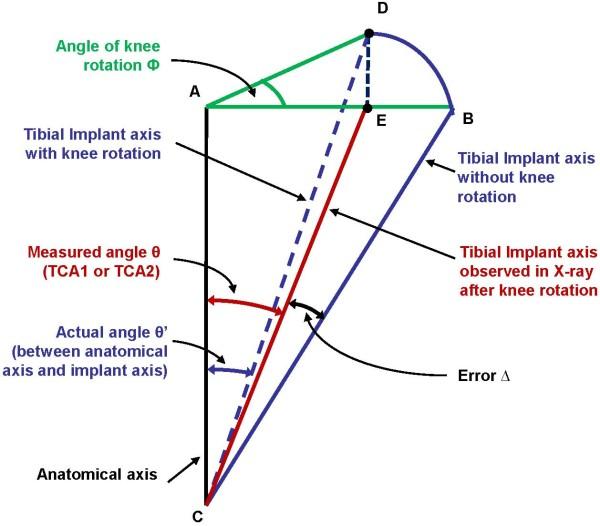
There was more varus placement in coronal plane with extramedullary cutting guide (-1.18 +/- 2.4 degrees) than the intramedullary guide (-0.34 +/- 2.31 degrees) but this did not reach statistical significance. The goal of 90 +/- 2 degrees alignment of tibial component was achieved in 54% of patients in the extramedullary group versus 67% in the intramedullary group. In terms of sagittal plane alignment, extramedullary guide showed less accurate results (2.09 +/- 2.4 degrees) than intramedullary guide (0.50 +/- 3.80 degrees) for tibial component alignment, though 78% of patients were aligned within the goal of 0-5 degrees of tibial slope angle in extramedullary group versus 63% in intramedullary group. The mean error in the measurements due to rotation of the knee during taking the X-rays was less than 0.1 degrees and distribution of the X-rays with the rotation of knee was similar in both the groups.
CONCLUSIONS
Overall, in megaprosthetic knee replacement intramedullary guides gave more accurate results in sagittal plane and exhibited similar variability as of extramedullary guides in coronal plane.
背景
在标准的全膝关节置换术中,胫骨部件的对线是手术长期成功的关键因素。本研究旨在比较国产和进口假体中使用的髓外和髓内胫骨截骨导向器在大段假体膝关节置换中定位胫骨部件的准确性。
方法
对 92 例股骨远端肿瘤的大段假体膝关节置换术进行了髓外和髓内胫骨截骨导向器准确性的对比研究。对于胫骨部件放置的胫骨近端截骨,65 例患者使用髓外导向器,27 例患者使用髓内导向器。术后 X 线片借助 CAD 软件测量胫骨部件的对线角度。
结果
与髓内导向器(-0.34 ± 2.31 度)相比,髓外导向器(-1.18 ± 2.4 度)更易导致冠状面的内翻畸形,但差异无统计学意义。54%的髓外组患者达到了胫骨部件 90 ± 2 度的对线目标,而髓内组则为 67%。在矢状面对线方面,髓外导向器的结果不如髓内导向器准确(胫骨部件对线 2.09 ± 2.4 度),尽管髓外组 78%的患者胫骨倾斜角在 0-5 度的目标范围内,而髓内组则为 63%。由于 X 线拍摄时膝关节旋转,测量的平均误差小于 0.1 度,并且两组膝关节旋转时 X 线的分布相似。
结论
总体而言,在大段假体膝关节置换术中,髓内导向器在矢状面的结果更准确,在冠状面的变异性与髓外导向器相似。


 Zotero 插件