Institute of Public Health, University of Heidelberg, Heidelberg, Germany.
Glob Health Action. 2012 Oct 1;5:1-18. doi: 10.3402/gha.v5i0.19120.
The quality of health care depends on the competence and motivation of the health workers that provide it. In the West, several tools exist to measure worker motivation, and some have been applied to the health sector. However, none have been validated for use in sub-Saharan Africa. The complexity of such tools has also led to concerns about their application at primary care level.
To develop a common instrument to monitor any changes in maternal and neonatal health (MNH) care provider motivation resulting from the introduction of pilot interventions in rural, primary level facilities in Ghana, Burkina Faso, and Tanzania.
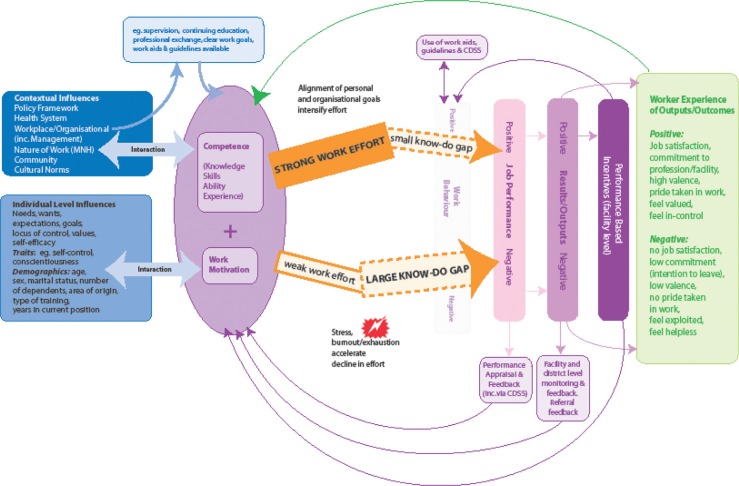
Initially, a conceptual framework was developed. Based upon this, a literature review and preliminary qualitative research, an English-language instrument was developed and validated in an iterative process with experts from the three countries involved. The instrument was then piloted in Ghana. Reliability testing and exploratory factor analysis were used to produce a final, parsimonious version.
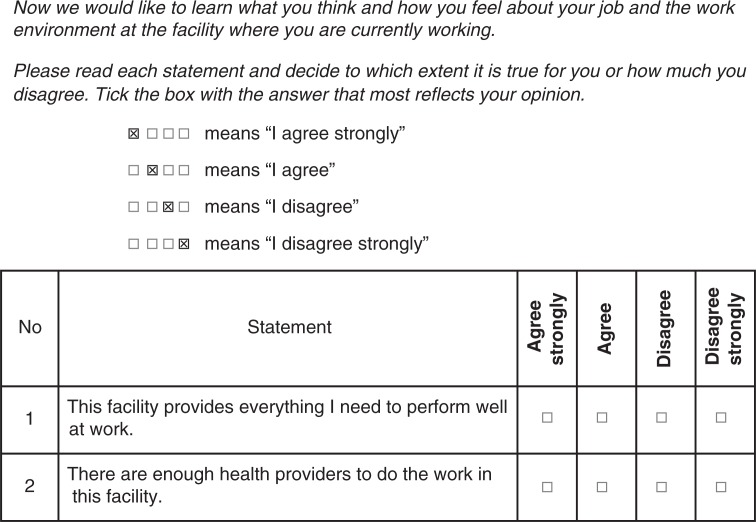
This paper describes the actual process of developing the instrument. Consequently, the concepts and items that did not perform well psychometrically at pre-test are first presented and discussed. The final version of the instrument, which comprises 42 items for self-assessment and eight for peer-assessment, is then shown. This is followed by a presentation and discussion of the findings from first use of the instrument with MNH providers from 12 rural, primary level facilities in each of the three countries.
It is possible to undertake work of this nature at primary health care level, particularly if the instruments are kept as straightforward as possible and well introduced. However, their development requires very lengthy preparatory periods. The effort needed to adapt such instruments for use in different countries within the region of sub-Saharan Africa should not be underestimated.
医疗保健的质量取决于提供医疗服务的卫生工作者的能力和积极性。在西方,有几种工具可以用来衡量员工的积极性,其中一些已经应用于医疗保健领域。然而,在撒哈拉以南非洲地区,还没有对这些工具进行验证。这些工具的复杂性也导致了人们对在初级保健层面应用它们的担忧。
开发一种通用工具,以监测由于在加纳、布基纳法索和坦桑尼亚的农村初级卫生保健设施试点干预措施的引入而导致的母婴健康(MNH)护理提供者积极性的任何变化。
最初,开发了一个概念框架。在此基础上,通过文献回顾和初步定性研究,以迭代方式开发了一种英文工具,并与来自三个参与国的专家进行了验证。然后在加纳进行了试点。使用可靠性测试和探索性因素分析来生成最终的简约版本。
本文介绍了开发工具的实际过程。因此,首先介绍和讨论了在预测试中表现不佳的心理测量学概念和项目。然后展示了工具的最终版本,该版本包括 42 个自我评估项目和 8 个同伴评估项目。接着介绍并讨论了在三个国家的每个国家的 12 个农村初级卫生保健设施中,对母婴健康提供者使用该工具的初步结果。
在初级卫生保健层面进行此类工作是可行的,特别是如果工具尽可能简单并且引入得当。然而,它们的开发需要很长的准备期。在该地区不同国家使用这些工具时,需要进行调整,因此不应低估这方面的工作难度。