Laboratory of Respiratory Biology, National Institute of Environmental Health Sciences (NIEHS), National Institutes of Health, Research Triangle Park, NC, USA.
Nat Med. 2012 Nov;18(11):1705-10. doi: 10.1038/nm.2920. Epub 2012 Oct 14.
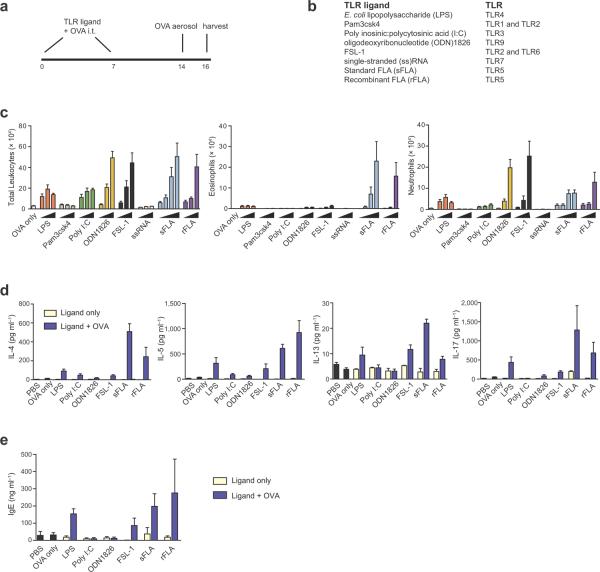
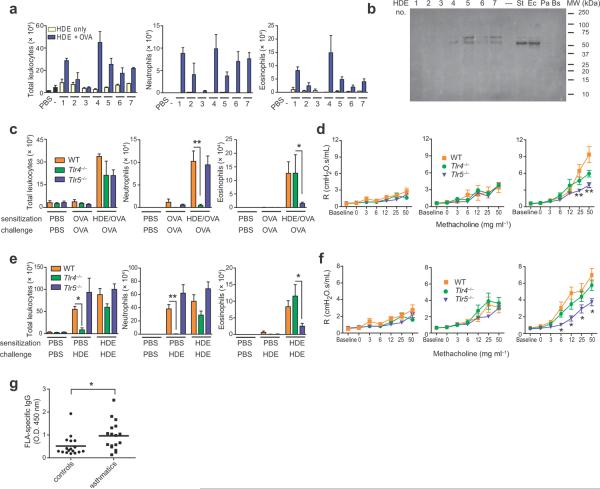
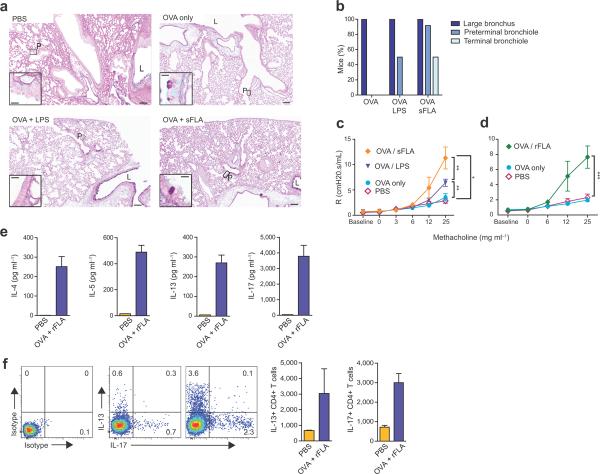
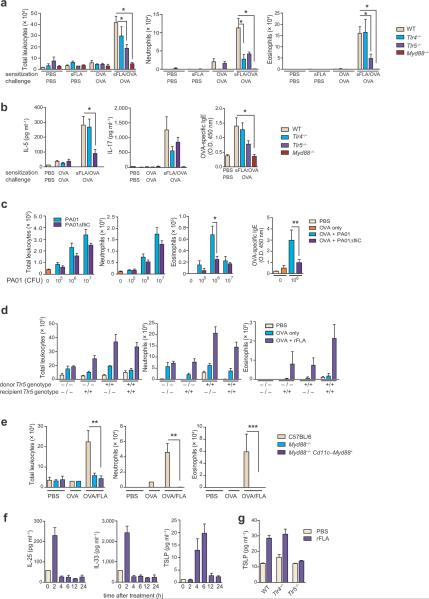
Allergic asthma is a complex disease characterized by eosinophilic pulmonary inflammation, mucus production and reversible airway obstruction. Exposure to indoor allergens is a risk factor for asthma, but this disease is also associated with high household levels of total and particularly Gram-negative bacteria. The ability of bacterial products to act as adjuvants suggests they might promote asthma by priming allergic sensitization to inhaled allergens. In support of this idea, house dust extracts (HDEs) can activate antigen-presenting dendritic cells (DCs) in vitro and promote allergic sensitization to inhaled innocuous proteins in vivo. It is unknown which microbial products provide most of the adjuvant activity in HDEs. A screen for adjuvant activity of microbial products revealed that the bacterial protein flagellin (FLA) stimulated strong allergic airway responses to an innocuous inhaled protein, ovalbumin (OVA). Moreover, Toll-like receptor 5 (TLR5), the mammalian receptor for FLA, was required for priming strong allergic responses to natural indoor allergens present in HDEs. In addition, individuals with asthma have higher serum levels of FLA-specific antibodies as compared to nonasthmatic individuals. Together, these findings suggest that household FLA promotes the development of allergic asthma by TLR5-dependent priming of allergic responses to indoor allergens.
变应性哮喘是一种复杂的疾病,其特征是嗜酸性粒细胞性肺炎症、黏液产生和可逆转的气道阻塞。室内过敏原暴露是哮喘的一个危险因素,但这种疾病也与家庭中总细菌和特别是革兰氏阴性菌水平较高有关。细菌产物作为佐剂的能力表明,它们可能通过对吸入性过敏原的过敏致敏作用促进哮喘。为了支持这一观点,房屋灰尘提取物(HDE)可以在体外激活抗原呈递树突状细胞(DC),并在体内促进对吸入无害蛋白质的过敏致敏。尚不清楚 HDE 中哪种微生物产物提供了大部分佐剂活性。对微生物产物的佐剂活性进行筛选发现,细菌蛋白鞭毛蛋白(FLA)刺激对无害吸入性蛋白质卵清蛋白(OVA)产生强烈的过敏气道反应。此外,FLA 的哺乳动物受体 Toll 样受体 5(TLR5)是对 HDE 中存在的天然室内过敏原产生强烈过敏反应所必需的。此外,与非哮喘个体相比,哮喘患者的血清 FLA 特异性抗体水平更高。这些发现表明,室内 FLA 通过 TLR5 依赖性对室内过敏原的过敏反应的引发,促进了过敏性哮喘的发展。