College of Medicine, Biology and Environment, Australian National University, Canberra, Australia.
PLoS One. 2012;7(10):e47438. doi: 10.1371/journal.pone.0047438. Epub 2012 Oct 12.
In a previous longitudinal analysis of our cohort as 8 to 10 year-olds, insulin resistance (IR) increased with age, but was not modified by changes in percent body fat (%BF), and was only responsive to changes in physical activity (PA) in boys. We aimed to determine whether these responses persisted as the children approached adolescence.
In this prospective cohort study, 256 boys and 278 girls were assessed at ages 8, 10 and 12 years for fasting blood glucose and insulin, %BF (dual energy X-ray absorptiometry); PA (7-day pedometers), fitness (multistage run); and pubertal development (Tanner stage).
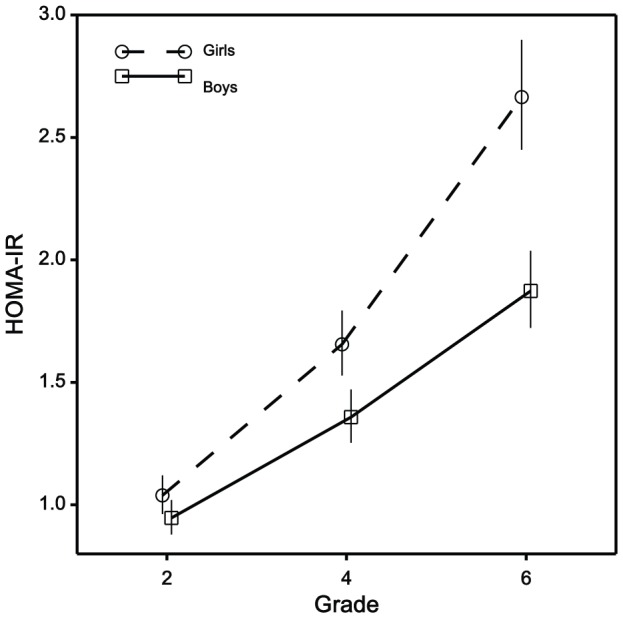
From age 8 to 12 years, the median homeostatic model of IR (HOMA-IR) doubled in boys and increased 250% in girls. By age 12, 23% of boys and 31% of girls had elevated IR, as indicated by HOMA-IR greater than 3. Longitudinal relationships, with important adjustments for covariates body weight, PA, %BF, Tanner score and socioeconomic status showed that, on average, for every 1 unit reduction of %BF, HOMA-IR was lowered by 2.2% (95% CI 0.04-4) in girls and 1.6% (95% CI 0-3.2) in boys. Furthermore, in boys but not girls, HOMA-IR was decreased by 3.5% (95%CI 0.5-6.5) if PA was increased by 2100 steps/day.
Evidence that a quarter of our apparently healthy 12 year-old Australians possessed elevated IR suggests that community-based education and prevention strategies may be warranted. Responsiveness of IR to changes in %BF in both sexes during late preadolescence and to changes in PA in the boys provides a specific basis for targeting elevated IR. That body weight was a strong covariate of IR, independent of %BF, points to the importance of adjusting for weight in correctly assessing these relationships in growing children.
在之前对我们队列的 8 至 10 岁儿童的纵向分析中,胰岛素抵抗(IR)随年龄增长而增加,但不受体脂百分比(%BF)变化的影响,并且仅对男孩的身体活动(PA)变化有反应。我们旨在确定当儿童接近青春期时,这些反应是否仍然存在。
在这项前瞻性队列研究中,256 名男孩和 278 名女孩在 8、10 和 12 岁时进行了空腹血糖和胰岛素检测、%BF(双能 X 射线吸收法)、PA(7 天计步器)、体能(多级跑步)和青春期发育(Tanner 分期)。
从 8 岁到 12 岁,男孩的稳态模型胰岛素抵抗(HOMA-IR)中位数增加了一倍,女孩增加了 250%。到 12 岁时,23%的男孩和 31%的女孩存在胰岛素抵抗,HOMA-IR 大于 3。经过重要的协变量调整后,纵向关系表明,平均而言,每降低 1%BF,HOMA-IR 就会降低 2.2%(95%CI 0.04-4)在女孩和 1.6%(95%CI 0-3.2)在男孩中。此外,在男孩中,但不是在女孩中,如果 PA 增加 2100 步/天,则 HOMA-IR 会降低 3.5%(95%CI 0.5-6.5)。
我们发现四分之一的 12 岁澳大利亚儿童存在明显的胰岛素抵抗,这表明可能需要基于社区的教育和预防策略。在青春期后期,IR 对%BF 变化的反应以及男孩 PA 的变化,为靶向升高的 IR 提供了具体的基础。体重是 IR 的一个强有力的协变量,独立于%BF,这表明在评估生长儿童的这些关系时,调整体重非常重要。