Section on Lipid Sciences, Department of Pathology, Wake Forest School of Medicine, Medical Center Blvd, Winston-Salem, NC 27157-1016, USA.
Arterioscler Thromb Vasc Biol. 2012 Nov;32(11):2561-5. doi: 10.1161/ATVBAHA.112.300135.
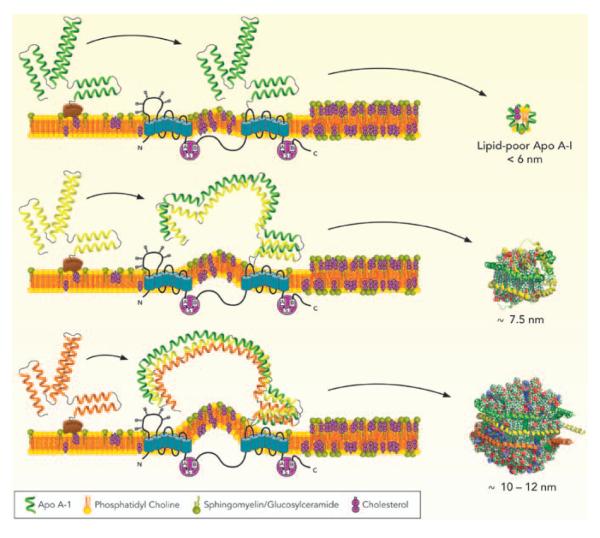
This review provides a summary of recent research on the role of high-density lipoprotein (HDL)/apolipoprotein A-I cholesterol efflux and immune cell function. Plasma concentrations of HDL have been known to inversely correlate with risk for coronary vascular disease. Bulk transport of HDL cholesterol from the peripheral tissues to the liver is a major pathway, termed reverse cholesterol transport, responsible for maintaining whole body cholesterol homeostasis. In addition to participating in this pathway, HDL and apolipoprotein A-I exert anti-inflammatory effects through different pathways. One pathway that seems to be important in atherosclerosis and autoimmunity is its role in modulation of T cell activation. HDL/apolipoprotein A-I helps regulate cell signaling by accepting membrane cholesterol from ATP binding cassette transporter A1 on immune cells and, thereby, fine tuning the amount of cholesterol present in plasma membrane lipid rafts.
本综述概述了高密度脂蛋白(HDL)/载脂蛋白 A-I 胆固醇外排和免疫细胞功能的最新研究。人们已经知道,血浆 HDL 浓度与冠心病的风险呈负相关。从外周组织到肝脏的 HDL 胆固醇的大量转运是一种主要途径,称为胆固醇逆转运,负责维持全身胆固醇的平衡。除了参与这一途径外,HDL 和载脂蛋白 A-I 通过不同的途径发挥抗炎作用。在动脉粥样硬化和自身免疫中似乎很重要的一条途径是其在调节 T 细胞活化中的作用。HDL/载脂蛋白 A-I 通过从免疫细胞上的 ATP 结合盒转运蛋白 A1 接受膜胆固醇,从而帮助调节细胞信号转导,精细调节质膜脂筏中胆固醇的含量。