
精子中环核苷酸系统在生育男性和不育男性之间的差异。
Differences in the endocannabinoid system of sperm from fertile and infertile men.
机构信息
School of Medicine, Centre for Public Health, Queen's University Belfast, Institute of Clinical Science, Belfast, United Kingdom.
出版信息
PLoS One. 2012;7(10):e47704. doi: 10.1371/journal.pone.0047704. Epub 2012 Oct 17.
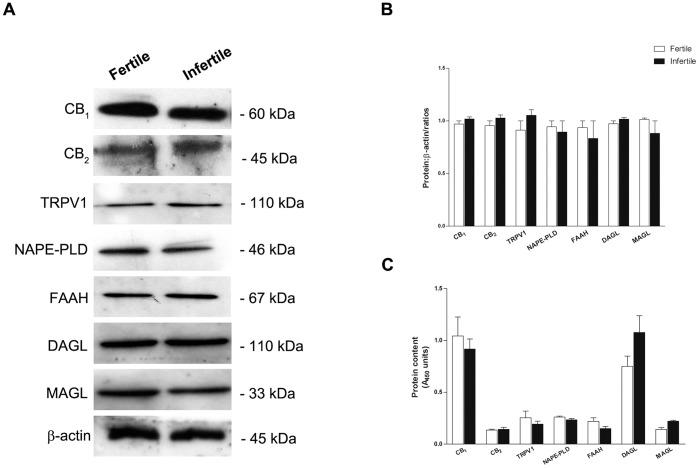
Male infertility is a major cause of problems for many couples in conceiving a child. Recently, lifestyle pastimes such as alcohol, tobacco and marijuana have been shown to have further negative effects on male reproduction. The endocannabinoid system (ECS), mainly through the action of anandamide (AEA) and 2-arachidonoylglycerol (2-AG) at cannabinoid (CB(1), CB(2)) and vanilloid (TRPV1) receptors, plays a crucial role in controlling functionality of sperm, with a clear impact on male reproductive potential. Here, sperm from fertile and infertile men were used to investigate content (through LC-ESI-MS), mRNA (through quantitative RT-PCR), protein (through Western Blotting and ELISA) expression, and functionality (through activity and binding assays) of the main metabolic enzymes of AEA and 2-AG (NAPE-PLD and FAAH, for AEA; DAGL and MAGL for 2-AG), as well as of their binding receptors CB(1), CB(2) and TRPV1. Our findings show a marked reduction of AEA and 2-AG content in infertile seminal plasma, paralleled by increased degradation: biosynthesis ratios of both substances in sperm from infertile versus fertile men. In addition, TRPV1 binding was detected in fertile sperm but was undetectable in infertile sperm, whereas that of CB(1) and CB(2) receptors was not statistically different in the two groups. In conclusion, this study identified unprecedented alterations of the ECS in infertile sperm, that might impact on capacitation and acrosome reaction, and hence fertilization outcomes. These alterations might also point to new biomarkers to determine male reproductive defects, and identify distinct ECS elements as novel targets for therapeutic exploitation of ECS-oriented drugs to treat male fertility problems.
男性不育是许多夫妇在生育孩子方面遇到问题的主要原因。最近,研究表明,像酒精、烟草和大麻这样的生活方式消遣会对男性生殖产生进一步的负面影响。内源性大麻素系统(ECS)主要通过大麻素(CB(1)、CB(2))和香草素(TRPV1)受体上的花生四烯酸乙醇酰胺(AEA)和 2-花生四烯酰甘油(2-AG)的作用,在控制精子功能方面发挥着关键作用,对男性生殖潜力有明显影响。在这里,使用来自生育能力正常和不育男性的精子来研究主要代谢酶 AEA 和 2-AG(NAPE-PLD 和 FAAH,用于 AEA;DAGL 和 MAGL,用于 2-AG)的主要代谢酶的内容(通过 LC-ESI-MS)、mRNA(通过定量 RT-PCR)、蛋白(通过 Western Blotting 和 ELISA)表达和功能(通过活性和结合测定),以及它们的结合受体 CB(1)、CB(2)和 TRPV1。我们的研究结果表明,不育精液中的 AEA 和 2-AG 含量明显减少,同时降解增加:与生育能力正常的男性相比,不育男性精子中这两种物质的生物合成比率。此外,在生育能力正常的精子中检测到 TRPV1 结合,但在不育精子中无法检测到,而两组中 CB(1)和 CB(2)受体的结合则没有统计学差异。总之,这项研究首次发现不育精子中 ECS 发生了改变,这可能会影响精子的获能和顶体反应,从而影响受精结果。这些改变也可能指向新的生物标志物,以确定男性生殖缺陷,并确定新的 ECS 元素作为治疗男性生育问题的 ECS 靶向药物治疗的新靶标。
 Zotero 插件