Department of Medical Oncology, Ankara Numune Education and Research Hospital, Sihhiye, Ankara 06100, Turkey.
Br J Cancer. 2012 Nov 20;107(11):1815-9. doi: 10.1038/bjc.2012.473. Epub 2012 Oct 25.
Increased adiposity may trigger signalling pathways that induce aromatase expression. As aromatase inhibitors exert their effects by blocking the aromatase enzyme, higher body mass index (BMI) can reduce the effect of aromatase inhibitors. Thus, we aimed to investigate retrospectively the effect of BMI on the efficacy of aromatase inhibitors in hormone receptor-positive postmenopausal patients with breast cancer.
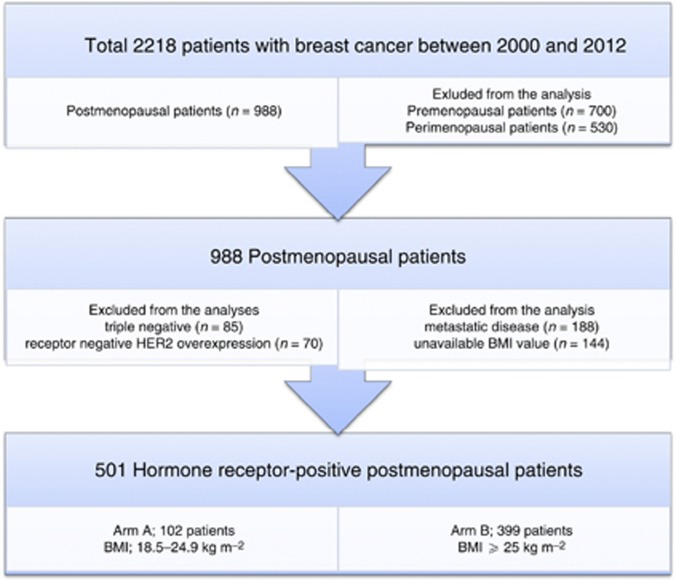
Newly diagnosed hormone receptor-positive breast cancer patients who were postmenopausal and non-metastatic were enrolled to the study. Patients with BMI ranging between 18.5 and 24.9 kgm(-2) were considered as normal weight patients (Arm A, n=102), and patients with a BMI ranging ≥ 25 kgm(-2) were grouped as overweight and obese patients (Arm B, n=399).
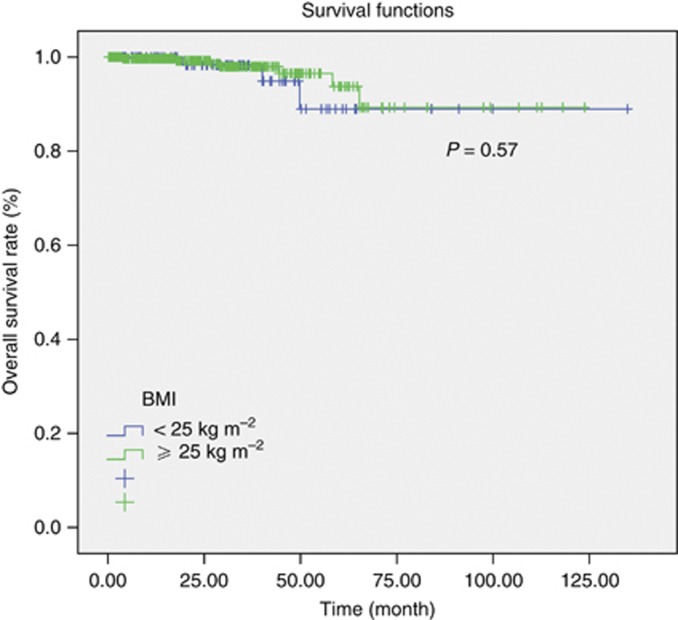
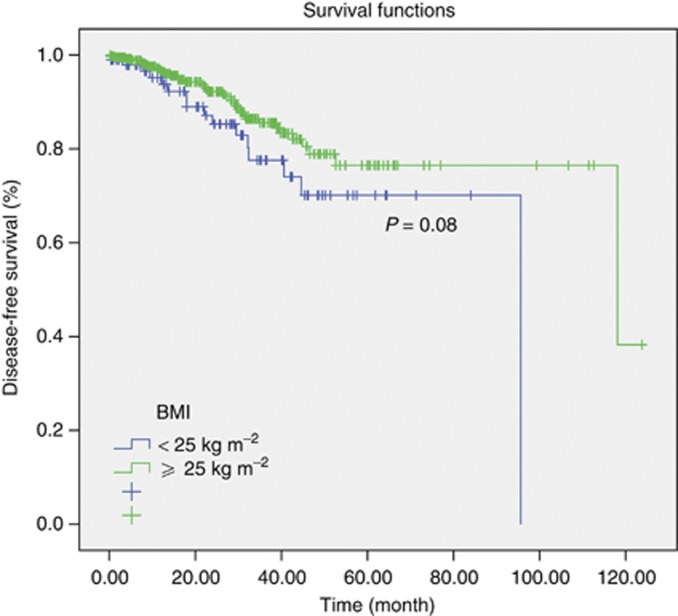
In both normal weight and overweight patients, the baseline clinico-pathologic properties and the treatment history with radiotherapy and chemotherapy were similar, and with no statistically significant difference. In normal weight patients disease-free survival (DFS) rate was 93.7% and 77.6%, whereas in overweight and obese patients DFS rate was 96.8% and 85.5% in the first and third years, respectively, (P=0.08). Three year survival rate in Arm A patients was 98.3%, whereas in Arm B was 98.0% (P=0.57). When anastrozole was compared with letrozole in the subgroup analysis no difference with regard to DFS and overall survival was detected.
These results, contradictory to the prior results, show that BMI has no worse effect on outcomes of aromatase inhibitors in postmenopausal hormone receptor-positive breast cancer patients. In the subgroup analysis, letrozole and anastrozole had similar survival outcomes.
肥胖可能会触发诱导芳香酶表达的信号通路。由于芳香酶抑制剂通过阻断芳香酶来发挥作用,较高的体重指数(BMI)可能会降低芳香酶抑制剂的效果。因此,我们旨在回顾性研究 BMI 对激素受体阳性绝经后乳腺癌患者芳香酶抑制剂疗效的影响。
本研究纳入了新诊断的激素受体阳性绝经后且无转移的乳腺癌患者。BMI 在 18.5 至 24.9 kg/m²之间的患者被认为是正常体重患者(Arm A,n=102),BMI 大于等于 25 kg/m²的患者被分为超重和肥胖患者(Arm B,n=399)。
在正常体重和超重患者中,基线临床病理特征和放疗、化疗治疗史相似,无统计学差异。在正常体重患者中,无病生存期(DFS)率分别为 93.7%和 77.6%,而超重和肥胖患者在第 1 年和第 3 年的 DFS 率分别为 96.8%和 85.5%(P=0.08)。Arm A 患者的 3 年生存率为 98.3%,而 Arm B 为 98.0%(P=0.57)。在亚组分析中,与来曲唑相比,阿那曲唑在 DFS 和总生存方面没有差异。
这些结果与之前的结果相反,表明 BMI 对绝经后激素受体阳性乳腺癌患者芳香酶抑制剂的结局没有更差的影响。在亚组分析中,来曲唑和阿那曲唑的生存结局相似。