Scientific Institute for Quality of Healthcare, Radboud University Nijmegen Medical Centre, Nijmegen, the Netherlands.
Implement Sci. 2012 Oct 26;7:104. doi: 10.1186/1748-5908-7-104.
Implementation of lifestyle interventions in patient care is a major challenge. Understanding factors that influence implementation is a first step in programs to enhance uptake of these interventions. A lifestyle-counseling intervention, Lively Legs, delivered by trained nurses, can effectively improve the lifestyle in patients with venous leg ulcers. The aim of this study was to identify factors that hindered or facilitated implementation of this intervention in outpatient dermatology clinics and in home care.
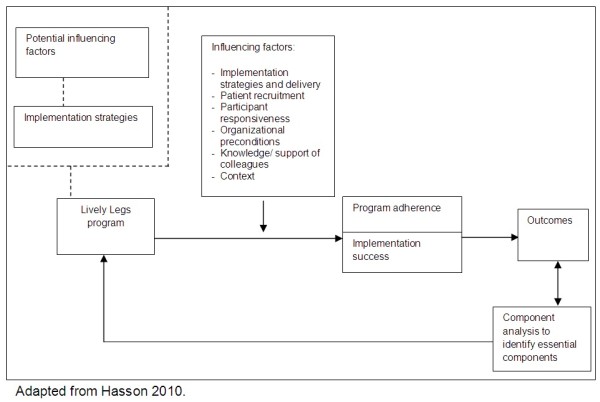
A mixed-methods multiple case study in five purposefully selected healthcare settings in the Netherlands was conducted. Measurements to identify influencing factors before and after implementation of Lively Legs included interviews, focus groups, questionnaires, and nurses' registration. Analyses focused on qualitative data as the main data source. All data were compared across multiple cases to draw conclusions from the study as a whole.
A total of 53 patients enrolled in the Lively Legs program, which was delivered by 12 trained nurses. Barriers for implementation were mainly organizational. It was difficult to effectively organize reaching and recruiting patients for the program, especially in home care. Main barriers were a lack of a standardized healthcare delivery process, insufficient nursing time, and a lack of motivated nurses to deliver the program. Facilitating factors were nurse-driven coordination of care and a standardized care process to tie Lively Legs into, as this resulted in better patient recruitment and better program implementation.
This study identified a range of factors influencing the implementation of a lifestyle-counseling program, mainly related to the organization of healthcare. Using a case study method proved valuable in obtaining insight into influencing factors for implementation. This study also shed light on a more general issue, which is that leg ulcer care is often fragmented, indicating that quality improvement is needed.
在患者护理中实施生活方式干预是一项重大挑战。了解影响实施的因素是增强这些干预措施实施的第一步。由经过培训的护士提供的生活方式咨询干预措施 Lively Legs 可以有效改善静脉溃疡患者的生活方式。本研究的目的是确定在门诊皮肤科诊所和家庭护理中实施这种干预措施的障碍和促进因素。
在荷兰五个有目的选择的医疗保健环境中进行了一项混合方法多案例研究。在实施 Lively Legs 之前和之后,用于识别影响因素的测量包括访谈、焦点小组、问卷调查和护士登记。分析侧重于定性数据,作为主要数据来源。对所有数据进行了跨多个案例的比较,以便从整个研究中得出结论。
共有 53 名患者参加了 Lively Legs 计划,该计划由 12 名经过培训的护士提供。实施的障碍主要是组织上的。有效地组织对该计划的患者的接触和招募非常困难,特别是在家庭护理中。主要障碍是缺乏标准化的医疗服务提供流程、护士时间不足以及缺乏积极提供该计划的护士。促进因素是护士驱动的护理协调和将 Lively Legs 纳入的标准化护理流程,因为这导致了更好的患者招募和更好的计划实施。
本研究确定了一系列影响生活方式咨询计划实施的因素,主要与医疗保健的组织有关。使用案例研究方法在获得实施影响因素的见解方面非常有价值。本研究还揭示了一个更普遍的问题,即腿部溃疡护理通常是分散的,这表明需要进行质量改进。