Department of Pathology, The University of Iowa, Iowa City, Iowa, USA.
PLoS One. 2012;7(10):e48175. doi: 10.1371/journal.pone.0048175. Epub 2012 Oct 31.
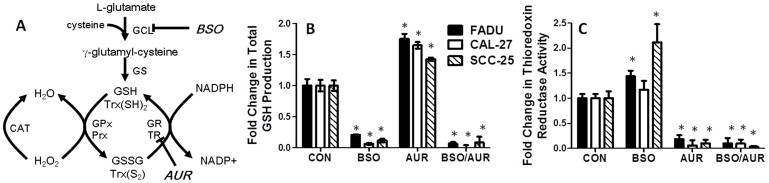
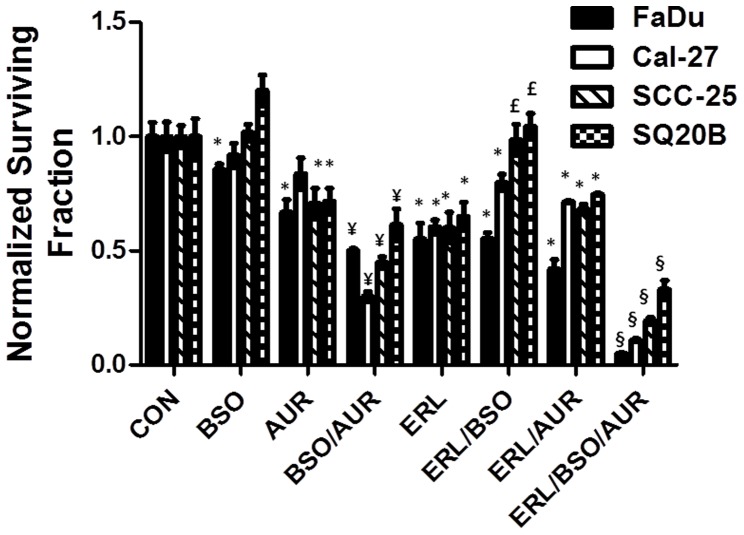
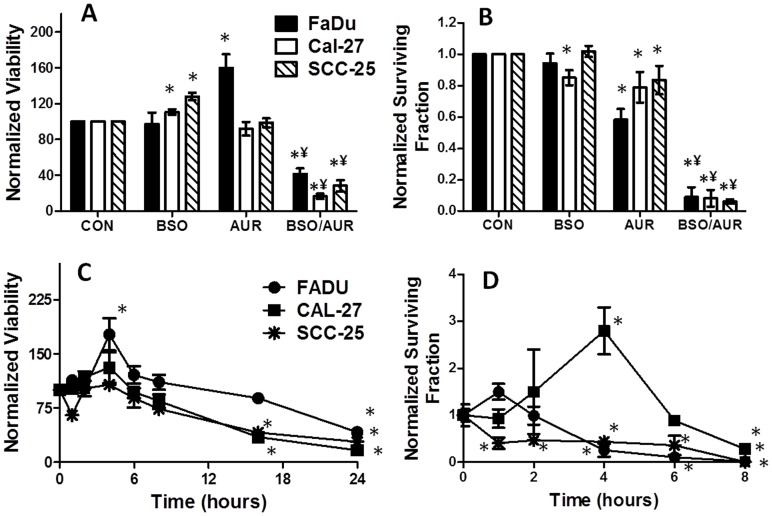
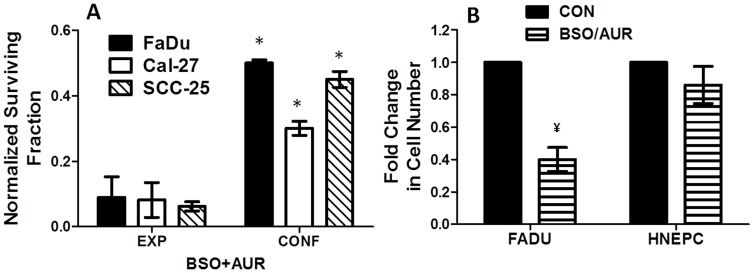
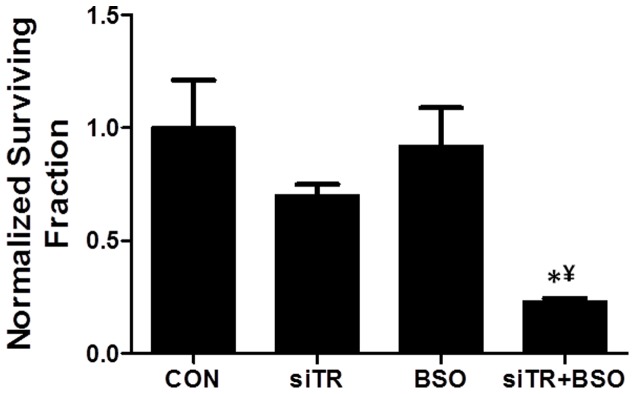
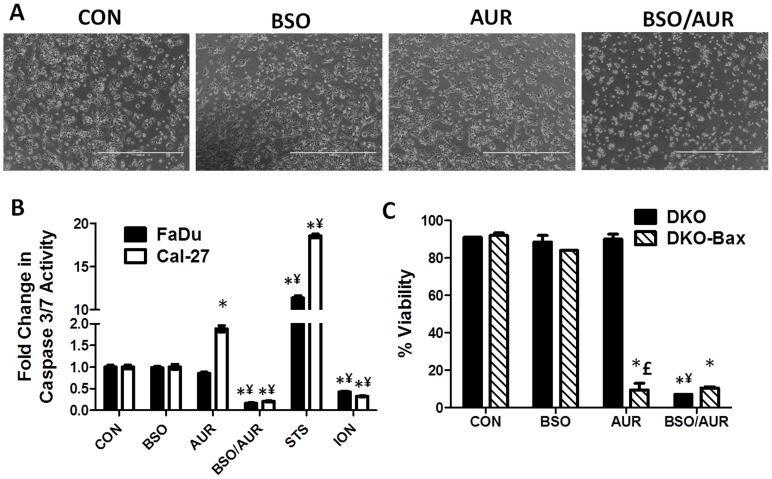
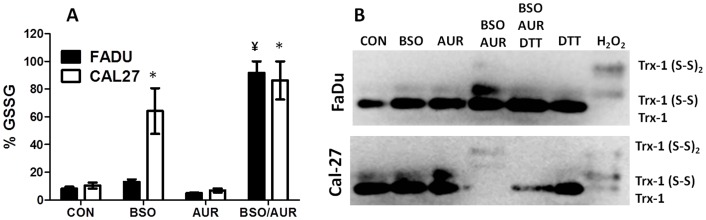
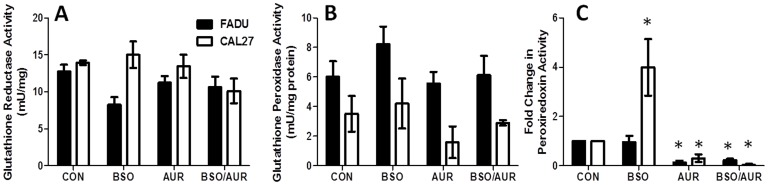
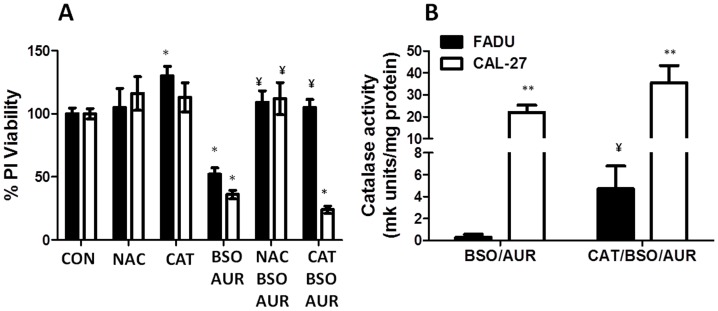
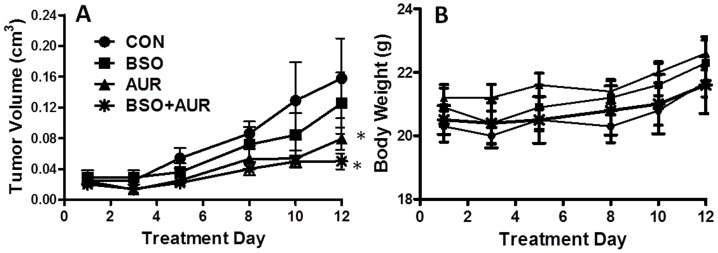
Increased glutathione (GSH) and thioredoxin (Trx) metabolism are mechanisms that are widely implicated in resistance of cancer cells to chemotherapy. The current study determined if simultaneous inhibition of GSH and Trx metabolism enhanced cell killing of human head and neck squamous cell carcinoma (HNSCC) cells by a mechanism involving oxidative stress. Inhibition of GSH and Trx metabolism with buthionine sulfoximine (BSO) and auranofin (AUR), respectively, induced significant decreases in clonogenic survival compared to either drug alone in FaDu, Cal-27 and SCC-25 HNSCC cells in vitro and in vivo in Cal-27 xenografts. BSO+AUR significantly increased glutathione and thioredoxin oxidation and suppressed peroxiredoxin activity in vitro. Pre-treatment with N-acetylcysteine completely reversed BSO+AUR-induced cell killing in FaDu and Cal-27 cells, while catalase and selenium supplementation only inhibited BSO+AUR-induced cell killing in FaDu cells. BSO+AUR decreased caspase 3/7 activity in HNSCC cells and significantly reduced the viability of both Bax/Bak double knockout (DKO) and DKO-Bax reconstituted hematopoietic cells suggesting that necrosis was involved. BSO+AUR also significantly sensitized FaDu, Cal-27, SCC-25 and SQ20B cells to cell killing induced by the EGFR inhibitor Erlotinib in vitro. These results support the conclusion that simultaneous inhibition of GSH and Trx metabolism pathways induces oxidative stress and clonogenic killing in HNSCCs and this strategy may be useful in sensitizing HNSCCs to EGFR inhibitors.
谷胱甘肽 (GSH) 和硫氧还蛋白 (Trx) 代谢的增加是广泛涉及癌细胞对化疗耐药的机制。本研究确定了同时抑制 GSH 和 Trx 代谢是否通过涉及氧化应激的机制增强了人头颈部鳞状细胞癌 (HNSCC) 细胞的细胞杀伤作用。用丁硫氨酸亚砜 (BSO) 和金诺芬 (AUR) 分别抑制 GSH 和 Trx 代谢,与单独使用任一药物相比,在 FaDu、Cal-27 和 SCC-25 HNSCC 细胞的体外和 Cal-27 异种移植物的体内均显著降低了集落形成存活。BSO+AUR 显著增加了谷胱甘肽和硫氧还蛋白的氧化,并抑制了体外过氧化物酶的活性。用 N-乙酰半胱氨酸预处理完全逆转了 BSO+AUR 诱导的 FaDu 和 Cal-27 细胞的细胞杀伤作用,而过氧化氢酶和硒补充仅抑制了 BSO+AUR 诱导的 FaDu 细胞的细胞杀伤作用。BSO+AUR 降低了 HNSCC 细胞中 caspase 3/7 的活性,并显著降低了 Bax/Bak 双敲除 (DKO) 和 DKO-Bax 重建的造血细胞的活力,表明坏死参与其中。BSO+AUR 还显著增强了 FaDu、Cal-27、SCC-25 和 SQ20B 细胞对表皮生长因子受体抑制剂 Erlotinib 在体外诱导的细胞杀伤作用的敏感性。这些结果支持以下结论:同时抑制 GSH 和 Trx 代谢途径会诱导 HNSCC 中的氧化应激和集落杀伤作用,这种策略可能有助于增强 HNSCC 对表皮生长因子受体抑制剂的敏感性。