
4-氰基吡啶氢氯冉酸盐的三斜多晶型物。
A triclinic polymorph of 4-cyano-pyridinium hydrogen chloranilate.
作者信息
Gotoh Kazuma, Ishida Hiroyuki
机构信息
Department of Chemistry, Faculty of Science, Okayama University, Okayama 700-8530, Japan.
出版信息
Acta Crystallogr Sect E Struct Rep Online. 2012 Oct 1;68(Pt 10):o2830. doi: 10.1107/S1600536812037221. Epub 2012 Sep 1.
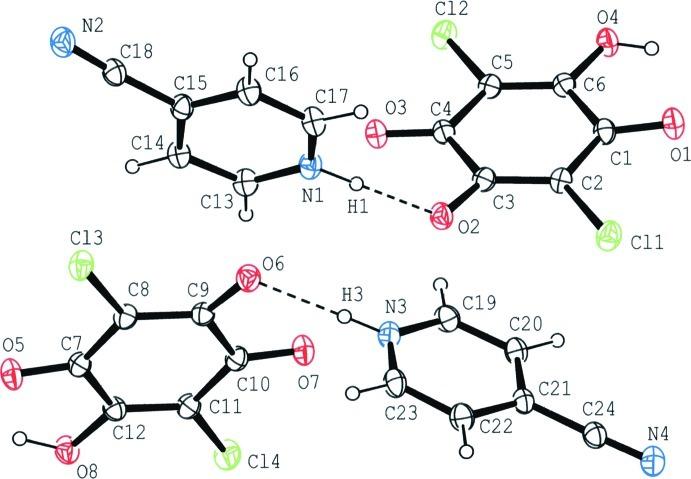
THE ASYMMETRIC UNIT OF THE TRICLINIC POLYMORPH OF THE TITLE COMPOUND (SYSTEMATIC NAME: 4-cyano-pyridinium 2,5-dichloro-4-hy-droxy-3,6-dioxocyclo-hexa-1,4-dien-1-olate), C(6)H(5)N(2) (+)·C(6)HCl(2)O(4) (-), consists of two crystallographically independent cation-anion units, in each of which the cation and the anion are linked by an N-H⋯O hydrogen bond. In the units, the dihedral angles between the cation and anion rings are 78.43 (11) and 80.71 (11)°. In the crystal, each unit independently forms a chain through N-H⋯O and O-H⋯N hydrogen bonds; one chain runs along the c axis while the other runs along [011]. Weak C-H⋯O, C-H⋯N and C-H⋯Cl inter-actions are observed between the chains.
标题化合物(系统名称:4-氰基吡啶鎓 2,5-二氯-4-羟基-3,6-二氧代环己-1,4-二烯-1-醇盐)三斜晶系多晶型物的不对称单元,C(6)H(5)N(2) (+)·C(6)HCl(2)O(4) (-),由两个晶体学独立的阳离子-阴离子单元组成,在每个单元中阳离子和阴离子通过 N-H⋯O 氢键相连。在这些单元中,阳离子环和阴离子环之间的二面角分别为 78.43 (11)° 和 80.71 (11)°。在晶体中,每个单元通过 N-H⋯O 和 O-H⋯N 氢键独立形成一条链;一条链沿 c 轴方向,另一条沿 [011] 方向。在这些链之间观察到弱的 C-H⋯O、C-H⋯N 和 C-H⋯Cl 相互作用。

 Zotero 插件