Reilly Matthew T, Harris R Adron, Noronha Antonio
Division of Neuroscience and Behavior, National Institute on Alcohol Abuse and Alcoholism, Bethesda, Maryland.
Alcohol Res. 2012;34(3):282-91.
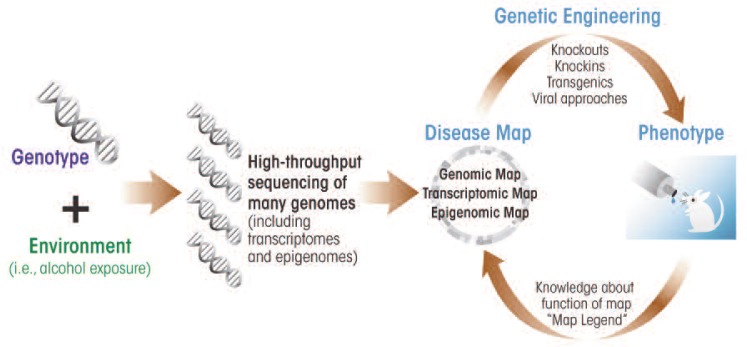
Over the last 50 years, researchers have made substantial progress in identifying genetic variations that underlie the complex phenotype of alcoholism. Not much is known, however, about how this genetic variation translates into altered biological function. Genetic animal models recapitulating specific characteristics of the human condition have helped elucidate gene function and the genetic basis of disease. In particular, major advances have come from the ability to manipulate genes through a variety of genetic technologies that provide an unprecedented capacity to determine gene function in the living organism and in alcohol-related behaviors. Even newer genetic-engineering technologies have given researchers the ability to control when and where a specific gene or mutation is activated or deleted, allowing investigators to narrow the role of the gene's function to circumscribed neural pathways and across development. These technologies are important for all areas of neuroscience, and several public and private initiatives are making a new generation of genetic-engineering tools available to the scientific community at large. Finally, high-throughput "next-generation sequencing" technologies are set to rapidly increase knowledge of the genome, epigenome, and transcriptome, which, combined with genetically engineered mouse mutants, will enhance insight into biological function. All of these resources will provide deeper insight into the genetic basis of alcoholism.
在过去的50年里,研究人员在识别构成酒精中毒复杂表型基础的基因变异方面取得了重大进展。然而,对于这种基因变异如何转化为生物功能的改变,人们所知甚少。重现人类疾病特定特征的遗传动物模型有助于阐明基因功能和疾病的遗传基础。特别是,通过各种基因技术操纵基因的能力取得了重大进展,这些技术提供了前所未有的能力来确定基因在生物体和与酒精相关行为中的功能。更新的基因工程技术使研究人员能够控制特定基因或突变何时何地被激活或删除,从而使研究人员能够将基因功能的作用范围缩小到特定的神经通路和整个发育过程。这些技术对神经科学的所有领域都很重要,一些公共和私人项目正在为广大科学界提供新一代的基因工程工具。最后,高通量的“下一代测序”技术将迅速增加对基因组、表观基因组和转录组的了解,再结合基因工程小鼠突变体,将增强对生物功能的认识。所有这些资源将为酒精中毒的遗传基础提供更深入的见解。