Armstrong Vickie, Maurer Daphne, Ellemberg Dave, Lewis Terri L
Department of Psychology, Neuroscience & Behaviour, McMaster University, Hamilton, ON, Canada, L8S 4K1; e-mail:
Iperception. 2011;2(5):440-57. doi: 10.1068/i0406. Epub 2011 Aug 8.
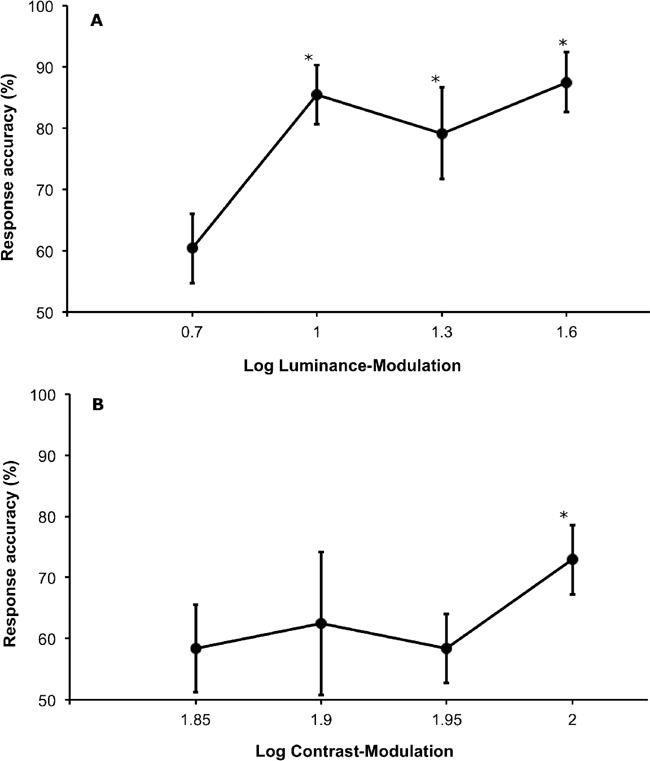
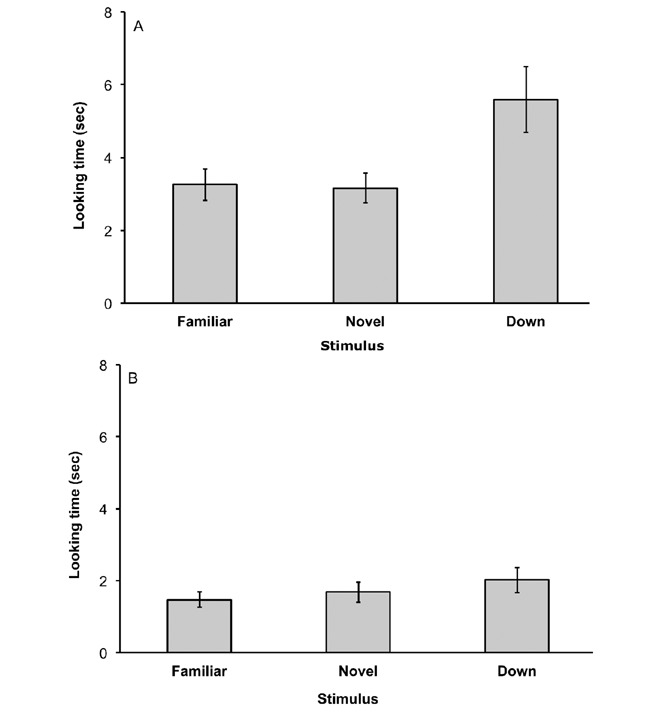
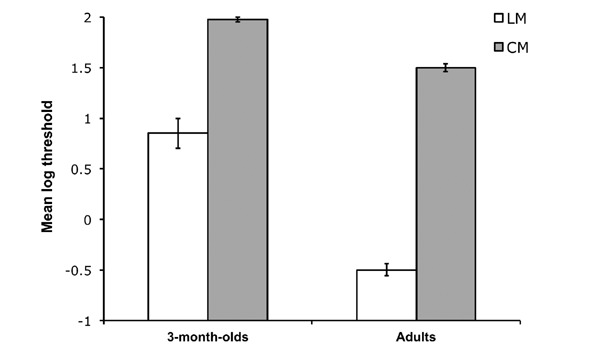
In two experiments, we investigated 3-month-old infants' sensitivity to first- and second-order drifting gratings. In Experiment 1 we used forced-choice preferential looking with drifting versus stationary gratings to estimate depth modulation thresholds for 3-month-old infants and a similar task for a comparison group of adults. Thresholds for infants were more adult-like for second-order than first-order gratings. In Experiment 2, 3-month-olds dishabituated to a change in first-order orientation, but not to a change in direction of first- or second-order motion. Hence, results from Experiment 1 were likely driven by the perception of flicker rather than motion. Thus, infants' sensitivity to uniform motion is slow to develop and appears to be driven initially by flicker-sensitive mechanisms. The underlying mechanisms have more mature tuning for second-order than for first-order information.
在两项实验中,我们研究了3个月大婴儿对一阶和二阶漂移光栅的敏感度。在实验1中,我们使用强迫选择偏好注视法,让婴儿在漂移光栅和静止光栅之间进行选择,以此来估计3个月大婴儿的深度调制阈值,并对一组成年对照组进行了类似任务。与一阶光栅相比,婴儿对二阶光栅的阈值更接近成年人。在实验2中,3个月大的婴儿对一阶方向的变化不再习惯化,但对一阶或二阶运动方向的变化却没有。因此,实验1的结果可能是由闪烁感知而非运动感知驱动的。所以,婴儿对匀速运动的敏感度发展缓慢,最初似乎是由对闪烁敏感的机制驱动的。其潜在机制对二阶信息的调谐比对一阶信息的调谐更成熟。