Department of Neurobiology and Anatomy, Program in Cancer Cell Biology, Mary Babb Randolph Cancer Center, West Virginia University, Morgantown, WV, USA.
Oncogene. 2013 Oct;32(40):4766-77. doi: 10.1038/onc.2012.513. Epub 2012 Nov 12.
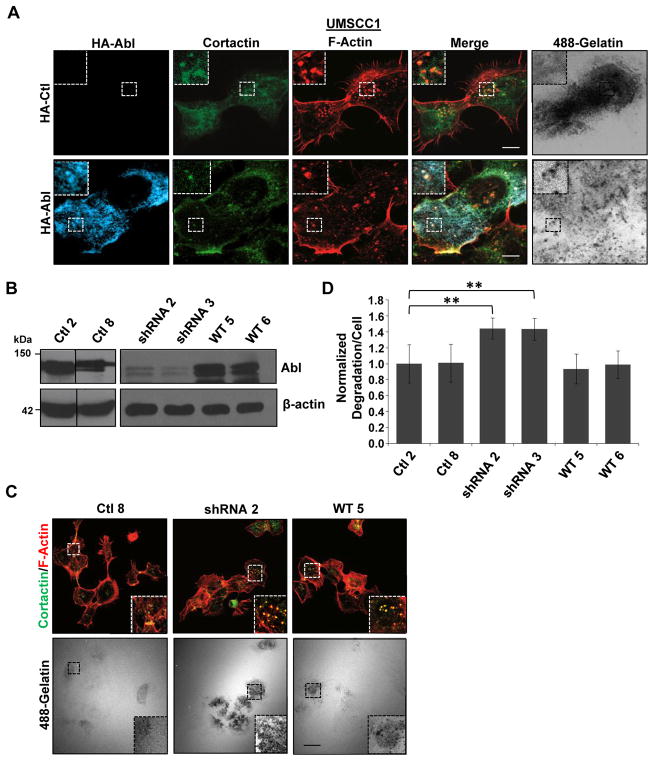
Head and neck squamous cell carcinoma (HNSCC) has a proclivity for locoregional invasion. HNSCC mediates invasion in part through invadopodia-based proteolysis of the extracellular matrix (ECM). Activation of Src, Erk1/2, Abl and Arg downstream of epidermal growth factor receptor (EGFR) modulates invadopodia activity through phosphorylation of the actin regulatory protein cortactin. In MDA-MB-231 breast cancer cells, Abl and Arg function downstream of Src to phosphorylate cortactin, promoting invadopodia ECM degradation activity and thus assigning a pro-invasive role for Ableson kinases. We report that Abl kinases have an opposite, negative regulatory role in HNSCC where they suppress invadopodia and tumor invasion. Impairment of Abl expression or Abl kinase activity with imatinib mesylate enhanced HNSCC matrix degradation and 3D collagen invasion, functions that were impaired in MDA-MB-231. HNSCC lines with elevated EGFR and Src activation did not contain increased Abl or Arg kinase activity, suggesting that Src could bypass Abl/Arg to phosphorylate cortactin and promote invadopodia ECM degradation. Src-transformed Abl(-/-)/Arg(-/-) fibroblasts produced ECM degrading invadopodia containing pY421 cortactin, indicating that Abl/Arg are dispensable for invadopodia function in this system. Imatinib-treated HNSCC cells had increased EGFR, Erk1/2 and Src activation, enhancing cortactin pY421 and pS405/418 required for invadopodia function. Imatinib stimulated shedding of the EGFR ligand heparin-binding EGF-like growth factor (HB-EGF) from HNSCC cells, where soluble HB-EGF enhanced invadopodia ECM degradation in HNSCC but not in MDA-MB-231. HNSCC cells treated with inhibitors of the EGFR-invadopodia pathway indicated that EGFR and Src are required for invadopodia function. Collectively, our results indicate that Abl kinases negatively regulate HNSCC invasive processes through suppression of an HB-EGF autocrine loop responsible for activating a EGFR-Src-cortactin cascade, in contrast to the invasion promoting functions of Abl kinases in breast and other cancer types. Our results provide mechanistic support for recent failed HNSCC clinical trials utilizing imatinib.
头颈部鳞状细胞癌 (HNSCC) 倾向于局部侵袭。HNSCC 通过细胞外基质 (ECM) 的侵袭小体蛋白水解在部分介导侵袭。表皮生长因子受体 (EGFR) 下游的Src、Erk1/2、Abl 和 Arg 的激活通过磷酸化肌动蛋白调节蛋白 cortactin 调节侵袭小体活性。在 MDA-MB-231 乳腺癌细胞中,Abl 和 Arg 作为 Src 的下游因子发挥作用,磷酸化 cortactin,促进侵袭小体 ECM 降解活性,从而赋予 Ablson 激酶促进侵袭的作用。我们报告说,Abl 激酶在 HNSCC 中具有相反的负调节作用,它们抑制侵袭小体和肿瘤侵袭。用甲磺酸伊马替尼抑制 Abl 表达或 Abl 激酶活性增强了 HNSCC 基质降解和 3D 胶原侵袭,而 MDA-MB-231 中的这些功能受损。EGFR 和 Src 激活水平升高的 HNSCC 细胞系中,并没有增加 Abl 或 Arg 激酶活性,这表明 Src 可以绕过 Abl/Arg 磷酸化 cortactin 并促进侵袭小体 ECM 降解。Src 转化的 Abl(-/-)/Arg(-/-)成纤维细胞产生含有 pY421 cortactin 的 ECM 降解侵袭小体,表明在该系统中 Abl/Arg 对于侵袭小体功能是可有可无的。用伊马替尼处理的 HNSCC 细胞 EGFR、Erk1/2 和 Src 激活增加,增强了侵袭小体功能所必需的 cortactin pY421 和 pS405/418。伊马替尼刺激 HNSCC 细胞释放表皮生长因子受体配体肝素结合表皮生长因子样生长因子 (HB-EGF),可溶性 HB-EGF 增强 HNSCC 中的侵袭小体 ECM 降解,但在 MDA-MB-231 中没有。用 EGFR-侵袭小体通路抑制剂处理的 HNSCC 细胞表明,EGFR 和 Src 是侵袭小体功能所必需的。总的来说,我们的结果表明,Abl 激酶通过抑制负责激活 EGFR-Src-cortactin 级联反应的 HB-EGF 自分泌环,负调节 HNSCC 侵袭过程,与 Abl 激酶在乳腺癌和其他癌症类型中的促进侵袭功能形成对比。我们的结果为最近使用伊马替尼的 HNSCC 临床试验的失败提供了机制支持。