Arora Jyoti, Saraswathy Kallur N, Deb Roumi
Amity Institute of Biotechnology, Amity University, Noida, U.P., India.
Indian J Hum Genet. 2012 May;18(2):177-82. doi: 10.4103/0971-6866.100757.
Tumor protein 53 (tp53) is one of the candidate gene proposed for neural tube defects, which affects central nervous system during early embryonic development, on the basis of mouse models.
The present study is an attempt to unfold the possible role of tp53 G412C polymorphism in the incidence of neural tube defect (NTDs) in humans.
Case-control study was carried out in government hospitals of Delhi, India.
Subjects comprised of 100 mothers of NTD children and 100 matched control mothers. Information on some environmental exposures was collected along with blood samples. After DNA extraction, the genotyping of tp53 G412C polymorphism was carried out by PCR-RFLP method. STATISTICAL ANALYSYS: Fisher Exact or Chi square test, binary logistic model, and odds ratio (95% confidence interval) calculations were used to evaluate effect of risk factors on NTDs using SPSS v17.0.
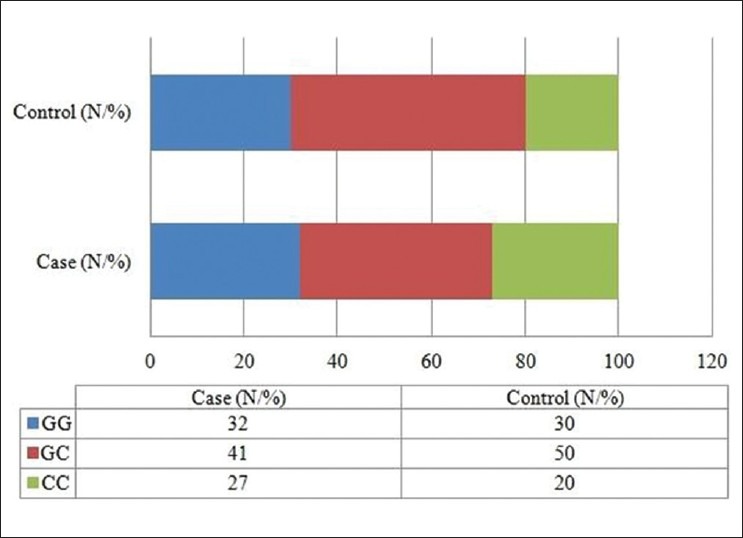
The 'CC' genotype of tp53 G412C showed protective effect towards the development of anencephaly and/or encephalocele (OR: 0.44; 95% CI: 0.19-1.00); however, no significant difference among overall NTD cases and controls was observed (P>0.05). Further segregation of all subjects based on 2 different communities, Hindus and Muslims, the association of 'CC' genotype of the polymorphism with reduced NTD risk was observed among Hindu community (OR: 0.33; 95% CI: 0.13-0.79).
The study highlights the selective advantage provided by maternal 'CC' genotype, thereby reducing risk of cephalic NTDs, probably due to the lower apoptotic activity of the protein, however, more specifically in the presence of community-specific microenvironment.
基于小鼠模型,肿瘤蛋白53(tp53)是被提出与神经管缺陷相关的候选基因之一,神经管缺陷在胚胎发育早期会影响中枢神经系统。
本研究旨在揭示tp53基因G412C多态性在人类神经管缺陷(NTDs)发病中的可能作用。
在印度德里的政府医院开展病例对照研究。
研究对象包括100名神经管缺陷患儿的母亲和100名匹配的对照母亲。采集血样的同时收集了一些环境暴露信息。DNA提取后,采用聚合酶链反应-限制性片段长度多态性(PCR-RFLP)方法对tp53基因G412C多态性进行基因分型。统计分析:使用Fisher精确检验或卡方检验、二元逻辑模型以及比值比(95%置信区间)计算,通过SPSS v17.0评估危险因素对神经管缺陷的影响。
tp53基因G412C的“CC”基因型对无脑儿和/或脑膨出的发生具有保护作用(比值比:0.44;95%置信区间:0.19 - 1.00);然而,在总体神经管缺陷病例和对照之间未观察到显著差异(P>0.05)。根据印度教徒和穆斯林这两个不同群体对所有研究对象进一步分类后,在印度教群体中观察到该多态性的“CC”基因型与降低的神经管缺陷风险相关(比值比:0.33;95%置信区间:0.13 - 0.79)。
该研究强调了母亲“CC”基因型所提供的选择性优势,从而降低了头部神经管缺陷的风险,这可能是由于该蛋白较低的凋亡活性,然而,更具体地说是在特定社区微环境存在的情况下。