Chiquette Elaine, Toth Peter P, Ramirez Gilbert, Cobble Michael, Chilton Robert
Amylin Pharmaceuticals, San Diego, CA, USA.
Vasc Health Risk Manag. 2012;8:621-9. doi: 10.2147/VHRM.S37969. Epub 2012 Nov 12.
Cyslipidemia and type 2 diabetes are two of the most significant risk factors for the development of cardiovascular disease. Measurement of lipoprotein subclasses provides important information about derangements in lipid metabolism and helps refine cardiovascular risk assessment. Exenatide, a glucagon-like peptide 1 receptor agonist, improved glycemic control, obesity, hypertension, and dyslipidemia in patients with type 2 diabetes in clinical trials.
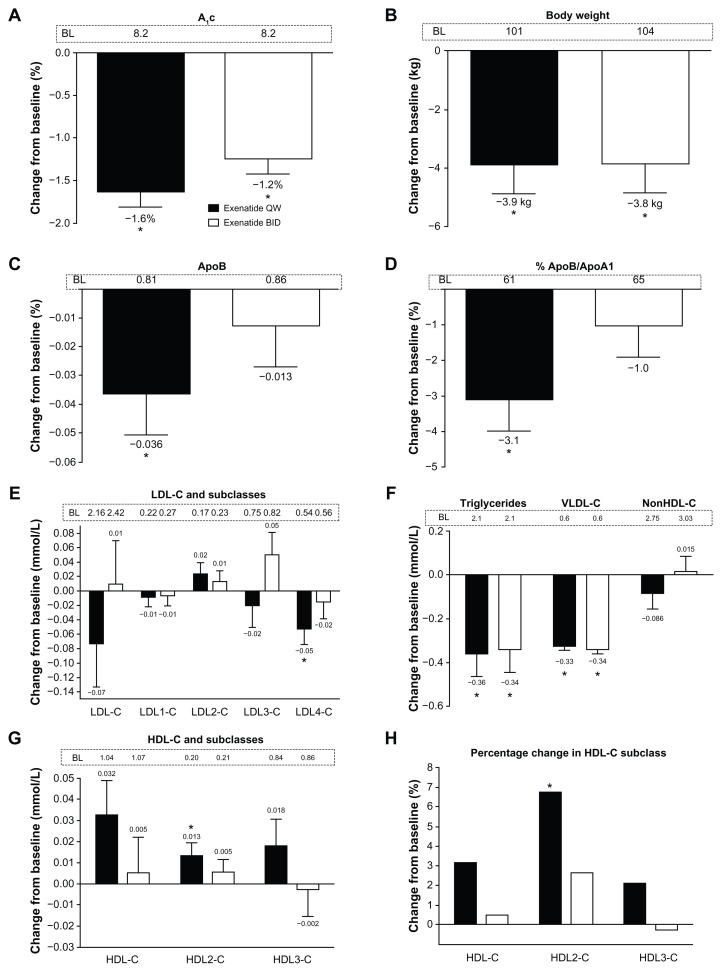
In the DURATION-1 trial, patients with type 2 diabetes were treated with exenatide once weekly or twice daily for 30 weeks. This post hoc analysis evaluated the impact of exenatide on lipoprotein subclasses in 211 DURATION-1 patients using vertical auto profile methodology and the Statistical Package for the Social Sciences general linear model adjusted for glycosylated hemoglobin (HbA(1c)) and weight.
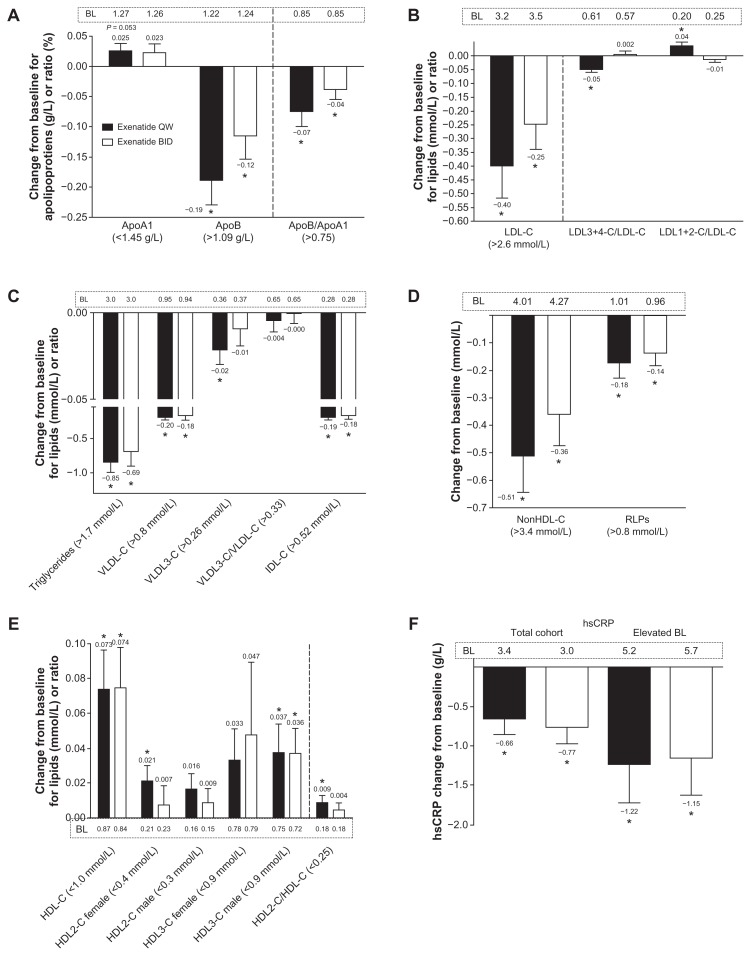
Baseline lipids and high sensitivity C-reactive protein were normal overall based on the standard lipid panel. Once-weekly exenatide reduced apolipoprotein B and the apolipoprotein B to apolipoprotein A1 ratio (P < 0.05), independent of glycemic improvement and weight loss. A significant shift in lipoprotein pattern away from small, dense low-density lipoprotein-4 cholesterol was also observed (P < 0.05). Exenatide once weekly increased high-density lipoprotein-2 cholesterol, even after adjustment for changes in HbA(1c) and weight (P < 0.05). Triglycerides, very low-density lipoprotein cholesterol, and high sensitivity C-reactive protein were reduced with both the once-weekly and twice-daily exenatide regimens (P < 0.05).
In this post hoc analysis, exenatide significantly improved a number of cardiovascular risk markers. Continuous exenatide exposure with exenatide once weekly elicited a greater response than did immediate-release exenatide twice daily, generally independent of glycemic improvement and weight loss. Thus, in addition to improving glycemic control, exenatide induced favorable changes in lipid and lipoprotein metabolism and decreased systemic inflammation.
胱脂血症和2型糖尿病是心血管疾病发生的两个最重要的危险因素。脂蛋白亚类的测定提供了有关脂质代谢紊乱的重要信息,并有助于完善心血管风险评估。在临床试验中,胰高血糖素样肽1受体激动剂艾塞那肽改善了2型糖尿病患者的血糖控制、肥胖、高血压和血脂异常。
在DURATION-1试验中,2型糖尿病患者接受每周一次或每日两次的艾塞那肽治疗,为期30周。这项事后分析使用垂直自动分析方法和社会科学统计软件通用线性模型,对211名DURATION-1患者中艾塞那肽对脂蛋白亚类的影响进行了评估,并对糖化血红蛋白(HbA1c)和体重进行了校正。
根据标准血脂检测指标,总体上基线血脂和高敏C反应蛋白正常。每周一次的艾塞那肽降低了载脂蛋白B以及载脂蛋白B与载脂蛋白A1的比值(P<0.05),且与血糖改善和体重减轻无关。还观察到脂蛋白模式明显从较小、致密的低密度脂蛋白-4胆固醇转变(P<0.05)。即使在对HbA1c和体重变化进行校正后,每周一次的艾塞那肽仍增加了高密度脂蛋白-2胆固醇(P<0.05)。每周一次和每日两次的艾塞那肽治疗方案均降低了甘油三酯、极低密度脂蛋白胆固醇和高敏C反应蛋白(P<0.05)。
在这项事后分析中,艾塞那肽显著改善了多项心血管风险指标。每周一次持续使用艾塞那肽比每日两次的速释型艾塞那肽引发的反应更大,且一般与血糖改善和体重减轻无关。因此,除了改善血糖控制外,艾塞那肽还引起了脂质和脂蛋白代谢的有利变化,并减轻了全身炎症。