Centre for Endocrinology, William Harvey Research Institute, Barts and the London, London EC1M 6BQ, UK.
Mol Cell Endocrinol. 2013 Jan 30;365(2):303-8. doi: 10.1016/j.mce.2012.11.007. Epub 2012 Nov 20.
Ghrelin is a potent orexigenic brain-gut peptide with lipogenic and diabetogenic effects, possibly mediated by growth hormone secretagogue receptor (GHS-R1a). Cannabinoids also have orexigenic and lipogenic effects. AMPK is a regulator of energy homeostasis and we have previously shown that ghrelin and cannabinoids stimulate hypothalamic AMPK activity while inhibiting it in the liver and adipose tissue, suggesting that AMPK mediates both the central appetite-inducing and peripheral effects of ghrelin and cannabinoids.
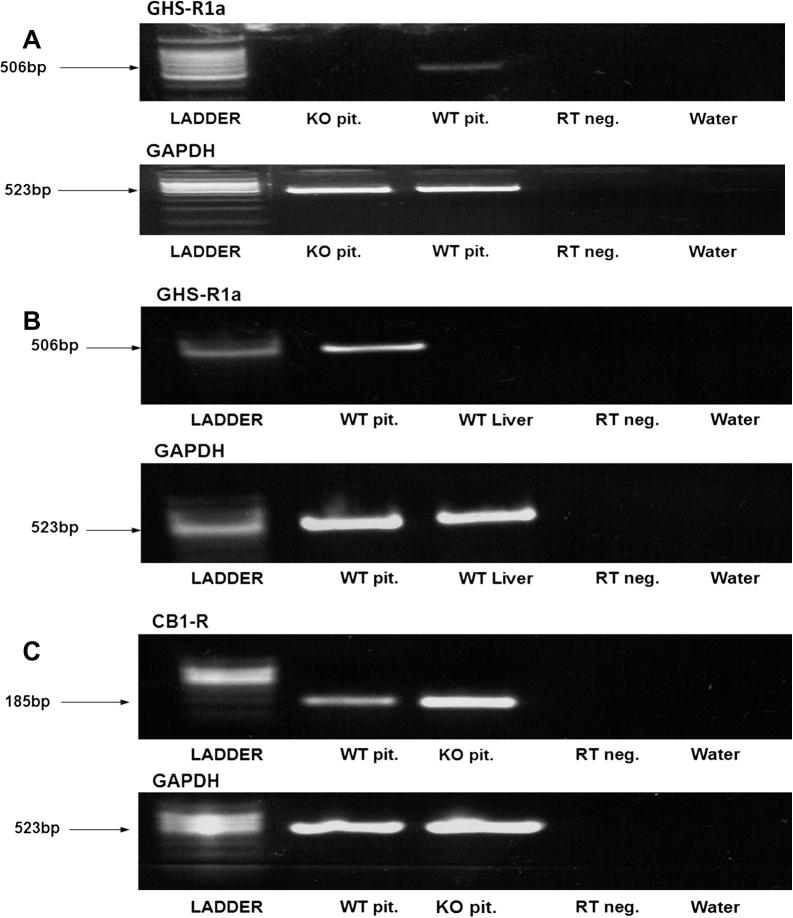
Using GHS-R KO mice, we investigated whether the known ghrelin receptor GHS-R1a is required for the tissue-specific effects of ghrelin on AMPK activity, and if an intact ghrelin signalling pathway is necessary for the effects of cannabinoids on AMPK activity.
Wild-type and GHS-R KO mice were treated intraperitoneally with ghrelin 500 ng/g bodyweight or CB1 agonist HU210 20 ng/g and hypothalamic, hepatic and adipose AMPK activity was studied using a functional kinase assay.
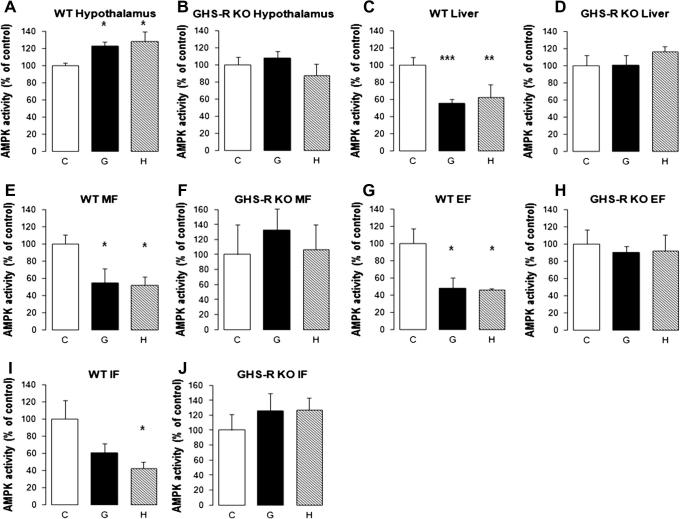
Ghrelin and HU210 significantly stimulated hypothalamic AMPK activity in wild-type animals (mean±SEM, 122.5±5.2% and 128±11.6% of control, p<0.05) and inhibited it in liver (55.1±4.8% and 62.2±14.5%, p<0.01) and visceral fat (mesenteric fat (MF): 54.6±16% and 52.0±9.3%, p<0.05; epididymal fat (EF): 47.9±12.1% and 45.6±1.7%, p<0.05). The effects of ghrelin, and interestingly also HU210, on hypothalamic, visceral fat and liver AMPK activity were abolished in the GHS-R KO mice (hypothalamus: 107.9±7.7% and 87.4±13.3%, liver: 100.5±11.6% and 116.7±5.4%, MF: 132.1±29.9% and 107.1±32.7%, EF: 89.8±7.3% and 91.7±18.3%, p>0.05).
Ghrelin requires GHS-R1a for its effect on hypothalamic, liver and adipose tissue AMPK activity. An intact ghrelin signalling pathway is necessary for the effects of cannabinoids on AMPK activity.
Ghrelin 是一种强效的食欲肽,具有促脂和致糖尿病作用,可能通过生长激素促分泌素受体(GHS-R1a)介导。大麻素也具有食欲和促脂作用。AMPK 是能量平衡的调节剂,我们之前的研究表明,ghrelin 和大麻素刺激下丘脑 AMPK 活性,同时抑制肝脏和脂肪组织中的 AMPK 活性,这表明 AMPK 介导了 ghrelin 和大麻素的中枢食欲诱导和外周作用。
使用 GHS-R KO 小鼠,我们研究了已知的 ghrelin 受体 GHS-R1a 是否是 ghrelin 对 AMPK 活性的组织特异性作用所必需的,以及大麻素对 AMPK 活性的影响是否需要完整的 ghrelin 信号通路。
腹腔内给予野生型和 GHS-R KO 小鼠 500ng/g 体重的 ghrelin 或 CB1 激动剂 HU210 20ng/g,使用功能性激酶测定法研究下丘脑、肝和脂肪组织中的 AMPK 活性。
Ghrelin 和 HU210 显著刺激野生型动物的下丘脑 AMPK 活性(平均值±SEM,分别为 122.5±5.2%和 128±11.6%,p<0.05),并抑制肝脏(55.1±4.8%和 62.2±14.5%,p<0.01)和内脏脂肪(肠系膜脂肪(MF):54.6±16%和 52.0±9.3%,p<0.05;附睾脂肪(EF):47.9±12.1%和 45.6±1.7%,p<0.05)。ghrelin 的作用,有趣的是 HU210 对下丘脑、内脏脂肪和肝脏 AMPK 活性的作用在 GHS-R KO 小鼠中被消除(下丘脑:107.9±7.7%和 87.4±13.3%,肝脏:100.5±11.6%和 116.7±5.4%,MF:132.1±29.9%和 107.1±32.7%,EF:89.8±7.3%和 91.7±18.3%,p>0.05)。
Ghrelin 对下丘脑、肝脏和脂肪组织 AMPK 活性的作用需要 GHS-R1a。大麻素对 AMPK 活性的影响需要完整的 ghrelin 信号通路。