Department of General Surgery, Qilu Hospital of Shandong University, Jinan, China.
Onco Targets Ther. 2012;5:335-42. doi: 10.2147/OTT.S36098. Epub 2012 Nov 9.
To investigate the effects of mifepristone, a progesterone receptor (PR) antagonist, through the proliferation of human cholangiocarcinoma cell line FRH-0201 in vitro and the possible mechanisms involved.
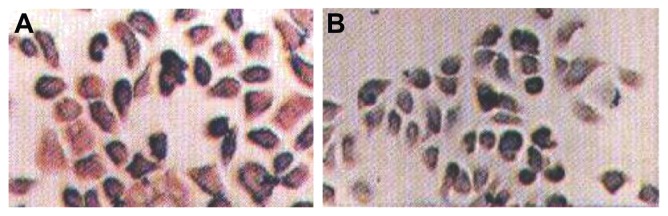
A two-step addition of poly-HRP anti-mouse immunoglobulin G detection system was used to detect the expression of PR in FRH-0201 cells. After treatments with various concentrations of mifepristone (10, 20, 40, 80, 160, and 320 μmol/L) at various time intervals (24, 48, and 72 hours), the rate of cell inhibition, the rate of cell apoptosis, and the expression of bax/bcl-2/Fas were analyzed with tetrazolium blue (MTT) assay, flow cytometry, reverse transcription polymerase chain reaction and Western blotting. The effect of mifepristone and mifepristone combined with interferon (IFN)-γ-inducing apoptosis on the cells was observed.
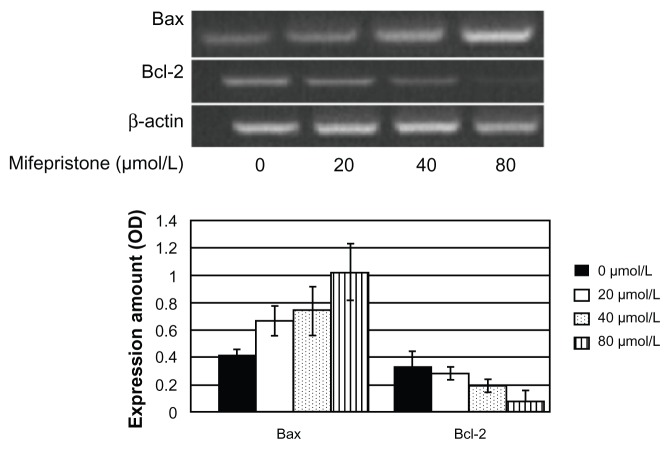
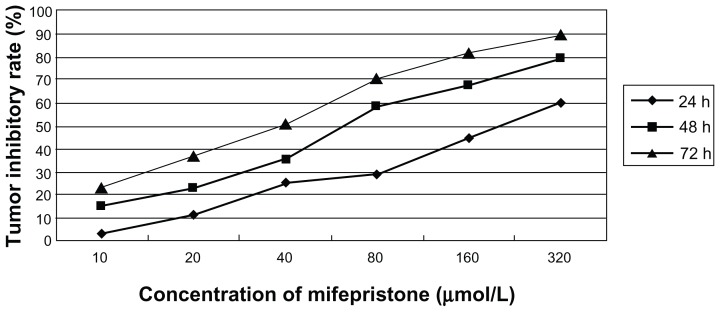
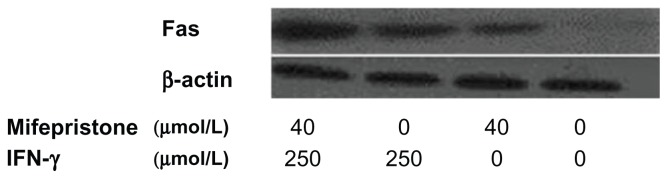
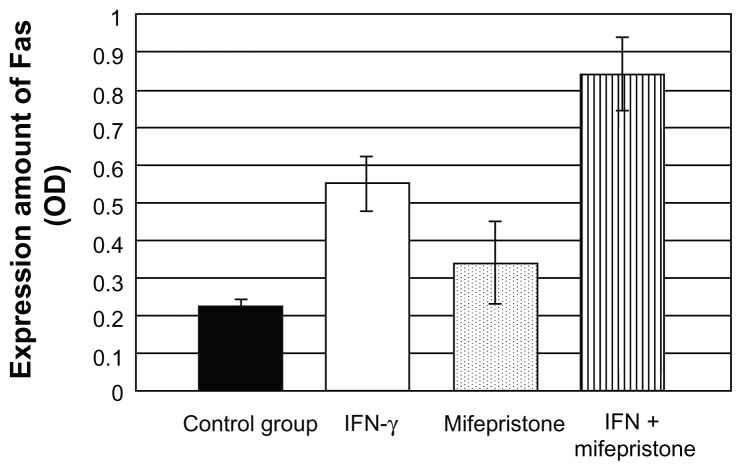
Mifepristone remarkably inhibited the proliferation of FRH-0201 cells, which was revealed by MTT assay in a dose- and time-dependent manner. The inhibitory rate gradually increased following the increase of the dosage of mifepristone from a low dosage (10 μmol/L) to a high dosage (320 μmol/L) at different time intervals. Flow cytometry analysis showed mifepristone increased the rate of the FRH-0201 cell-line apoptosis. Notably, the rate of apoptosis increased markedly when the cells were pretreated with IFN-γ and then treated with mifepristone. In addition, mifepristone obviously upregulated bax and Fas expression and downregulated bcl-2 expression.
Mifepristone effectively inhibited the growth of PR-positive human cholangiocarcinoma cell line FRH-0201 in vitro through multiple mechanisms. Mifepristone combined with IFN-γ might therefore induce the apoptosis of the cell line, which is possibly a beneficial clinical scheme for patients suffering from cholangiocarcinoma.
探讨孕激素受体(PR)拮抗剂米非司酮对体外人胆管癌细胞系 FRH-0201 增殖的影响及其可能的作用机制。
采用两步法加聚 HRP 抗鼠免疫球蛋白 G 检测系统检测 FRH-0201 细胞中 PR 的表达。用不同浓度(10、20、40、80、160 和 320μmol/L)米非司酮在不同时间(24、48 和 72 小时)处理细胞后,用四唑蓝(MTT)法检测细胞抑制率、细胞凋亡率、bax/bcl-2/Fas 表达,并用逆转录聚合酶链反应和 Western 印迹法分析。观察米非司酮和米非司酮联合干扰素(IFN)-γ诱导细胞凋亡的作用。
MTT 法显示,米非司酮呈剂量和时间依赖性显著抑制 FRH-0201 细胞增殖。随着米非司酮剂量从低剂量(10μmol/L)增加到高剂量(320μmol/L),不同时间间隔的抑制率逐渐增加。流式细胞术分析显示,米非司酮增加了 FRH-0201 细胞系的凋亡率。值得注意的是,当细胞先用 IFN-γ 预处理,然后用米非司酮处理时,细胞凋亡率显著增加。此外,米非司酮明显上调 bax 和 Fas 表达,下调 bcl-2 表达。
米非司酮通过多种机制有效抑制体外 PR 阳性人胆管癌细胞系 FRH-0201 的生长。米非司酮联合 IFN-γ 可能诱导细胞凋亡,这可能是胆管癌患者的有益临床方案。