
多糖K抑制结肠癌细胞中的血管生成。
Polysaccharide K suppresses angiogenesis in colon cancer cells.
作者信息
Satoh Yoshiki, Goi Takanori, Nakazawa Toshiyuki, Kimura Youhei, Hirono Yasuo, Katayama Kanji, Yamaguchi Akio
机构信息
First Department of Surgery, University of Fukui, Yoshida-gun, Fukui, Japan.
出版信息
Exp Ther Med. 2012 Sep;4(3):370-374. doi: 10.3892/etm.2012.632. Epub 2012 Jul 4.
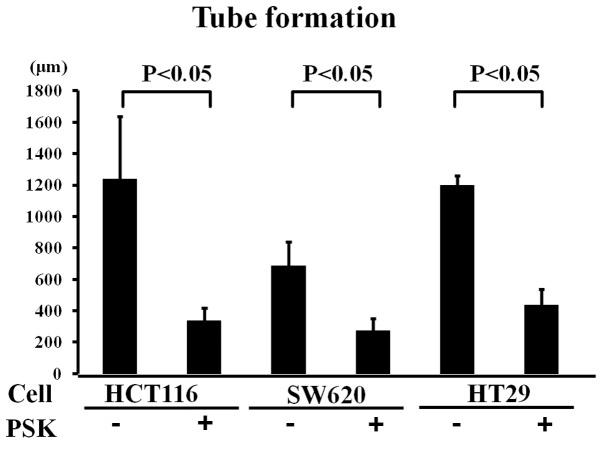
The protein-bound polysaccharide K (PSK) is used as a non-specific immunotherapeutic agent for the treatment of colon cancer. Little research, however, has been conducted on its association with angiogenesis, which is a prognostic factor markedly correlated with hematogenous metastases. We therefore decided to investigate the action of PSK on angiogenic growth factors, angiogenesis inhibitors and angiogenesis in colon cancer cells. Reverse transcription-polymerase chain reaction (RT-PCR) was used to investigate changes in HIF-1α mRNA expression. PCR array was used to investigate changes in angiogenic growth factors and angiogenesis inhibitors, as well as the expression of related genes. Colon cancer cells were cultured with or without PSK for 48 h. The following day, cells were cultured for two days at 37°C in new complete media. The resulting culture medium was placed in the chamber of a tube formation system in order to investigate tube formation. Investigation of HIF-1α mRNA expression in colon cancer cell lines and in cells cultured under identical conditions with added PSK revealed a significant decrease in expression, as well as a decrease in angiogenic growth factors and related genes in PSK-treated colon cancer cell lines. By contrast, levels of angiogenesis inhibitors and related genes were higher in the PSK-treated colon cancer cell lines. Investigation of tube formation revealed that elongation was inhibited in the medium of the PSK-treated colon cancer cell lines in comparison to the medium of the non-treated colon cancer cell lines. PSK suppresses angiogenic growth factors and related genes, enhances angiogenesis inhibitors and related genes and ultimately suppresses angiogenesis in colon cancer cells.
蛋白结合多糖K(PSK)用作治疗结肠癌的非特异性免疫治疗药物。然而,关于其与血管生成的关联研究甚少,而血管生成是与血行转移显著相关的预后因素。因此,我们决定研究PSK对结肠癌细胞中血管生成生长因子、血管生成抑制剂及血管生成的作用。采用逆转录-聚合酶链反应(RT-PCR)研究缺氧诱导因子-1α(HIF-1α)mRNA表达的变化。利用PCR芯片研究血管生成生长因子和血管生成抑制剂的变化以及相关基因的表达。将结肠癌细胞在有或无PSK的情况下培养48小时。次日,将细胞在37℃的新鲜完全培养基中培养两天。将所得培养基置于血管生成系统的小室中以研究血管生成。对结肠癌细胞系以及在添加PSK的相同条件下培养的细胞中HIF-1α mRNA表达的研究显示,PSK处理的结肠癌细胞系中表达显著降低,血管生成生长因子及相关基因也减少。相比之下,PSK处理的结肠癌细胞系中血管生成抑制剂及相关基因的水平较高。血管生成研究显示,与未处理的结肠癌细胞系的培养基相比,PSK处理的结肠癌细胞系的培养基中血管生成的延长受到抑制。PSK可抑制血管生成生长因子及相关基因,增强血管生成抑制剂及相关基因,并最终抑制结肠癌细胞中的血管生成。


 Zotero 插件