Institute of Botany, Academy of Sciences of the Czech Republic, Průhonice, Czech Republic.
PLoS One. 2012;7(11):e49471. doi: 10.1371/journal.pone.0049471. Epub 2012 Nov 21.
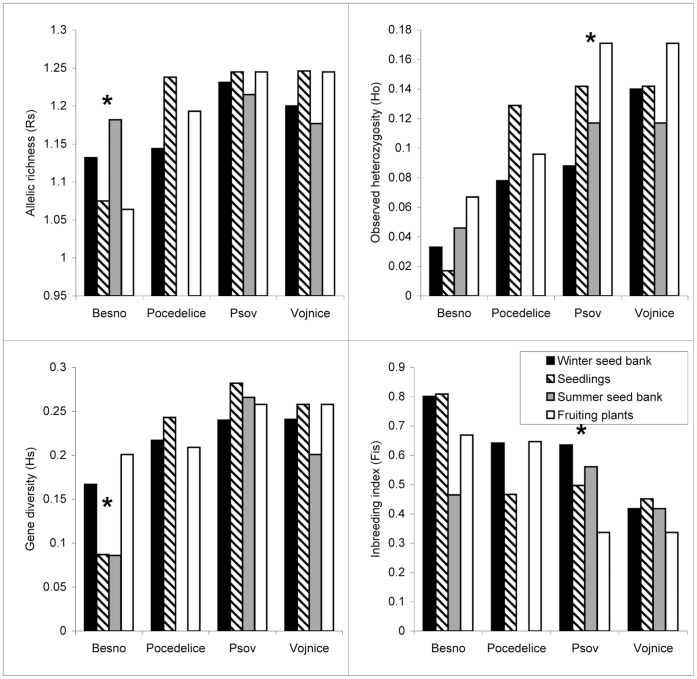
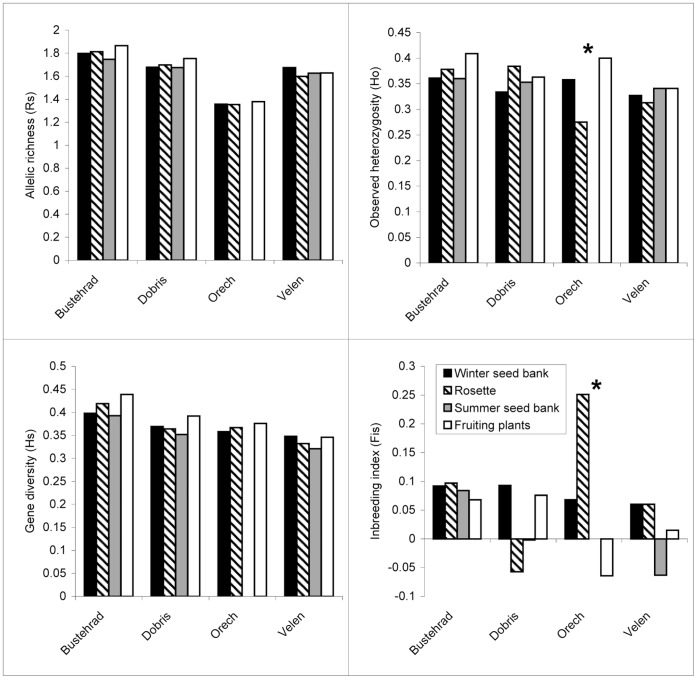
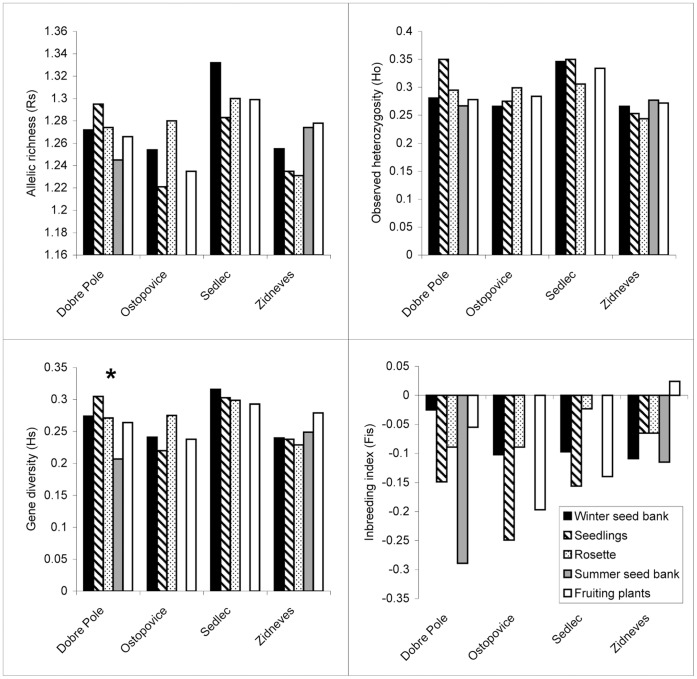
We attempted to confirm that seed banks can be viewed as an important genetic reservoir by testing the hypothesis that standing (aboveground) plants represent a nonrandom sample of the seed bank. We sampled multilocus allozyme genotypes from three species with different life history strategies: Amaranthus retroflexus, Carduus acanthoides, Pastinaca sativa. In four populations of each species we analysed the extent to which allele and genotype frequencies vary in consecutive life history stages including the summer seed bank, which has been overlooked up to now. We compared the winter seed bank (i.e., seeds collected before the spring germination peak), seedlings, rosettes, the summer seed bank (i.e., seeds collected after the spring germination peak) and fruiting plants. We found that: (1) All three species partitioned most of their genetic diversity within life history stages and less among stages within populations and among populations. (2) All genetic diversity parameters, except for allele frequencies, were similar among all life history stages across all populations in different species. (3) There were differences in allele frequencies among life history stages at all localities in Amaranthus retroflexus and at three localities in both Carduus acanthoides and Pastinaca sativa. (4) Allele frequencies did not differ between the winter and summer seed bank in most Carduus acanthoides and Pastinaca sativa populations, but there was a marked difference in Amaranthus retroflexus. In conclusion, we have shown that the summer seed bank is not genetically depleted by spring germination and that a majority of genetic diversity remains in the soil through summer. We suggest that seed banks in the species investigated play an important role by maintaining genetic diversity sufficient for recovery rather than by accumulating new genetic diversity at each locality.
即地上(露地)植物代表了种子库的一个非随机样本。我们从具有不同生活史策略的三个物种中采样了多位点等位酶基因型:反枝苋、刺头菜和野菘菜。在每个物种的四个种群中,我们分析了等位基因和基因型频率在连续的生活史阶段中的变化程度,包括迄今为止被忽视的夏季种子库。我们比较了冬季种子库(即在春季萌发高峰前采集的种子)、幼苗、莲座叶丛、夏季种子库(即在春季萌发高峰后采集的种子)和结实植物。结果发现:(1)三个物种在生活史阶段内将其大部分遗传多样性进行了划分,而在种群内和种群间的阶段间则较少。(2)除了等位基因频率外,所有遗传多样性参数在不同物种的所有种群的所有生活史阶段中均相似。(3)在反枝苋的所有地点以及刺头菜和野菘菜的三个地点中,各生活史阶段的等位基因频率均存在差异。(4)在大多数刺头菜和野菘菜种群中,冬季和夏季种子库的等位基因频率没有差异,但在反枝苋中存在明显差异。总之,我们已经表明,夏季种子库不会因春季萌发而导致遗传枯竭,并且在整个夏季期间,大部分遗传多样性仍保留在土壤中。我们认为,所研究的物种的种子库通过维持足以恢复的遗传多样性而不是在每个地点积累新的遗传多样性,从而发挥了重要作用。