Helsmoortel Céline, Vandeweyer Geert, Kooy R Frank
Cognitive Genetics, Department of Medical Genetics, University of Antwerp Prins Boudewijnlaan 43, B-2650 Edegem, Belgium.
F1000 Biol Rep. 2012;4:22. doi: 10.3410/B4-22. Epub 2012 Nov 1.
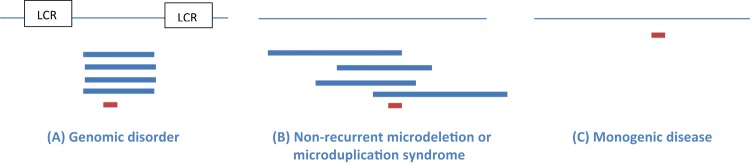
Over the last decade, the detection of chromosomal abnormalities has shifted from conventional karyotyping under a light microscope to molecular detection using microarrays. The latter technology identified copy number variation as a major source of variation in the human genome; moreover, copy number variants were found responsible for 10-20% of cases of intellectual disability. Recent technological advances in microarray technology have also enabled the detection of very small local chromosomal rearrangements, sometimes affecting the function of only a single gene. Here, we illustrate how high resolution microarray analysis has led to increased insights into the contribution of specific genes in disease.
在过去十年中,染色体异常的检测已从光学显微镜下的传统核型分析转向使用微阵列的分子检测。后一种技术将拷贝数变异确定为人类基因组变异的主要来源;此外,发现拷贝数变异导致了10%-20%的智力残疾病例。微阵列技术的最新进展还能够检测非常小的局部染色体重排,有时仅影响单个基因的功能。在此,我们举例说明高分辨率微阵列分析如何增进了对特定基因在疾病中作用的认识。