Division Analytical Biosciences, Leiden/Amsterdam Center for Drug Research, Einsteinweg 55, 2333CC Leiden, The Netherlands ; Netherlands Metabolomics Centre, Einsteinweg 55, 2333CC Leiden, The Netherlands ; MSD, Molenstraat 110, 5340 BH Oss, The Netherlands.
Netherlands Metabolomics Centre, Einsteinweg 55, 2333CC Leiden, The Netherlands ; Biosystems Data Analysis, Swammerdam Institute for Life Sciences, University of Amsterdam, Amsterdam, The Netherlands.
Genome Med. 2012 Nov 30;4(11):94. doi: 10.1186/gm395. eCollection 2012.
Glucocorticoids, such as prednisolone, are widely used anti-inflammatory drugs, but therapy is hampered by a broad range of metabolic side effects including skeletal muscle wasting and insulin resistance. Therefore, development of improved synthetic glucocorticoids that display similar efficacy as prednisolone but reduced side effects is an active research area. For efficient development of such new drugs, in vivo biomarkers, which can predict glucocorticoid metabolic side effects in an early stage, are needed. In this study, we aim to provide the first description of the metabolic perturbations induced by acute and therapeutic treatments with prednisolone in humans using urine metabolomics, and to derive potential biomarkers for prednisolone-induced metabolic effects.
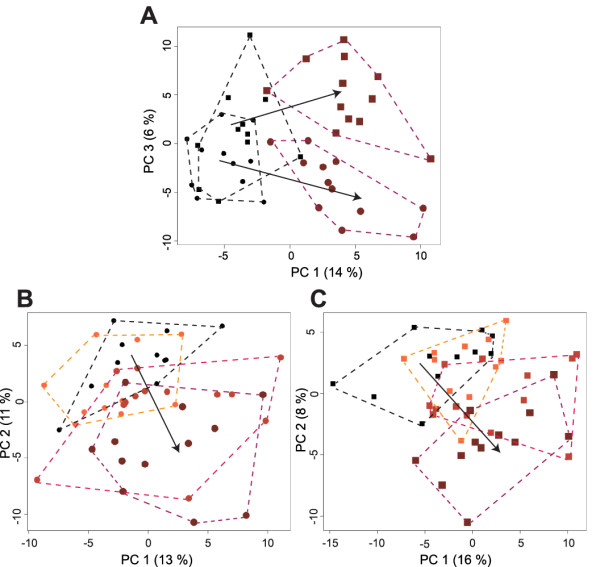
A randomized, double blind, placebo-controlled trial consisting of two protocols was conducted in healthy men. In protocol 1, volunteers received placebo (n = 11) or prednisolone (7.5 mg (n = 11), 15 mg (n = 13) or 30 mg (n = 12)) orally once daily for 15 days. In protocol 2, volunteers (n = 6) received placebo at day 0 and 75 mg prednisolone at day 1. We collected 24 h urine and serum samples at baseline (day 0), after a single dose (day 1) and after prolonged treatment (day 15) and obtained mass-spectrometry-based urine and serum metabolic profiles.
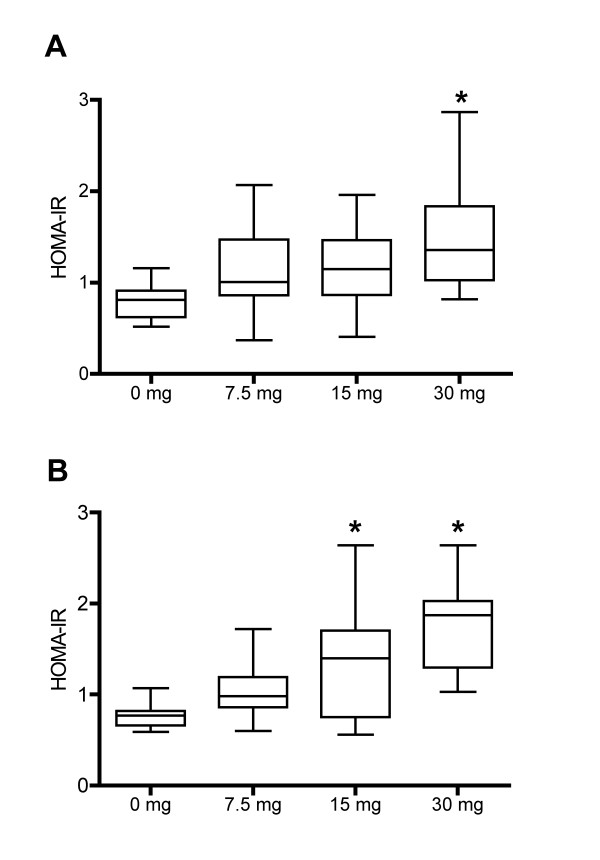
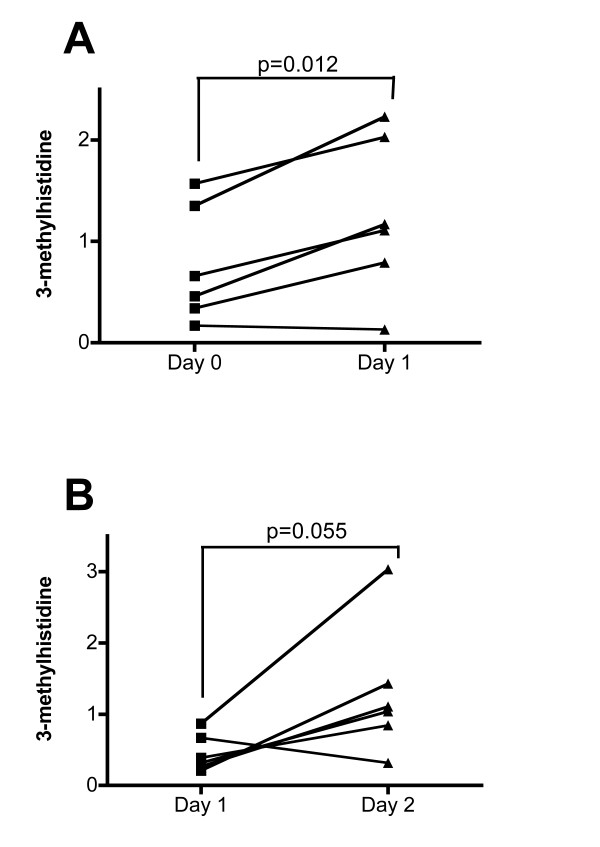
At day 1, high-dose prednisolone treatment increased levels of 13 and 10 proteinogenic amino acids in urine and serum respectively, as well as levels of 3-methylhistidine, providing evidence for an early manifestation of glucocorticoid-induced muscle wasting. Prednisolone treatment also strongly increased urinary carnitine derivatives at day 1 but not at day 15, which might reflect adaptive mechanisms under prolonged treatment. Finally, urinary levels of proteinogenic amino acids at day 1 and of N-methylnicotinamide at day 15 significantly correlated with the homeostatic model assessment of insulin resistance and might represent biomarkers for prednisolone-induced insulin resistance.
This study provides evidence that urinary metabolomics represents a noninvasive way of monitoring the effect of glucocorticoids on muscle protein catabolism after a single dose and can derive new biomarkers of glucocorticoid-induced insulin resistance. It might, therefore, help the development of improved synthetic glucocorticoids.
ClinicalTrials.gov NCT00971724.
糖皮质激素(如泼尼松龙)被广泛用作抗炎药物,但由于其广泛的代谢副作用,包括骨骼肌减少和胰岛素抵抗,治疗受到阻碍。因此,开发具有与泼尼松龙相似疗效但副作用较小的改良合成糖皮质激素是一个活跃的研究领域。为了有效开发此类新药,需要能够在早期预测糖皮质激素代谢副作用的体内生物标志物。在这项研究中,我们旨在使用尿液代谢组学首次描述泼尼松龙急性和治疗性治疗引起的代谢紊乱,并得出泼尼松龙诱导代谢作用的潜在生物标志物。
一项由两项方案组成的随机、双盲、安慰剂对照试验在健康男性中进行。在方案 1 中,志愿者每天口服安慰剂(n = 11)或泼尼松龙(7.5 mg(n = 11)、15 mg(n = 13)或 30 mg(n = 12))一次,共 15 天。在方案 2 中,志愿者(n = 6)在第 0 天和第 1 天接受安慰剂和 75 mg 泼尼松龙。我们在基线(第 0 天)、单次剂量后(第 1 天)和长期治疗后(第 15 天)采集 24 小时尿液和血清样本,并获得基于质谱的尿液和血清代谢图谱。
第 1 天,大剂量泼尼松龙治疗使尿液和血清中分别有 13 种和 10 种蛋白质氨基酸水平升高,以及 3-甲基组氨酸水平升高,表明糖皮质激素诱导的肌肉减少症的早期表现。泼尼松龙治疗还强烈增加了第 1 天的尿肉碱衍生物,但在第 15 天没有增加,这可能反映了长期治疗下的适应性机制。最后,第 1 天尿液中蛋白质氨基酸水平和第 15 天 N-甲基烟酰胺水平与稳态模型评估的胰岛素抵抗显著相关,可能代表泼尼松龙诱导的胰岛素抵抗的生物标志物。
这项研究表明,尿液代谢组学是监测单次剂量后糖皮质激素对肌肉蛋白分解代谢影响的一种非侵入性方法,并可以得出糖皮质激素诱导的胰岛素抵抗的新生物标志物。因此,它可能有助于开发改良的合成糖皮质激素。
ClinicalTrials.gov NCT00971724。