Sodi Andrea, Passerini Ilaria, Murro Vittoria, Caputo Roberto, Bacci Giacomo Maria, Bodoj Mirela, Torricelli Francesca, Menchini Ugo
Department of Specialized Surgical Sciences, Eye Clinic, University of Florence, Italy.
Mol Vis. 2012;18:2736-48. Epub 2012 Nov 17.
To analyze the spectrum of sequence variants in the BEST1 gene in a group of Italian patients affected by Best vitelliform macular dystrophy (VMD).
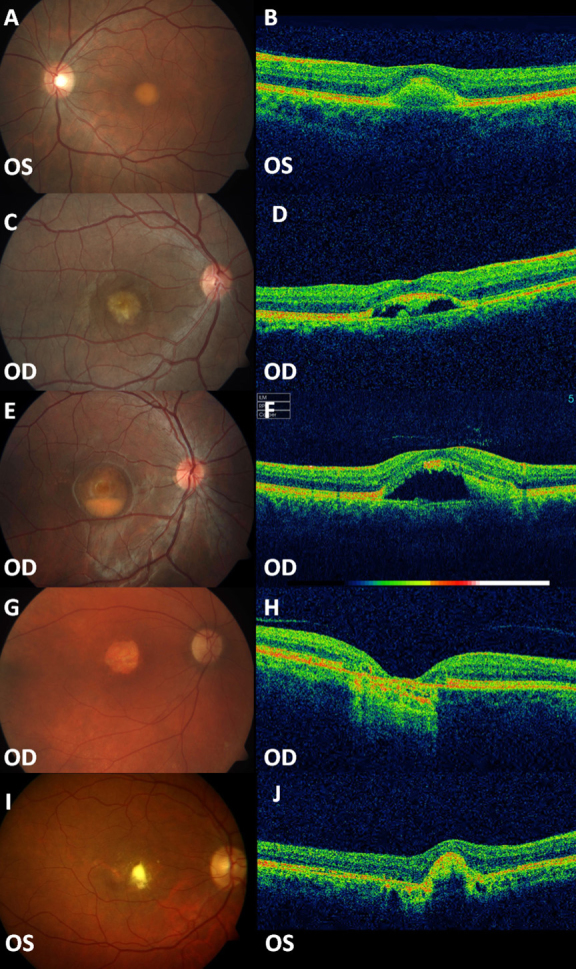
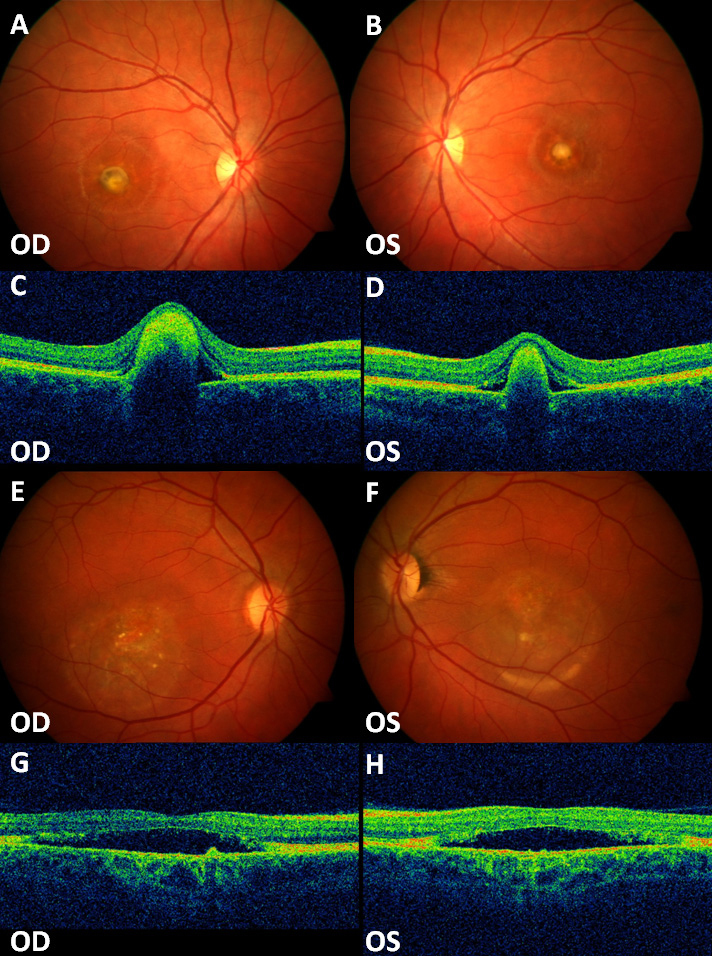
Thirty Italian patients with a diagnosis of VMD and 20 clinically healthy relatives were recruited. They belonged to 19 Italian families predominantly originating from central Italy. They received a standard ophthalmologic examination, OCT scan, and electrophysiological tests (ERG and EOG). Fluorescein and ICG angiographies and fundus autofluorescence imaging were performed in selected cases. DNA samples were analyzed for sequence variants of the BEST1 gene by direct sequencing techniques.
Nine missense variants and one deletion were found in the affected patients; each patient carried one mutation. Five variants [c.73C>T (p.Arg25Trp), c.652C>T (p.Arg218Cys), c.652C>G (p.Arg218Gly), c.728C>T (p.Ala243Val), c.893T>C (p.Phe298Ser)] have already been described in literature while another five variants [c.217A>C (p.Ile73Leu), c.239T>G (p.Phe80Cys), c.883_885del (p.Ile295del), c.907G>A (p.Asp303Asn), c.911A>G (p.Asp304Gly)] had not previously been reported. Affected patients, sometimes even from the same family, occasionally showed variable phenotypes. One heterozygous variant was also found in five clinically healthy relatives with normal fundus, visual acuity and ERG but with abnormal EOG.
Ten variants in the BEST1 gene were detected in a group of individuals with clinically apparent VMD, and in some clinically normal individuals with an abnormal EOG. The high prevalence of novel variants and the frequent report of a specific variant (p.Arg25Trp) that has rarely been described in other ethnic groups suggests a distribution of BEST1 variants peculiar to Italian VMD patients.
分析一组患有Best卵黄样黄斑营养不良(VMD)的意大利患者中BEST1基因的序列变异谱。
招募了30名诊断为VMD的意大利患者和20名临床健康的亲属。他们来自19个主要源自意大利中部的意大利家庭。他们接受了标准眼科检查、OCT扫描和电生理测试(ERG和EOG)。在部分病例中进行了荧光素和吲哚青绿血管造影以及眼底自发荧光成像。通过直接测序技术分析DNA样本中BEST1基因的序列变异。
在患病患者中发现了9个错义变异和1个缺失;每位患者携带1个突变。5个变异[c.73C>T(p.Arg25Trp)、c.652C>T(p.Arg218Cys)、c.652C>G(p.Arg218Gly)、c.728C>T(p.Ala243Val)、c.893T>C(p.Phe298Ser)]已在文献中描述,而另外5个变异[c.217A>C(p.Ile73Leu)、c.239T>G(p.Phe80Cys)、c.883_885del(p.Ile295del)、c.907G>A(p.Asp३03Asn)、c.911A>G(p.Asp304Gly)]此前未被报道。患病患者,有时甚至来自同一家族,偶尔表现出可变的表型。在5名眼底、视力和ERG正常但EOG异常的临床健康亲属中也发现了1个杂合变异。
在一组临床明显患有VMD的个体以及一些EOG异常的临床正常个体中检测到了BEST1基因的10个变异。新变异的高发生率以及在其他种族群体中很少描述的特定变异(p.Arg25Trp)的频繁报道表明,意大利VMD患者存在独特的BEST1变异分布。