Division of Biotechnology, The Graduate School of Engineering, Kyoto Sangyo University , Kyoto 603-8555 , Japan.
Biol Open. 2012 Oct 15;1(10):1024-34. doi: 10.1242/bio.20121115. Epub 2012 Aug 17.
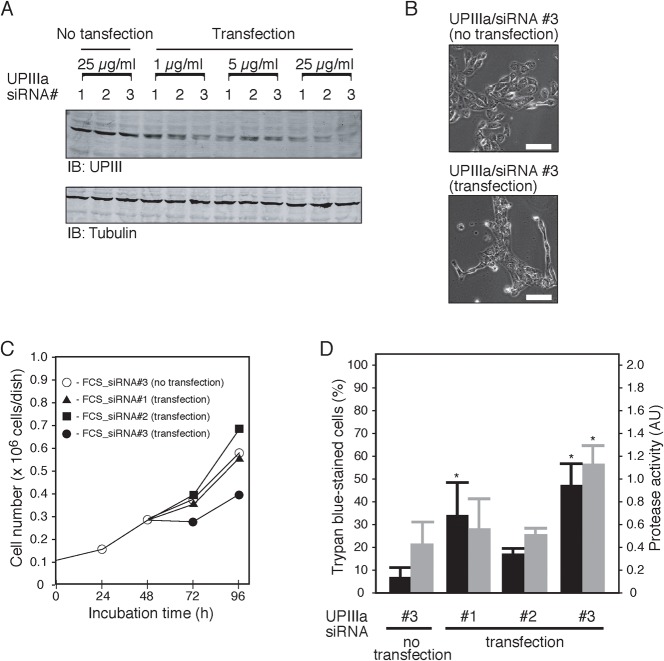
Our previous study demonstrated that tyrosine phosphorylation of p145(met)/β-subunit of hepatocyte growth factor receptor by epidermal growth factor receptor and Src contributes to the anti-apoptotic growth of human bladder carcinoma cell 5637 under serum-starved conditions. Here, we show that some other cell lines of human bladder carcinoma, but not other types of human cancer cells, also exhibit Src-dependent, anti-apoptotic proliferation under serum-starved conditions, and that low-density, detergent-insoluble membrane microdomains (MD) serve as a structural platform for signaling events involving p145(met), EGFR, and Src. As an MD-associated molecule that may contribute to bladder carcinoma-specific cellular function, we identified uroplakin IIIa (UPIIIa), an urothelium-specific protein. Results obtained so far revealed: 1) UPIIIa undergoes partial proteolysis in serum-starved cells; 2) a specific antibody to the extracellular domain of UPIIIa inhibits the proteolysis of UPIIIa and the activation of Src, and promotes apoptosis in serum-starved cells; and 3) knockdown of UPIIIa by short interfering RNA also promotes apoptosis in serum-starved cells. GM6001, a potent inhibitor of matrix metalloproteinase (MMP), inhibits the proteolysis of UPIIIa and promotes apoptosis in serum-starved cells. Furthermore, serum starvation promotes expression and secretion of the heparin-binding EGF-like growth factor in a manner that depends on the functions of MMP, Src, and UPIIIa. These results highlight a hitherto unknown signaling network involving a subset of MD-associated molecules in the anti-apoptotic mechanisms of human bladder carcinoma cells.
我们之前的研究表明,表皮生长因子受体和Src 对肝细胞生长因子受体 p145(met)/β-亚基的酪氨酸磷酸化作用有助于人膀胱癌 5637 细胞在血清饥饿条件下的抗凋亡生长。在这里,我们发现人膀胱癌的其他一些细胞系,而不是其他类型的人类癌细胞,也在血清饥饿条件下表现出Src 依赖性的抗凋亡增殖,并且低密、去垢剂不溶性膜微区(MD)作为涉及 p145(met)、EGFR 和 Src 的信号事件的结构平台。作为可能有助于膀胱癌特异性细胞功能的 MD 相关分子,我们鉴定了尿路上皮特异性蛋白 uroplakin IIIa (UPIIIa)。迄今为止获得的结果表明:1)UPIIIa 在血清饥饿细胞中发生部分蛋白水解;2)针对 UPIIIa 细胞外结构域的特异性抗体抑制 UPIIIa 的蛋白水解和 Src 的激活,并促进血清饥饿细胞的凋亡;3)短干扰 RNA 敲低 UPIIIa 也促进血清饥饿细胞的凋亡。GM6001,一种有效的基质金属蛋白酶(MMP)抑制剂,抑制 UPIIIa 的蛋白水解并促进血清饥饿细胞的凋亡。此外,血清饥饿以依赖 MMP、Src 和 UPIIIa 功能的方式促进肝素结合表皮生长因子样生长因子的表达和分泌。这些结果突出了一个迄今为止未知的信号网络,涉及人膀胱癌细胞抗凋亡机制中一组 MD 相关分子。