SRI International, Menlo Park, CA 94025, USA.
Eur J Pharmacol. 2013 Jan 15;699(1-3):200-6. doi: 10.1016/j.ejphar.2012.11.050. Epub 2012 Dec 5.
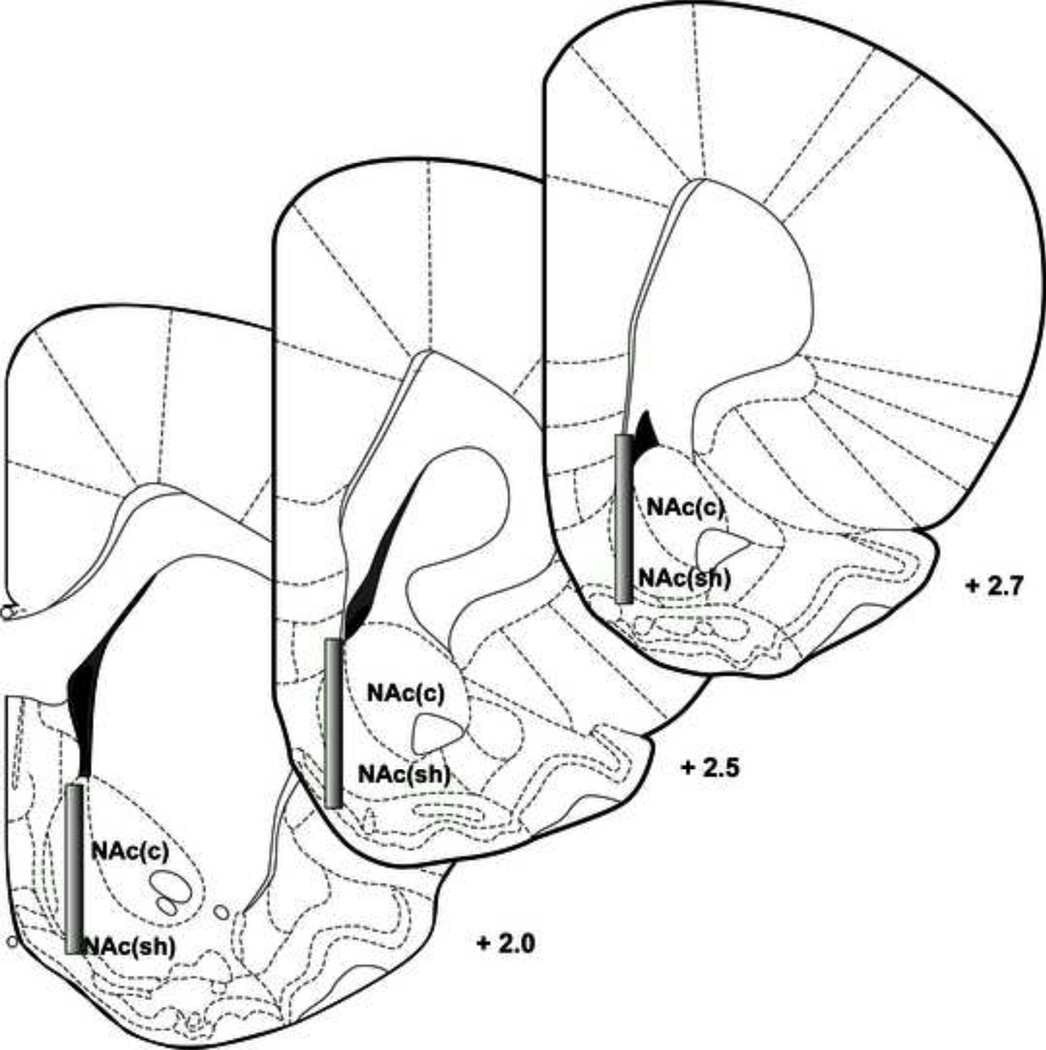
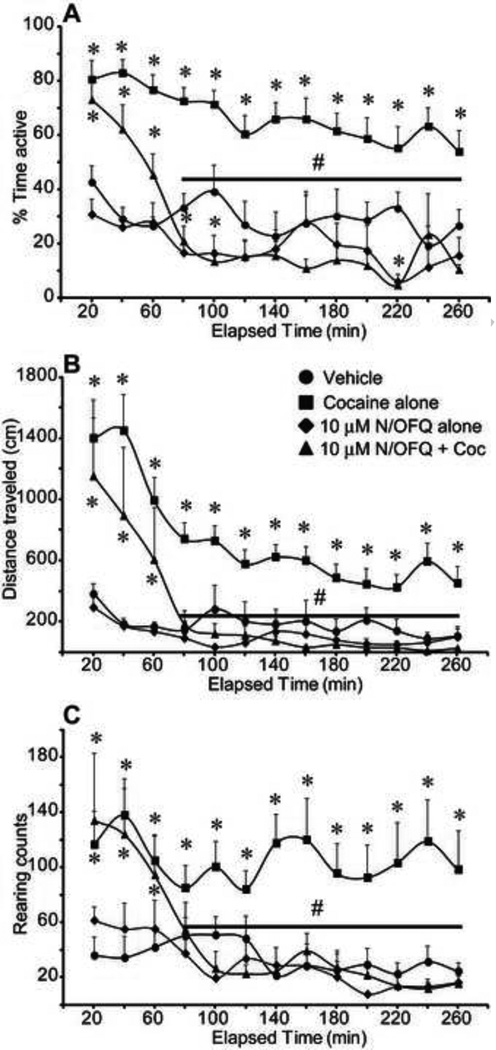
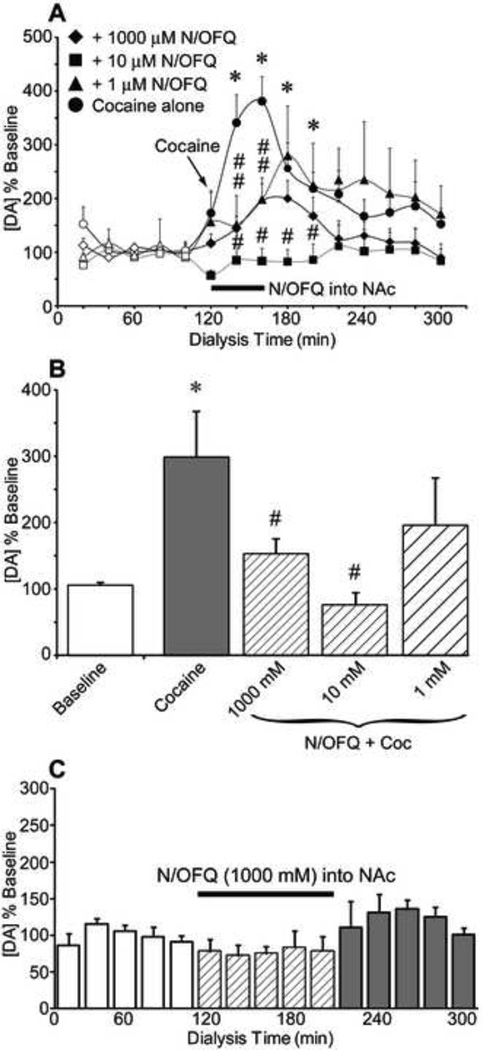
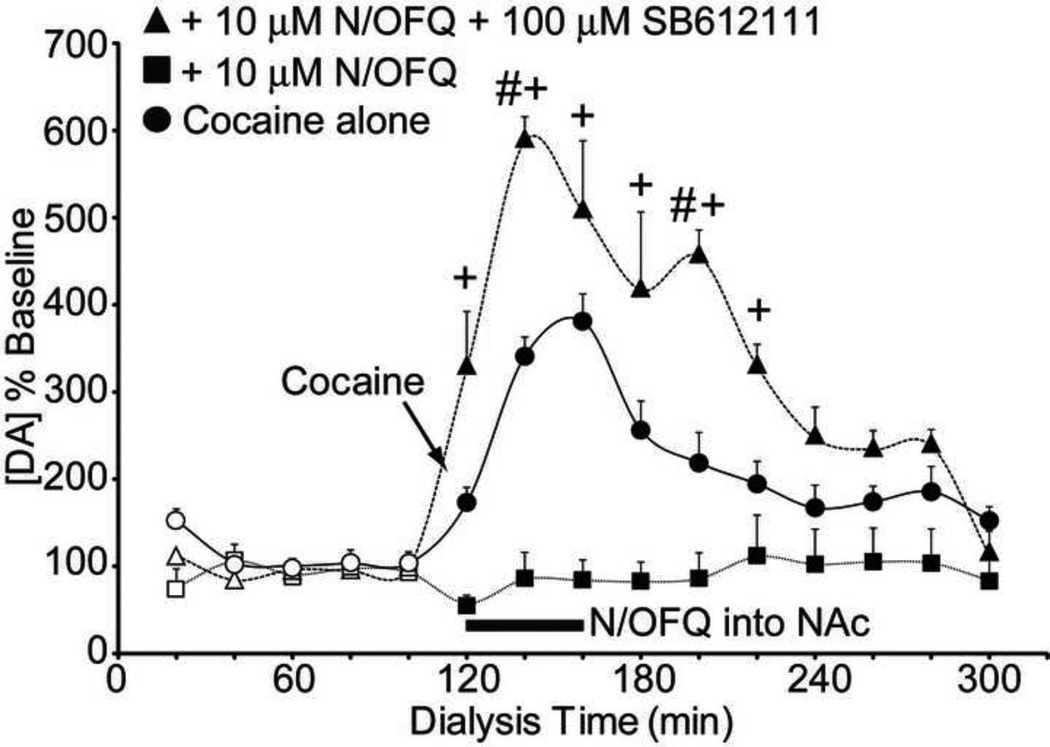
Nociceptin (N/OFQ) has been implicated in a variety of neurological disorders, most notably in reward processes and drug abuse. N/OFQ suppresses extracellular dopamine in the nucleus accumbens (NAc) after intracerebroventricular injection. This study sought to examine the effects of retrodialyzed N/OFQ on the cocaine-induced increase in extracellular dopamine levels in the NAc, as well as locomotor activity, in freely moving rats. 1.0μM, 10μM, and 1mM N/OFQ, in the NAc shell, significantly suppressed the cocaine-induced dopamine increase in the NAc, while N/OFQ alone had no significant effect on dopamine levels. Co-delivery of the selective NOP receptor antagonist SB612111 ([(-)-cis-1-Methyl-7-[[4-(2,6-dichlorophenyl)piperidin-1-yl]methyl]-6,7,8,9-tetrahydro-5H-benzocyclohepten-5-ol] reversed the N/OFQ suppression of cocaine-induced dopamine in the NAc, suggesting that this is an NOP receptor-mediated effect. Using a novel system to assess locomotion, we measured various motor activities of the animals with simultaneous microdialysis from the home cage. Cocaine produced an expected increase in total activity, including horizontal movement and rearing behavior. Retrodialysis of N/OFQ with cocaine administration affected all motor activities, initially showing no effect on behavior, but over time inhibiting cocaine-induced motor behaviors. These results suggest that N/OFQ can act directly in the NAc shell to block cocaine-induced increases in extracellular dopamine levels. Extracellular dopamine and locomotor activity can be dissociated within the NAc and may reflect motor output differences in shell versus core regions of the NAc. These studies confirm the widespread involvement of NOP receptors in drug addiction and further validate the utility of an NOP receptor agonist as a medication for treatment of drug addiction.
孤啡肽(N/OFQ)与多种神经紊乱相关,尤其是在奖赏过程和药物滥用方面。孤啡肽经脑室注射后抑制伏隔核(NAc)中的细胞外多巴胺释放。本研究旨在探讨鞘内逆行给予孤啡肽对可卡因诱导的 NAc 细胞外多巴胺水平升高的影响,以及自由活动大鼠的运动活动。1.0μM、10μM 和 1mM 孤啡肽在 NAc 壳内显著抑制了可卡因诱导的 NAc 中多巴胺的增加,而孤啡肽本身对多巴胺水平没有显著影响。选择性 NOP 受体拮抗剂 SB612111([(-)-顺-1-甲基-7-[[4-(2,6-二氯苯基)哌啶-1-基]甲基]-6,7,8,9-四氢-5H-苯并环庚烯-5-醇])的共传递逆转了 N/OFQ 对 NAc 中可卡因诱导的多巴胺的抑制作用,表明这是一种 NOP 受体介导的效应。使用一种新的系统评估运动,我们通过来自家笼的微透析同时测量动物的各种运动活动。可卡因产生了预期的总活动增加,包括水平运动和竖立行为。可卡因给药时鞘内逆行给予孤啡肽会影响所有运动活动,最初对行为没有影响,但随着时间的推移,会抑制可卡因诱导的运动行为。这些结果表明,孤啡肽可以直接在 NAc 壳内发挥作用,阻断可卡因诱导的细胞外多巴胺水平升高。NAc 中的细胞外多巴胺和运动活动可以分离,可能反映 NAc 壳区和核区的运动输出差异。这些研究证实了 NOP 受体在药物成瘾中的广泛参与,并进一步验证了 NOP 受体激动剂作为治疗药物成瘾药物的效用。