Morton and Gloria Shulman Movement Disorders Centre and Edmond J. Safra Program in Parkinson's Disease, Toronto Western Hospital, Toronto, Ontario, Canada.
Ann Neurol. 2013 Feb;73(2):155-69. doi: 10.1002/ana.23746. Epub 2012 Dec 7.
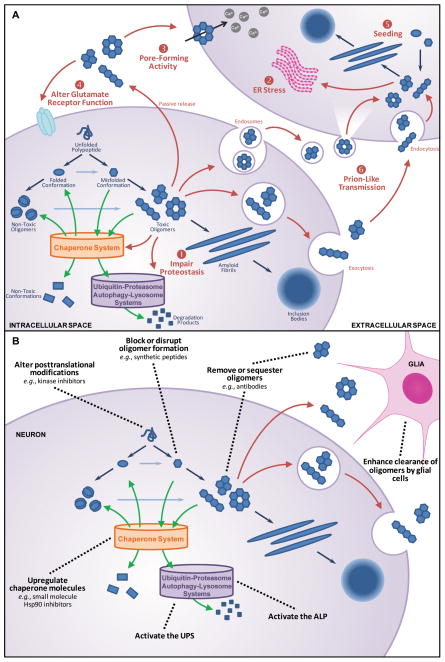
Protein aggregation within the central nervous system has been recognized as a defining feature of neurodegenerative diseases since the early 20th century. Since that time, there has been a growing list of neurodegenerative disorders, including Parkinson disease, which are characterized by inclusions of specific pathogenic proteins. This has led to the long-held dogma that these characteristic protein inclusions, which are composed of large insoluble fibrillar protein aggregates and visible by light microscopy, are responsible for cell death in these diseases. However, the correlation between protein inclusion formation and cytotoxicity is inconsistent, suggesting that another form of the pathogenic proteins may be contributing to neurodegeneration. There is emerging evidence implicating soluble oligomers, smaller protein aggregates not detectable by conventional microscopy, as potential culprits in the pathogenesis of neurodegenerative diseases. The protein α-synuclein is well recognized to contribute to the pathogenesis of Parkinson disease and is the major component of Lewy bodies and Lewy neurites. However, α-synuclein also forms oligomeric species, with certain conformations being toxic to cells. The mechanisms by which these α-synuclein oligomers cause cell death are being actively investigated, as they may provide new strategies for diagnosis and treatment of Parkinson disease and related disorders. Here we review the possible role of α-synuclein oligomers in cell death in Parkinson disease and discuss the potential clinical implications.
自 20 世纪初以来,蛋白质在中枢神经系统中的聚集已被认为是神经退行性疾病的一个特征。从那时起,越来越多的神经退行性疾病被发现,包括帕金森病,其特征是存在特定的致病性蛋白包涵体。这导致了一个长期以来的观点,即这些特征性的蛋白包涵体,由大的不溶性纤维状蛋白聚集体组成,在光镜下可见,是这些疾病中细胞死亡的原因。然而,蛋白包涵体形成与细胞毒性之间的相关性并不一致,这表明致病性蛋白的另一种形式可能对神经退行性变起作用。越来越多的证据表明,可溶性寡聚体,即常规显微镜无法检测到的较小的蛋白聚集体,可能是神经退行性疾病发病机制中的潜在罪魁祸首。α-突触核蛋白被认为是帕金森病发病机制的重要组成部分,是路易体和路易神经突的主要成分。然而,α-突触核蛋白也形成寡聚体,某些构象对细胞有毒性。这些α-突触核蛋白寡聚体导致细胞死亡的机制正在被积极研究,因为它们可能为帕金森病和相关疾病的诊断和治疗提供新的策略。本文综述了α-突触核蛋白寡聚体在帕金森病细胞死亡中的可能作用,并讨论了其潜在的临床意义。