Wagle Naveed, Nghiemphu Leia, Lai Albert, Pope Whitney, Mischel Paul S, Cloughesy Timothy
Department of Neurology, David Geffen School of Medicine at UCLA, Los Angeles, California;
Pharmgenomics Pers Med. 2010;3:79-85. doi: 10.2147/pgpm.s7940. Epub 2010 Jun 9.
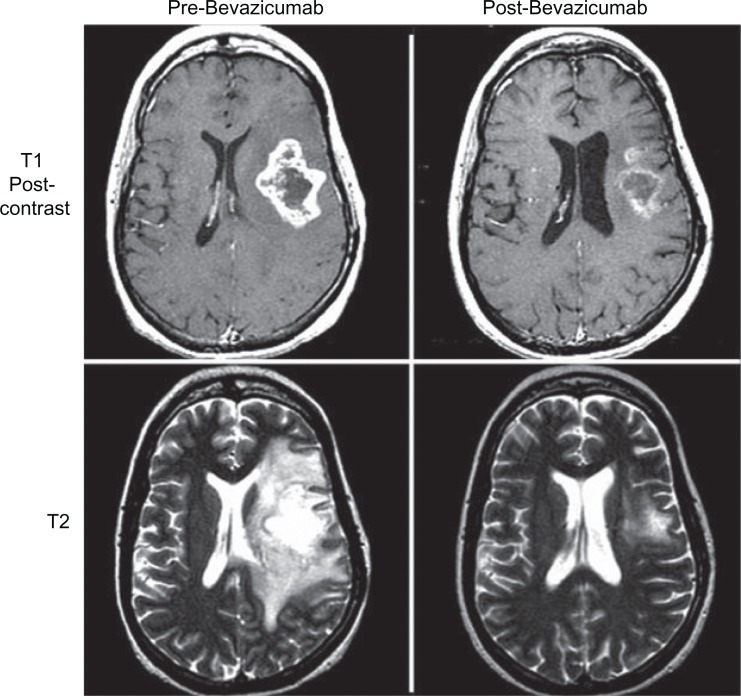
Glioblastoma is the most common primary brain tumor with a relatively poor prognosis. This article reviews the current standard therapy and discusses new developments in treatment of this disease. Surgical resection followed by radiation and chemotherapy has proven to be the most effective initial therapy. Recent advancement in molecular targeted therapies has led to the Food and Drug Administration (FDA) approval of bevacizumab in the setting of recurrent glioblastoma. The molecular pathways of glioblastoma growth are highlighted in this review. While numerous molecular targets are currently being intensely investigated, vascular endothelial growth factor (VEGF) receptor targeted therapy has been the only one to have shown clinical effect. The role of bevacizumab in this context provides a dynamic breakthrough in cancer therapy. Clinical trials have demonstrated significantly increased overall survival and six month progression free survival (PFS) in recurrent glioblastoma treated with bevacizumab alone or in combination with irinotecan. The use of this agent has also dramatically changed the imaging characteristics of glioblastoma. The anti-angiogenesis effects of bevacizumab have complicated the criterion for determining tumor growth. This may lead to redefinition of progressive disease based on non-invasive monitoring.
胶质母细胞瘤是最常见的原发性脑肿瘤,预后相对较差。本文回顾了当前的标准治疗方法,并讨论了该疾病治疗的新进展。手术切除后进行放疗和化疗已被证明是最有效的初始治疗方法。分子靶向治疗的最新进展已导致美国食品药品监督管理局(FDA)批准贝伐单抗用于复发性胶质母细胞瘤的治疗。本综述强调了胶质母细胞瘤生长的分子途径。虽然目前正在对众多分子靶点进行深入研究,但血管内皮生长因子(VEGF)受体靶向治疗是唯一已显示出临床效果的治疗方法。贝伐单抗在这方面的作用为癌症治疗带来了动态突破。临床试验表明,单独使用贝伐单抗或与伊立替康联合使用治疗复发性胶质母细胞瘤时,总生存期和六个月无进展生存期(PFS)显著提高。该药物的使用也极大地改变了胶质母细胞瘤的影像学特征。贝伐单抗的抗血管生成作用使确定肿瘤生长的标准变得复杂。这可能导致基于非侵入性监测对疾病进展进行重新定义。