The Sichuan Provincial Key Laboratory for Human Disease Gene Study, Sichuan Academy of Medical Sciences & Sichuan Provincial People's Hospital, No.32, Western 2nd Section, Chengdu, Sichuan, P. R. China.
PLoS One. 2012;7(11):e50579. doi: 10.1371/journal.pone.0050579. Epub 2012 Nov 30.
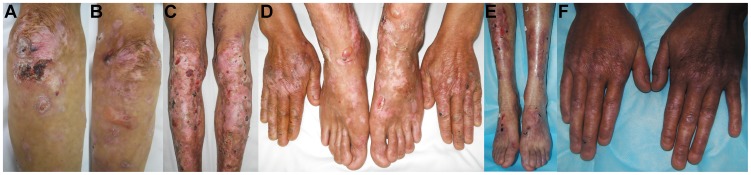
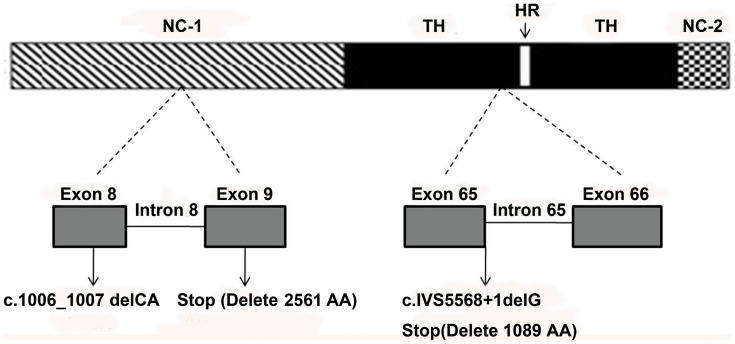
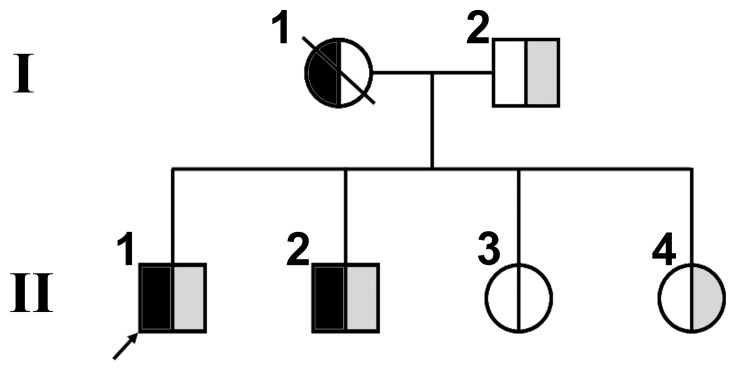
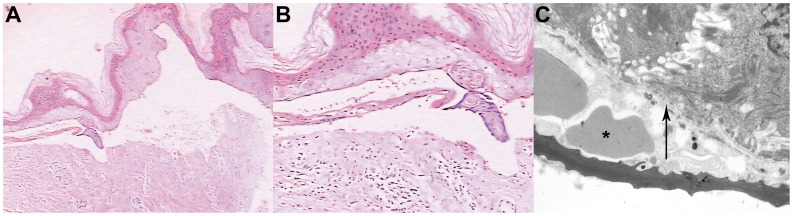
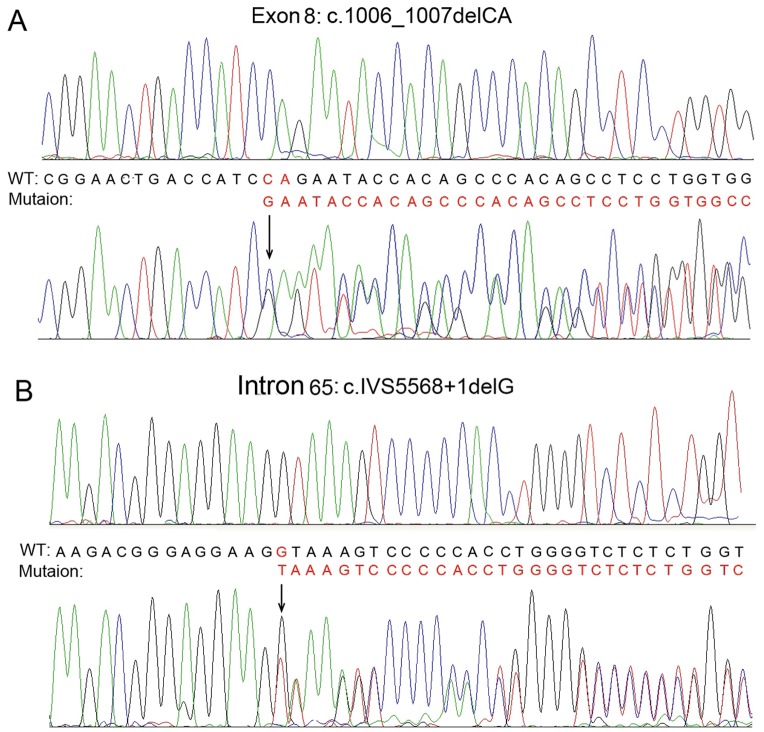
Dystrophic epidermolysis bullosa is an inherited bullous dermatosis caused by the COL7A1 gene mutation in autosomal dominant or recessive mode. COL7A1 gene encodes type VII collagen - the main component of the anchoring fibrils at the dermal-epidermal junction. Besides the 730 mutations reported, we identified two novel COL7A1 gene mutations in a Chinese family, which caused recessive dystrophic epidermolysis bullosa (RDEB). The diagnosis was established histopathologically and ultrastructurally. After genomic DNA extraction from the peripheral blood sample of all subjects (5 pedigree members and 136 unrelated control individuals), COL7A1 gene screening was performed by polymerase chain reaction amplification and direct DNA sequencing of the whole coding exons and flanking intronic regions. Genetic analysis of the COL7A1 gene in affected individuals revealed compound heterozygotes with identical novel mutations. The maternal mutation is a 2-bp deletion at exon 8 (c.1006_1007delCA), leading to a subsequent reading frame-shift and producing a premature termination codon located 48 amino acids downstream in exon 9 (p.Q336EfsX48), consequently resulting in the truncation of 2561 amino acids downstream. This was only present in two affected brothers, but not in the other unaffected family members. The paternal mutation is a 1-bp deletion occurring at the first base of intron 65 (c.IVS5568+1delG) that deductively changes the strongly conserved GT dinucleotide at the 5' donor splice site, results in subsequent reading-through into intron 65, and creates a stop codon immediately following the amino acids encoded by exon 65 (GTAA→TAA). This is predicted to produce a truncated protein lacking of 1089 C-terminal amino acids downstream. The latter mutation was found in all family members except one of the two unaffected sisters. Both mutations were observed concurrently only in the two affected brothers. Neither mutation was discovered in 136 unrelated Chinese control individuals. This study reveals novel disease-causing mutations in the COL7A1 gene.
营养不良型大疱性表皮松解症是一种遗传性大疱性皮肤病,由常染色体显性或隐性模式的 COL7A1 基因突变引起。COL7A1 基因编码 VII 型胶原 - 真皮-表皮连接的锚定纤维的主要成分。除了报道的 730 种突变外,我们还在一个中国家庭中发现了两种新的 COL7A1 基因突变,导致隐性营养不良型大疱性表皮松解症(RDEB)。通过组织病理学和超微结构确立了诊断。从所有受试者(5 个家系成员和 136 个无关对照个体)的外周血样中提取基因组 DNA 后,通过聚合酶链反应扩增和直接 DNA 测序对整个编码外显子和侧翼内含子区域进行 COL7A1 基因筛选。对受影响个体的 COL7A1 基因进行遗传分析显示,复合杂合子具有相同的新突变。母系突变是外显子 8 (c.1006_1007delCA)的 2 个碱基缺失,导致随后的阅读框移位,并在外显子 9 (p.Q336EfsX48)产生 48 个氨基酸下游的提前终止密码子,从而导致下游 2561 个氨基酸的截断。这种情况仅存在于两个受影响的兄弟中,但不存在于其他未受影响的家庭成员中。父系突变是发生在 65 号内含子第一个碱基的 1 个碱基缺失(c.IVS5568+1delG),推断该突变在 5'供体位点剪接强烈保守的 GT 二核苷酸,导致随后读入内含子 65 并在由外显子 65 编码的氨基酸之后立即产生终止密码子(GTAA→TAA)。这预计会产生一个缺少下游 1089 个 C 末端氨基酸的截断蛋白。除了两个未受影响的姐妹中的一个外,该突变在所有家庭成员中均被发现。仅在两个受影响的兄弟中同时观察到这两种突变。在 136 个无关的中国对照个体中未发现这两种突变。本研究揭示了 COL7A1 基因中的新致病突变。