Division of Vascular Surgery, Department of Surgery, Stanford University School of Medicine, Stanford, California, United States of America.
PLoS One. 2012;7(12):e49642. doi: 10.1371/journal.pone.0049642. Epub 2012 Dec 3.
Despite the importance of the renin-angiotensin (Ang) system in abdominal aortic aneurysm (AAA) pathogenesis, strategies targeting this system to prevent clinical aneurysm progression remain controversial and unproven. We compared the relative efficacy of two Ang II type 1 receptor blockers, telmisartan and irbesartan, in limiting experimental AAAs in distinct mouse models of aneurysm disease.
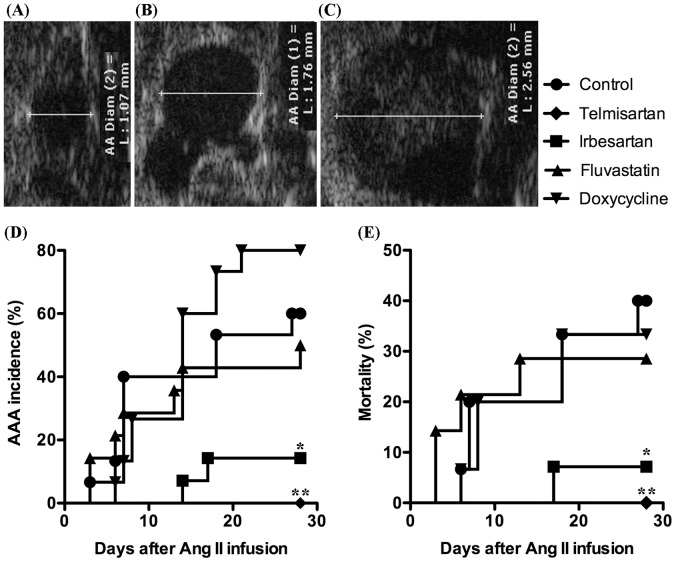
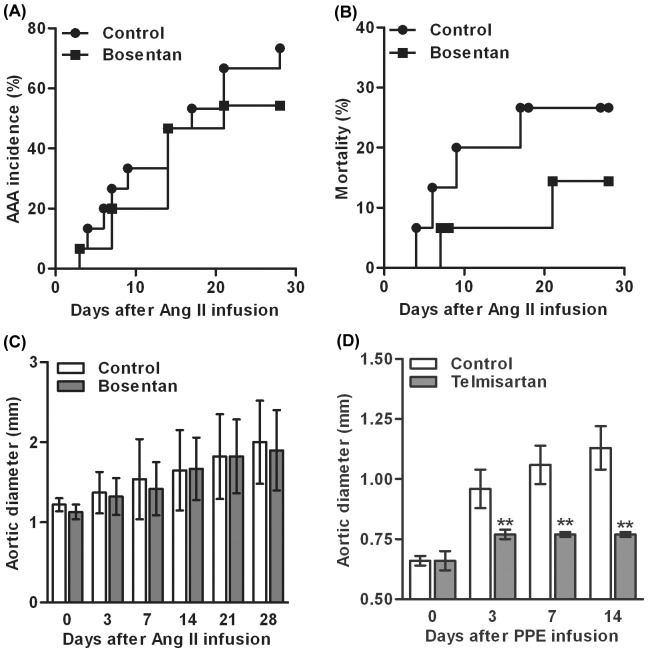
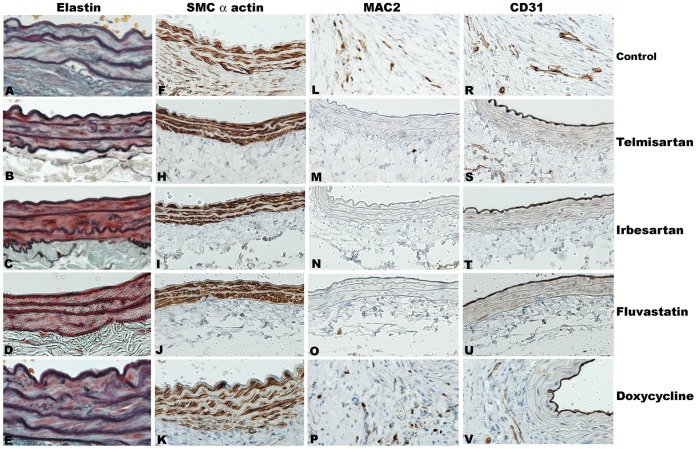
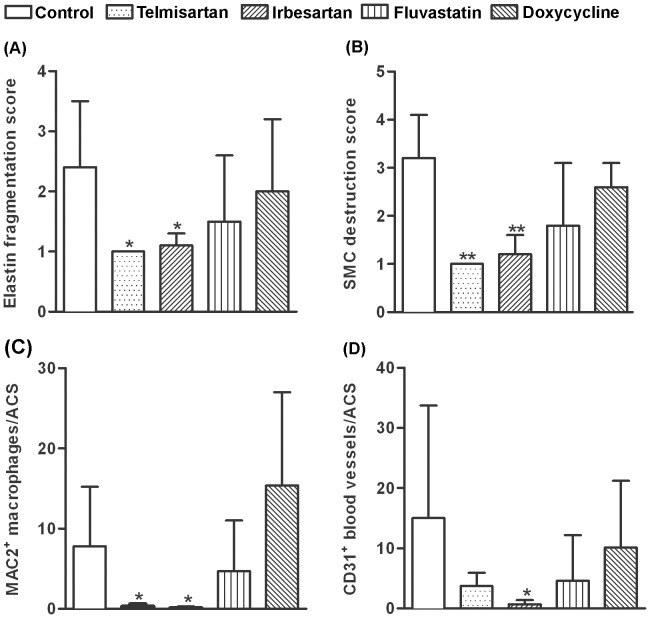
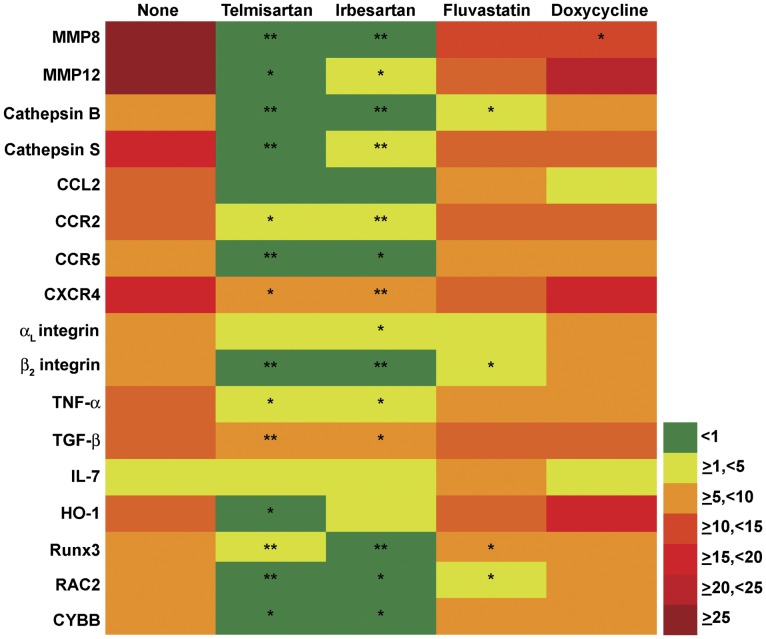
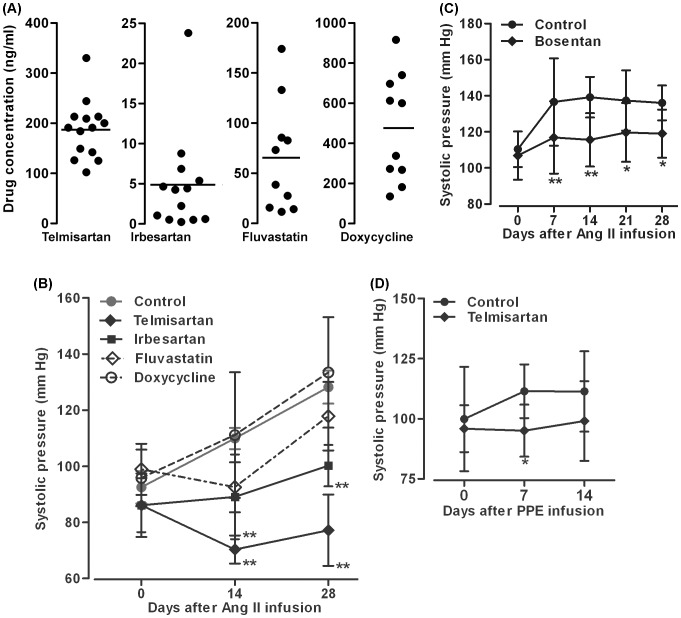
METHODOLOGY/PRINCIPAL FINDINGS: AAAs were induced using either 1) Ang II subcutaneous infusion (1000 ng/kg/min) for 28 days in male ApoE(-/-) mice, or 2) transient intra-aortic porcine pancreatic elastase infusion in male C57BL/6 mice. One week prior to AAA creation, mice started to daily receive irbesartan (50 mg/kg), telmisartan (10 mg/kg), fluvastatin (40 mg/kg), bosentan (100 mg/kg), doxycycline (100 mg/kg) or vehicle alone. Efficacy was determined via serial in vivo aortic diameter measurements, histopathology and gene expression analysis at sacrifice. Aortic aneurysms developed in 67% of Ang II-infused ApoE(-/-) mice fed with standard chow and water alone (n = 15), and 40% died of rupture. Strikingly, no telmisartan-treated mouse developed an AAA (n = 14). Both telmisartan and irbesartan limited aneurysm enlargement, medial elastolysis, smooth muscle attenuation, macrophage infiltration, adventitial neocapillary formation, and the expression of proteinases and proinflammatory mediators. Doxycycline, fluvastatin and bosentan did not influence aneurysm progression. Telmisartan was also highly effective in intra-aortic porcine pancreatic elastase infusion-induced AAAs, a second AAA model that did not require exogenous Ang II infusion.
CONCLUSION/SIGNIFICANCE: Telmisartan suppresses experimental aneurysms in a model-independent manner and may prove valuable in limiting clinical disease progression.
尽管肾素-血管紧张素(Ang)系统在腹主动脉瘤(AAA)发病机制中具有重要意义,但针对该系统预防临床动脉瘤进展的策略仍存在争议且未经证实。我们比较了两种血管紧张素 II 型 1 型受体阻滞剂,替米沙坦和厄贝沙坦,在限制不同的腹主动脉瘤疾病小鼠模型中实验性 AAA 的相对疗效。
方法/主要发现:使用以下方法诱导 AAA:1)在雄性 ApoE(-/-)小鼠中皮下输注 Ang II(1000ng/kg/min)28 天,或 2)在雄性 C57BL/6 小鼠中短暂经主动脉内注入猪胰腺弹性蛋白酶。在创建 AAA 前一周,小鼠开始每天接受厄贝沙坦(50mg/kg)、替米沙坦(10mg/kg)、氟伐他汀(40mg/kg)、波生坦(100mg/kg)、强力霉素(100mg/kg)或单独载体治疗。通过在体主动脉直径测量、组织病理学和牺牲时的基因表达分析来确定疗效。在仅用标准饲料和水喂养的 Ang II 输注 ApoE(-/-)小鼠中,67%发展为主动脉瘤(n=15),且 40%死于破裂。引人注目的是,没有接受替米沙坦治疗的小鼠发生 AAA(n=14)。替米沙坦和厄贝沙坦均限制了动脉瘤的扩大、中膜弹性溶解、平滑肌衰减、巨噬细胞浸润、外膜新毛细血管形成以及蛋白酶和促炎介质的表达。强力霉素、氟伐他汀和波生坦均未影响动脉瘤的进展。替米沙坦在不需要外源性 Ang II 输注的猪胰腺弹性蛋白酶输注诱导的 AAA 中也具有高度疗效,这是第二种 AAA 模型。
结论/意义:替米沙坦以独立于模型的方式抑制实验性动脉瘤,可能对限制临床疾病进展具有重要价值。