Psychology Service, VA San Diego Healthcare System, San Diego, California 92161, USA.
Annu Rev Clin Psychol. 2013;9:703-21. doi: 10.1146/annurev-clinpsy-050212-185610. Epub 2012 Dec 10.
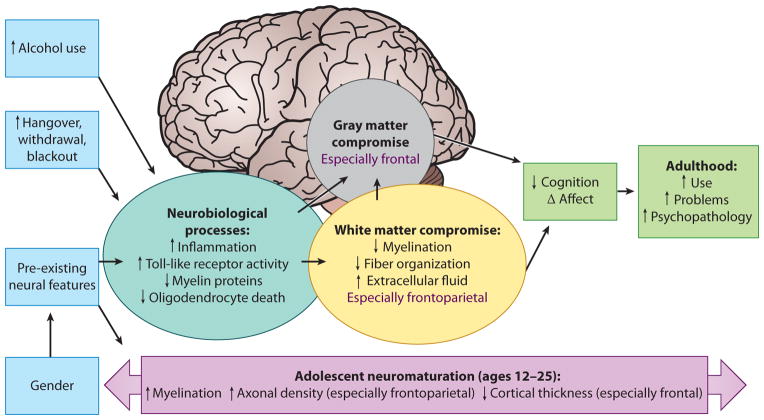
This review examines neuroimaging and neurocognitive findings on alcohol-related toxicity in adolescents. Teens who meet criteria for alcohol use disorders, as well as those who engage in subdiagnostic binge drinking behaviors, often show poorer neurocognitive performance, alterations in gray and white matter brain structure, and discrepant functional brain activation patterns when compared to nonusing and demographically matched controls. Abnormalities are also observed in teens with a family history of alcoholism, and such differences in neuromaturation may leave youths at increased risk for the development of an alcohol use disorder or increased substance use severity. More prospective investigations are needed, and future work should focus on disentangling preexisting differences from dose-dependent effects of alcohol on neurodevelopment. Intervention strategies that utilize neuroimaging findings (e.g., identified weaknesses in particular neural substrates and behavioral correlates) may be helpful in both prevention and intervention campaigns for teens both pre- and postinitiation of alcohol use.
这篇综述考察了与青少年酒精中毒相关的神经影像学和神经认知研究结果。符合酒精使用障碍标准的青少年,以及那些有亚临床 binge drinking 行为的青少年,与非饮酒者和人口统计学匹配的对照组相比,往往表现出较差的神经认知表现、灰质和白质脑结构的改变,以及功能脑激活模式的差异。在有酗酒家族史的青少年中也观察到了异常,这种神经成熟的差异可能使青少年更容易患上酒精使用障碍或增加物质使用的严重程度。需要进行更多的前瞻性研究,未来的工作应侧重于厘清神经发育过程中,酒精对大脑的影响是由剂量决定的,还是由个体差异决定的。利用神经影像学发现的干预策略(例如,确定特定神经基质和行为相关性的弱点)可能有助于在青少年开始饮酒之前和之后的预防和干预活动中都有所帮助。