Department of Biochemistry and Molecular Medicine, UC Davis, Sacramento, CA 95817, USA ; MIND Institute, UC Davis Medical Center, Sacramento, CA 95817, USA.
Department of Biochemistry and Molecular Medicine, UC Davis, Sacramento, CA 95817, USA.
Genome Med. 2012 Dec 21;4(12):100. doi: 10.1186/gm401. eCollection 2012.
Population screening for FMR1 mutations has been a topic of considerable discussion since the FMR1 gene was identified in 1991. Advances in understanding the molecular basis of fragile X syndrome (FXS) and in genetic testing methods have led to new, less expensive methodology to use for large screening endeavors. A core criterion for newborn screening is an accurate understanding of the public health burden of a disease, considering both disease severity and prevalence rate. This article addresses this need by reporting prevalence rates observed in a pilot newborn screening study for FXS in the US.
Blood spot screening of 14,207 newborns (7,312 males and 6,895 females) was conducted in three birthing hospitals across the United States beginning in November 2008, using a PCR-based approach.
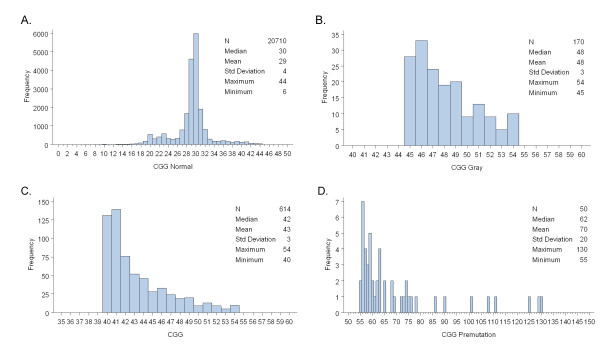
The prevalence of gray zone alleles was 1:66 females and 1:112 males, while the prevalence of a premutation was 1:209 females and 1:430 males. Differences in prevalence rates were observed among the various ethnic groups; specifically higher frequency for gray zone alleles in males was observed in the White group compared to the Hispanic and African-American groups. One full mutation male was identified (>200 CGG repeats).
The presented pilot study shows that newborn screening in fragile X is technically feasible and provides overall prevalence of the premutation and gray zone alleles in the USA, suggesting that the prevalence of the premutation, particularly in males, is higher than has been previously reported.
自 1991 年发现 FMR1 基因以来,人群中 FMR1 突变的筛查一直是一个备受关注的话题。对脆性 X 综合征(FXS)分子基础的深入了解以及遗传检测方法的进步,为大规模筛查工作提供了新的、成本更低的方法。新生儿筛查的核心标准是准确了解疾病的公共卫生负担,既要考虑疾病的严重程度,又要考虑患病率。本文通过报告在美国进行的 FXS 新生儿筛查研究中观察到的患病率,满足了这一需求。
2008 年 11 月开始,在美国三个分娩医院对 14207 名新生儿(7312 名男性和 6895 名女性)进行了血斑筛查,采用基于 PCR 的方法。
灰色区域等位基因的患病率为女性 1:66,男性 1:112,而前突变的患病率为女性 1:209,男性 1:430。不同种族群体之间观察到患病率存在差异;具体来说,白人组男性的灰色区域等位基因频率较高,而西班牙裔和非裔美国人组则较低。发现一名男性存在全突变(>200 个 CGG 重复)。
本研究表明,脆性 X 综合征的新生儿筛查在技术上是可行的,并提供了美国前突变和灰色区域等位基因的总体患病率,表明前突变,特别是男性的患病率高于以往报道。