Laboratoire d'Ethologie Expérimentale et Comparée, Université Paris 13, Sorbonne Paris Cité, 99 avenue J,-B, Clément, 93430, Villetaneuse, France.
Front Zool. 2012 Dec 31;9(1):38. doi: 10.1186/1742-9994-9-38.
Social parasitism is an important selective pressure for social insect species. It is particularly the case for the hosts of dulotic (so called slave-making) ants, which pillage the brood of host colonies to increase the worker force of their own colony. Such raids can have an important impact on the fitness of the host nest. An arms race which can lead to geographic variation in host defenses is thus expected between hosts and parasites. In this study we tested whether the presence of a social parasite (the dulotic ant Myrmoxenus ravouxi) within an ant community correlated with a specific behavioral defense strategy of local host or non-host populations of Temnothorax ants. Social recognition often leads to more or less pronounced agonistic interactions between non-nestmates ants. Here, we monitored agonistic behaviors to assess whether ants discriminate social parasites from other ants. It is now well-known that ants essentially rely on cuticular hydrocarbons to discriminate nestmates from aliens. If host species have evolved a specific recognition mechanism for their parasite, we hypothesize that the differences in behavioral responses would not be fully explained simply by quantitative dissimilarity in cuticular hydrocarbon profiles, but should also involve a qualitative response due to the detection of particular compounds. We scaled the behavioral results according to the quantitative chemical distance between host and parasite colonies to test this hypothesis.
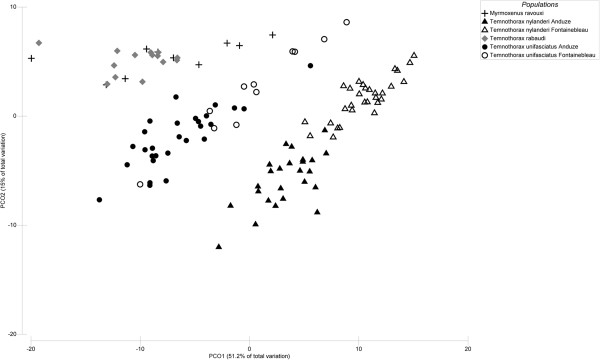
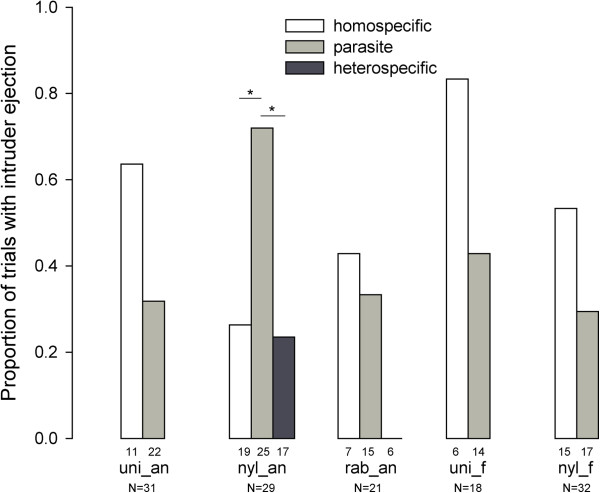
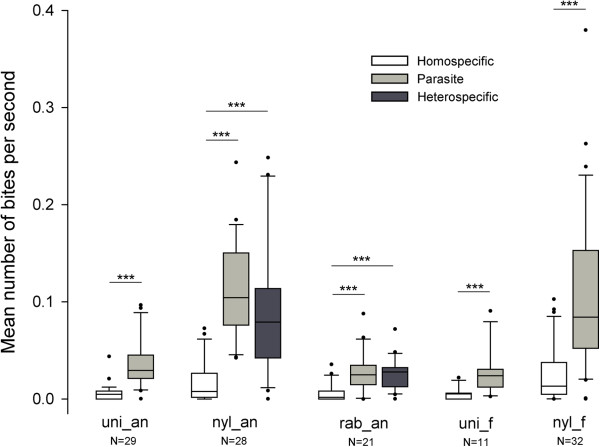
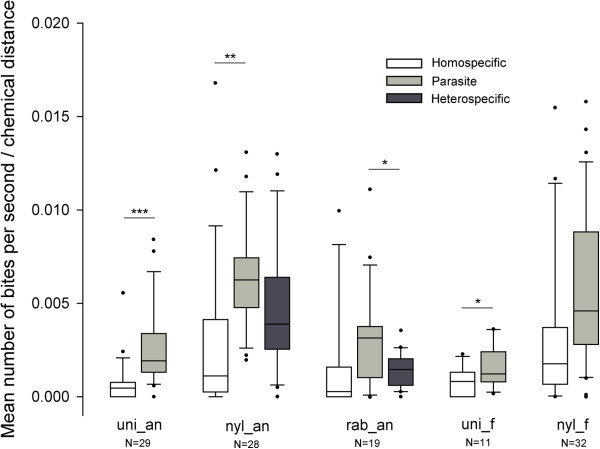
Cuticular hydrocarbon profiles were distinct between species, but host species did not show a clearly higher aggression rate towards the parasite than toward non-parasite intruders, unless the degree of response was scaled by the chemical distance between intruders and recipient colonies. By doing so, we show that workers of the host and of a non-host species in the parasitized site displayed more agonistic behaviors (bites and ejections) towards parasite than toward non-parasite intruders.
We used two different analyses of our behavioral data (standardized with the chemical distance between colonies or not) to test our hypothesis. Standardized data show behavioral differences which could indicate qualitative and specific parasite recognition. We finally stress the importance of considering the whole set of potentially interacting species to understand the coevolution between social parasites and their hosts.
社会寄生是社会性昆虫物种的一个重要选择压力。对于具有奴性(所谓的奴役制造)的蚂蚁的宿主来说尤其如此,它们掠夺宿主群体的幼虫以增加自己群体的工蚁数量。这种袭击可能会对宿主巢穴的适应性产生重要影响。因此,在宿主和寄生虫之间预计会出现导致宿主防御地理变异的军备竞赛。在这项研究中,我们测试了蚂蚁群落中是否存在一种社会寄生虫(奴性蚂蚁 Myrmoxenus ravouxi),这是否与当地宿主或非宿主群体的 Temnothorax 蚂蚁的特定行为防御策略相关。社会识别通常会导致非巢同伴蚂蚁之间或多或少的明显敌对互动。在这里,我们监测了敌对行为,以评估蚂蚁是否能够将社会寄生虫与其他蚂蚁区分开来。现在已经知道,蚂蚁主要依靠表皮碳氢化合物来区分巢同伴和外来者。如果宿主物种已经进化出针对其寄生虫的特定识别机制,我们假设行为反应的差异不仅可以通过表皮碳氢化合物图谱的定量差异来完全解释,还应该涉及由于检测到特定化合物而导致的定性反应。我们根据宿主和寄生虫群体之间的定量化学距离来衡量行为结果,以检验这一假设。
物种之间的表皮碳氢化合物图谱明显不同,但宿主物种对寄生虫的攻击率并没有明显高于对非寄生虫入侵者的攻击率,除非根据入侵者和接受者群体之间的化学距离来调整反应程度。通过这样做,我们表明在被寄生的地点,宿主和非宿主物种的工蚁对寄生虫的攻击行为(叮咬和喷射)比对非寄生虫入侵者的攻击行为更多。
我们使用两种不同的行为数据分析方法(标准化与群体之间的化学距离或不标准化)来检验我们的假设。标准化数据显示了可能指示定性和特定寄生虫识别的行为差异。最后,我们强调了考虑可能相互作用的所有物种的重要性,以理解社会寄生虫与其宿主之间的共同进化。