Translational Cancer Research Group, Instituto de Investigación Biomédica A Coruña (INIBIC), Complexo Hospitalario Universitario A Coruña (CHUAC)-SERGAS, A Coruña, Spain.
PLoS One. 2012;7(12):e52568. doi: 10.1371/journal.pone.0052568. Epub 2012 Dec 20.
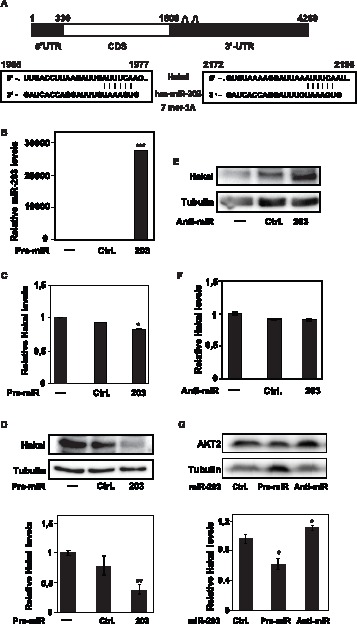
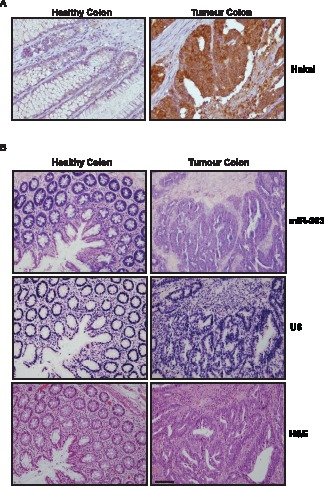
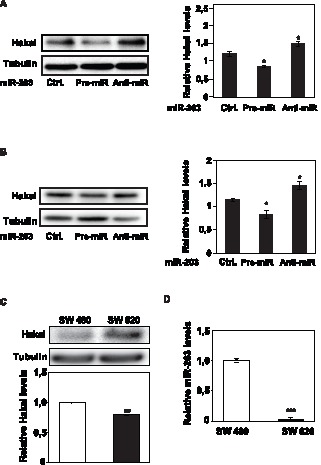
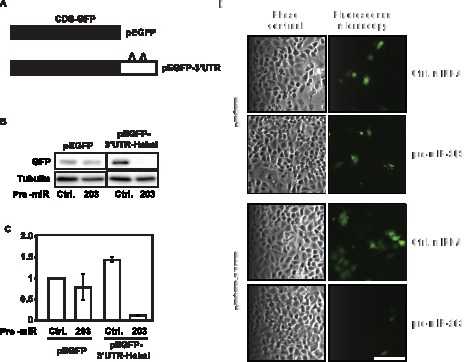
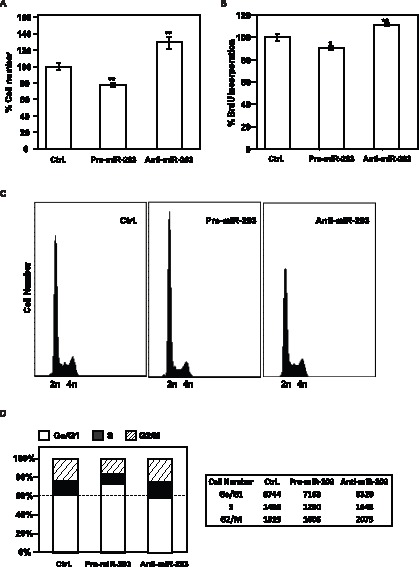
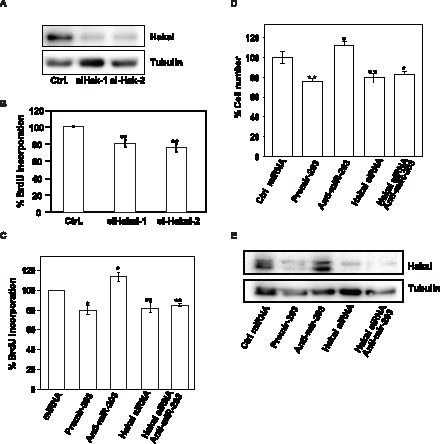
Gene expression is potently regulated through the action of microRNAs (miRNAs). Here, we present evidence of a miRNA regulating Hakai protein. Hakai was discovered as an E3 ubiquitin-ligase that mediates the posttranslational downregulation of E-cadherin, a major component of adherens junctions in epithelial cells and a potent tumour suppressor. Recent data have provided evidence that Hakai affects cell proliferation in an E-cadherin-independent manner, thus revealing a role for Hakai in the early stages of tumour progression. Furthermore, Hakai is highly up-regulated in human colon adenocarcinomas compared to normal tissues. However, the molecular mechanisms that regulate Hakai abundance are unknown. We identified two putative sites of miR-203 interaction on the Hakai mRNA, in its 3'-untranslated region (UTR). In several human carcinoma cell lines tested, overexpression of a miR-203 precursor (Pre-miR-203) reduced Hakai abundance, while inhibiting miR-203 by using an antisense RNA (Anti-miR-203) elevated Hakai levels. The repressive influence of miR-203 on the Hakai 3'-UTR was confirmed using heterologous reporter constructs. In keeping with Hakai's proliferative influence, Anti-miR-203 significantly increased cell number and BrdU incorporation, while Pre-miR-203 reduced these parameters. Importantly, the growth-promoting effects of anti-miR-203 required the presence of Hakai, because downregulation of Hakai by siRNA suppressed its proliferative action. Finally, in situ hybridization showed that miR-203 expression is attenuated in colon tumour tissues compared to normal colon tissues, suggesting that miR-203 could be a potential new prognostic marker and therapeutic target to explore in colon cancer. In conclusion, our findings reveal, for the first time, a post-transcriptional regulator of Hakai expression. Furthermore, by lowering Hakai abundance, miR-203 also reduces Hakai-regulated-cell division.
基因表达可通过 microRNAs(miRNAs)的作用得到强有力的调控。在这里,我们提供了一个 miRNA 调节 Hakai 蛋白的证据。Hakai 最初被发现是一种 E3 泛素连接酶,可介导上皮细胞中黏着连接的主要成分 E-钙黏蛋白的翻译后下调,而 E-钙黏蛋白是一种有效的肿瘤抑制因子。最近的数据提供了证据表明,Hakai 以一种不依赖于 E-钙黏蛋白的方式影响细胞增殖,从而揭示了 Hakai 在肿瘤进展的早期阶段的作用。此外,与正常组织相比,Hakai 在人结肠腺癌中高度上调。然而,调节 Hakai 丰度的分子机制尚不清楚。我们在 Hakai mRNA 的 3'非翻译区(UTR)上鉴定了两个假定的 miR-203 相互作用位点。在测试的几种人癌细胞系中,miR-203 前体(Pre-miR-203)的过表达降低了 Hakai 的丰度,而使用反义 RNA(Anti-miR-203)抑制 miR-203 则升高了 Hakai 水平。miR-203 对 Hakai 3'UTR 的抑制作用通过异源报告基因构建体得到了证实。与 Hakai 的增殖影响一致,Anti-miR-203 显著增加了细胞数量和 BrdU 掺入,而 Pre-miR-203 降低了这些参数。重要的是,anti-miR-203 的促生长作用需要 Hakai 的存在,因为 siRNA 下调 Hakai 抑制了其增殖作用。最后,原位杂交显示 miR-203 在结肠肿瘤组织中的表达较正常结肠组织减弱,提示 miR-203 可能是结肠癌中潜在的新预后标志物和治疗靶点。总之,我们的研究结果首次揭示了 Hakai 表达的转录后调节因子。此外,通过降低 Hakai 的丰度,miR-203 还减少了 Hakai 调节的细胞分裂。