Department of Ophthalmology and Visual Sciences, Carver College of Medicine, University of Iowa, Iowa City, IA 52242, USA.
Curr Eye Res. 2013 Feb;38(2):310-5. doi: 10.3109/02713683.2012.754047. Epub 2013 Jan 3.
Copy number variations (duplications) of TANK binding kinase 1 (TBK1) have been associated with normal tension glaucoma (NTG), a common cause of blindness worldwide. Mutations in other genes involved in autophagy (TLR4 and OPTN) have been associated with NTG. Here we report searching for additional proteins involved in autophagy that may also have roles in NTG.
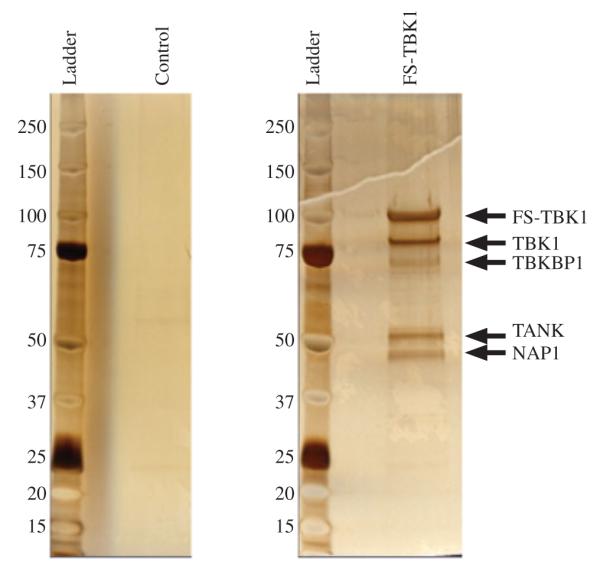
HEK-293T cells were transfected to produce synthetic TBK1 protein with FLAG and S tags. Proteins that associate with TBK1 were isolated from HEK-293T lysates using tandem affinity purification (TAP) and polyacrylamide gel electrophoresis (PAGE). Isolated proteins were identified with mass spectrometry. A cohort of 148 NTG patients and 77 controls from Iowa were tested for glaucoma-causing mutations in genes that encode identified proteins that interact with TBK1 using high resolution melt (HRM) analysis and DNA sequencing.
TAP studies show that three proteins expressed in HEK-293T cells (NAP1, TANK and TBKBP1) interact with TBK1. Testing cohorts of NTG and normal controls for disease-causing mutations in TANK, identified a total of nine unique variants including three non-synonymous changes, one synonymous changes and five intronic changes. When analyzed alone or as a group, the non-synonymous TBK1 coding sequence changes were not associated with either NTG or primary open angle glaucoma.
TAP showed that NAP1, TANK and TBKBP1 interact with TBK1 and are good candidates for contributing to NTG. A mutation screen of TANK detected three non-synonymous variants. Although, it remains possible that one or more of these TANK mutations may have a role in NTG, the data in this report do not provide statistical support for an association between TANK variants and NTG.
TANK 结合激酶 1(TBK1)的拷贝数变异(重复)与正常眼压性青光眼(NTG)有关,NTG 是全球范围内导致失明的常见原因。其他参与自噬的基因突变(TLR4 和 OPTN)也与 NTG 有关。在这里,我们报告了寻找可能在 NTG 中也具有作用的其他参与自噬的蛋白。
用 FLAG 和 S 标签转染 HEK-293T 细胞以产生合成的 TBK1 蛋白。使用串联亲和纯化(TAP)和聚丙烯酰胺凝胶电泳(PAGE)从 HEK-293T 裂解物中分离与 TBK1 结合的蛋白。使用质谱鉴定分离的蛋白。使用高分辨率熔解(HRM)分析和 DNA 测序,对来自爱荷华州的 148 名 NTG 患者和 77 名对照者进行编码与 TBK1 相互作用的鉴定蛋白的致盲基因突变检测。
TAP 研究表明,在 HEK-293T 细胞中表达的三种蛋白(NAP1、TANK 和 TBKBP1)与 TBK1 相互作用。在 NTG 和正常对照者中进行 TANK 疾病相关突变检测,共发现九个独特的变异,包括三个非同义突变、一个同义突变和五个内含子突变。单独或作为一组分析时,TBK1 编码序列的非同义改变与 NTG 或原发性开角型青光眼均无关。
TAP 显示 NAP1、TANK 和 TBKBP1 与 TBK1 相互作用,是导致 NTG 的良好候选者。TANK 的突变筛选检测到三个非同义变体。尽管这些 TANK 突变之一或多个可能在 NTG 中发挥作用,但本报告中的数据并未提供 TANK 变体与 NTG 之间关联的统计支持。