Centers for Disease Control and Prevention, Atlanta, Georgia 30341, USA.
JAMA. 2012 Dec 19;308(23):2489-96. doi: 10.1001/jama.2012.67929.
The frequency of remission of type 2 diabetes achievable with lifestyle intervention is unclear.
To examine the association of a long-term intensive weight-loss intervention with the frequency of remission from type 2 diabetes to prediabetes or normoglycemia.
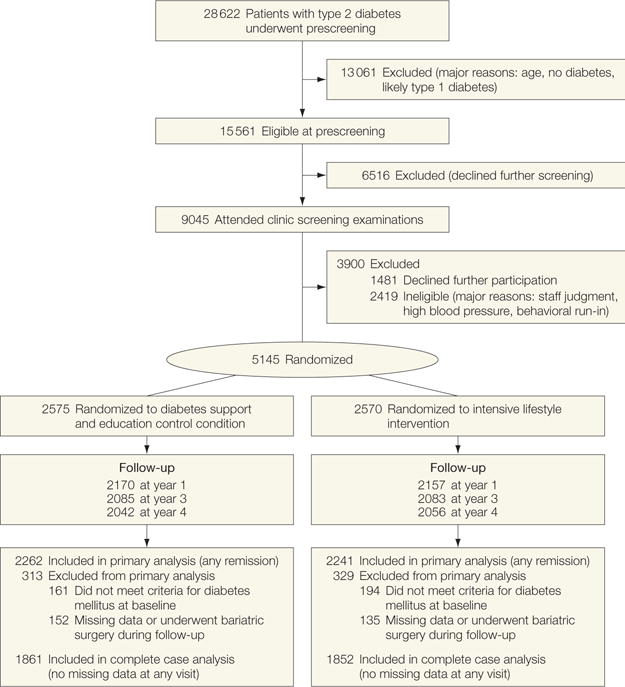
DESIGN, SETTING, AND PARTICIPANTS: Ancillary observational analysis of a 4-year randomized controlled trial (baseline visit, August 2001-April 2004; last follow-up, April 2008) comparing an intensive lifestyle intervention (ILI) with a diabetes support and education control condition (DSE) among 4503 US adults with body mass index of 25 or higher and type 2 diabetes.
Participants were randomly assigned to receive the ILI, which included weekly group and individual counseling in the first 6 months followed by 3 sessions per month for the second 6 months and twice-monthly contact and regular refresher group series and campaigns in years 2 to 4 (n=2241) or the DSE, which was an offer of 3 group sessions per year on diet, physical activity, and social support (n=2262).
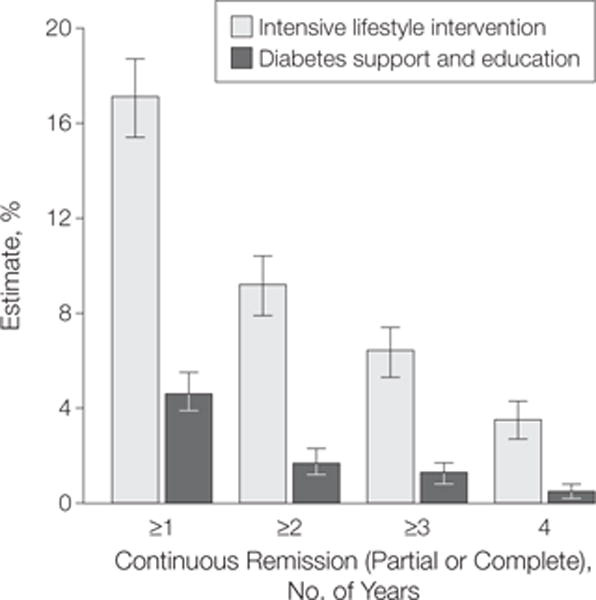
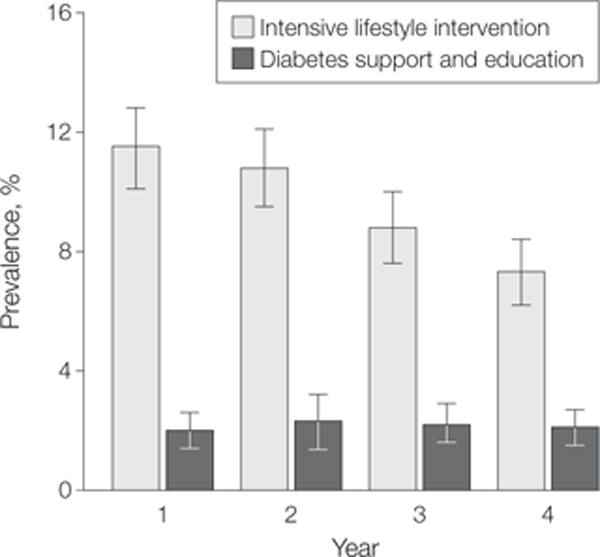
Partial or complete remission of diabetes, defined as transition from meeting diabetes criteria to a prediabetes or nondiabetic level of glycemia (fasting plasma glucose <126 mg/dL and hemoglobin A1c <6.5% with no antihyperglycemic medication). RESULTS Intensive lifestyle intervention participants lost significantly more weight than DSE participants at year 1 (net difference, -7.9%; 95% CI, -8.3% to -7.6%) and at year 4 (-3.9%; 95% CI, -4.4% to -3.5%) and had greater fitness increases at year 1 (net difference, 15.4%; 95% CI, 13.7%-17.0%) and at year 4 (6.4%; 95% CI, 4.7%-8.1%) (P < .001 for each). The ILI group was significantly more likely to experience any remission (partial or complete), with prevalences of 11.5% (95% CI, 10.1%-12.8%) during the first year and 7.3% (95% CI, 6.2%-8.4%) at year 4, compared with 2.0% for the DSE group at both time points (95% CIs, 1.4%-2.6% at year 1 and 1.5%-2.7% at year 4) (P < .001 for each). Among ILI participants, 9.2% (95% CI, 7.9%-10.4%), 6.4% (95% CI, 5.3%-7.4%), and 3.5% (95% CI, 2.7%-4.3%) had continuous, sustained remission for at least 2, at least 3, and 4 years, respectively, compared with less than 2% of DSE participants (1.7% [95% CI, 1.2%-2.3%] for at least 2 years; 1.3% [95% CI, 0.8%-1.7%] for at least 3 years; and 0.5% [95% CI, 0.2%-0.8%] for 4 years).
In these exploratory analyses of overweight adults, an intensive lifestyle intervention was associated with a greater likelihood of partial remission of type 2 diabetes compared with diabetes support and education. However, the absolute remission rates were modest. TRIAL REGISTRATION clinicaltrials.gov Identifier: NCT00017953.
通过生活方式干预实现 2 型糖尿病缓解的频率尚不清楚。
研究长期强化减重干预与 2 型糖尿病向糖尿病前期或正常血糖缓解的频率之间的关联。
设计、地点和参与者:对一项为期 4 年的随机对照试验(基线访视,2001 年 8 月至 2004 年 4 月;最后一次随访,2008 年 4 月)的辅助观察性分析,比较了美国 4503 名身体质量指数(BMI)≥25 且患有 2 型糖尿病的成年人的强化生活方式干预(ILI)与糖尿病支持和教育对照组(DSE)。
参与者被随机分配接受 ILI,包括前 6 个月每周一次的小组和个人咨询,随后 6 个月每月 3 次,第二年至第四年每两个月联系一次,定期进行小组系列和活动(n=2241)或 DSE,每年提供 3 次小组课程,内容为饮食、身体活动和社会支持(n=2262)。
糖尿病部分或完全缓解,定义为从符合糖尿病标准过渡到糖尿病前期或非糖尿病血糖水平(空腹血糖<126mg/dL 和血红蛋白 A1c<6.5%,无抗高血糖药物)。
与 DSE 组相比,ILI 组在第 1 年(净差值,-7.9%;95%置信区间,-8.3%至-7.6%)和第 4 年(-3.9%;95%置信区间,-4.4%至-3.5%)的体重减轻更为显著,并且在第 1 年(净差值,15.4%;95%置信区间,13.7%-17.0%)和第 4 年(6.4%;95%置信区间,4.7%-8.1%)的健康状况改善更为显著(P<.001 均为)。ILI 组更有可能经历任何缓解(部分或完全缓解),第 1 年的患病率为 11.5%(95%置信区间,10.1%-12.8%),第 4 年为 7.3%(95%置信区间,6.2%-8.4%),而 DSE 组在这两个时间点的患病率均为 2.0%(95%置信区间,第 1 年为 1.4%-2.6%,第 4 年为 1.5%-2.7%)(P<.001 均为)。在 ILI 组参与者中,9.2%(95%置信区间,7.9%-10.4%)、6.4%(95%置信区间,5.3%-7.4%)和 3.5%(95%置信区间,2.7%-4.3%)分别至少有 2、3 和 4 年的持续缓解,而 DSE 组参与者中则不到 2%(至少 2 年为 1.7%[95%置信区间,1.2%-2.3%];至少 3 年为 1.3%[95%置信区间,0.8%-1.7%];至少 4 年为 0.5%[95%置信区间,0.2%-0.8%])。
在对超重成年人的这些探索性分析中,与糖尿病支持和教育相比,强化生活方式干预与 2 型糖尿病部分缓解的可能性更大。然而,绝对缓解率是适度的。
clinicaltrials.gov 标识符:NCT00017953。