Department of Epidemiology, UNC Gillings School of Global Public Health, University of North Carolina at Chapel Hill, Chapel Hill, NC 27599, USA.
Pharmacoepidemiol Drug Saf. 2013 Aug;22(8):810-8. doi: 10.1002/pds.3386. Epub 2013 Jan 7.
Nonexperimental studies of treatment effectiveness provide an important complement to randomized trials by including heterogeneous populations. Propensity scores (PSs) are common in these studies but may not adequately capture changes in channeling experienced by innovative treatments. We use calendar time-specific (CTS) PSs to examine the effect of oxaliplatin during dissemination from off-label to widespread use.
Stage III colon cancer patients aged 65+ years initiating chemotherapy between 2003 and 2006 were examined using cancer registry data linked with Medicare claims. Two PS approaches for receipt of oxaliplatin versus 5-flourouricil were constructed using logistic models with key components of age, sex, substage, grade, census-level income, and comorbidities: (i) a conventional, year-adjusted PS and (ii) a CTS PS constructed and matched separately within 1-year intervals, then combined. We compared PS-matched hazard ratios (HRs) for mortality using Cox models.
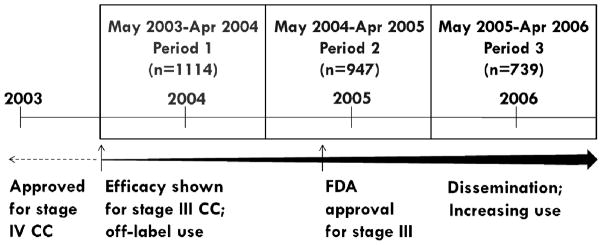
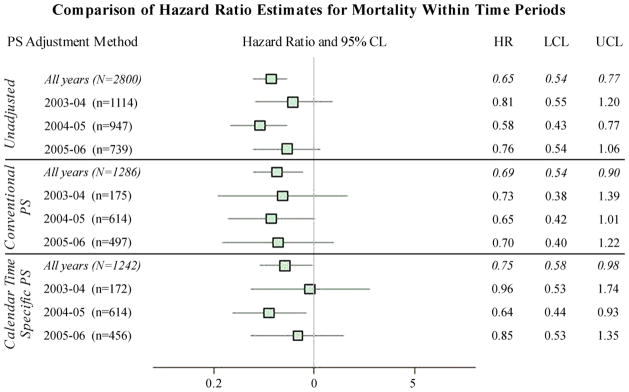
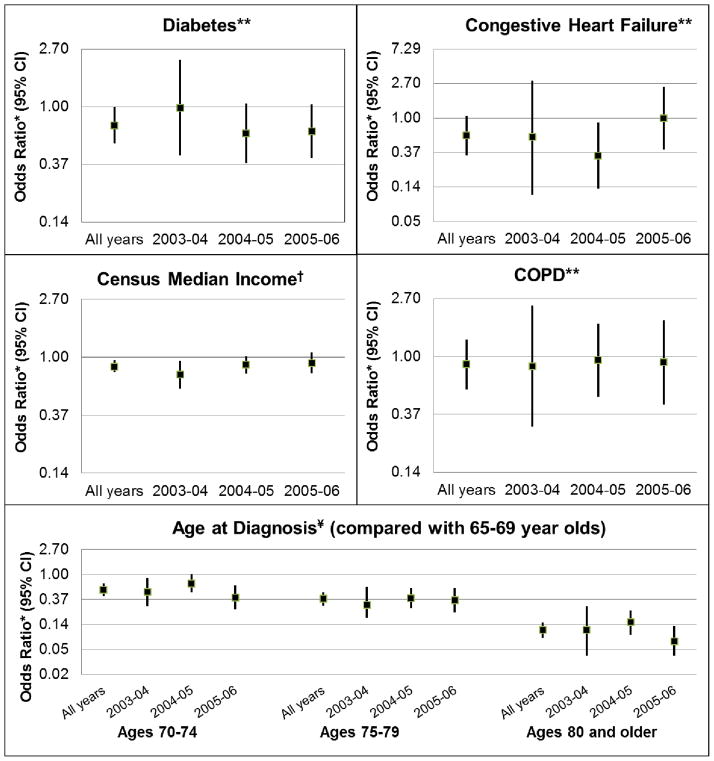
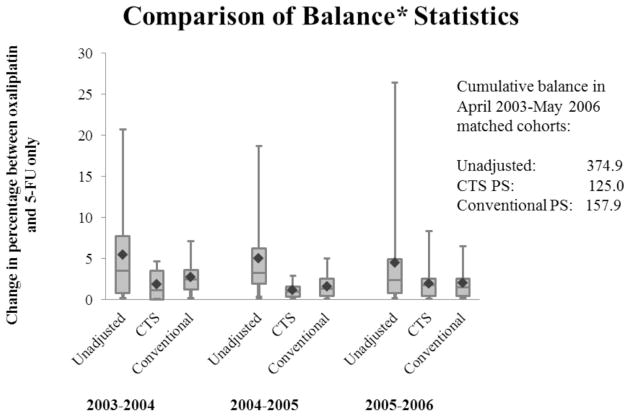
Oxaliplatin use increased significantly; 8% (n = 86) of patients received it in the first time period versus 52% (n = 386) in the last. Channeling by comorbidities, income, and age appeared to change over time. The CTS PS improved covariate balance within calendar time strata and yielded an attenuated estimated benefit of oxaliplatin (HR = 0.75) compared with the conventional PS (HR = 0.69).
In settings where prescribing patterns have changed and calendar time acts as a confounder, a CTS PS can characterize changes in treatment choices and estimating separate PSs within specific calendar time periods may result in enhanced confounding control. To increase validity of comparative effectiveness research, researchers should carefully consider drug lifecycles and effects of innovative treatment dissemination over time.
非实验性治疗效果研究通过纳入异质人群,为随机试验提供了重要补充。倾向评分(PS)在这些研究中很常见,但可能无法充分捕捉创新治疗所经历的渠道变化。我们使用日历时间特定(CTS)PS 来研究奥沙利铂从标签外使用到广泛使用的传播过程中的效果。
使用癌症登记数据与医疗保险索赔相链接,对 2003 年至 2006 年间接受化疗的年龄在 65 岁及以上的 III 期结肠癌患者进行了检查。使用包含年龄、性别、亚分期、分级、人口普查级别的收入和合并症等关键因素的逻辑模型构建了两种接受奥沙利铂与 5-氟尿嘧啶的 PS 方法:(i)常规的、逐年调整的 PS 和(ii)在 1 年内分别构建和匹配的 CTS PS,然后进行组合。我们使用 Cox 模型比较了 PS 匹配的死亡率风险比(HR)。
奥沙利铂的使用显著增加;第一时间段有 8%(n=86)的患者接受了奥沙利铂治疗,而最后一个时间段有 52%(n=386)的患者接受了奥沙利铂治疗。合并症、收入和年龄的渠道似乎随时间而变化。CTS PS 改善了日历时间层内的协变量平衡,并产生了奥沙利铂估计获益的衰减(HR=0.75),与常规 PS(HR=0.69)相比。
在处方模式发生变化且日历时间成为混杂因素的情况下,CTS PS 可以描述治疗选择的变化,并且在特定的日历时间内分别构建 PS 可能会导致混杂因素控制得到增强。为了提高比较有效性研究的有效性,研究人员应仔细考虑药物生命周期以及创新治疗随着时间的传播对效果的影响。