Missala I, Kassner U, Steinhagen-Thiessen E
Department of Lipid Disorder, Charité University Medical Department in Berlin, Berlin, Germany.
Int J Rheumatol. 2012;2012:480784. doi: 10.1155/2012/480784. Epub 2012 Dec 5.
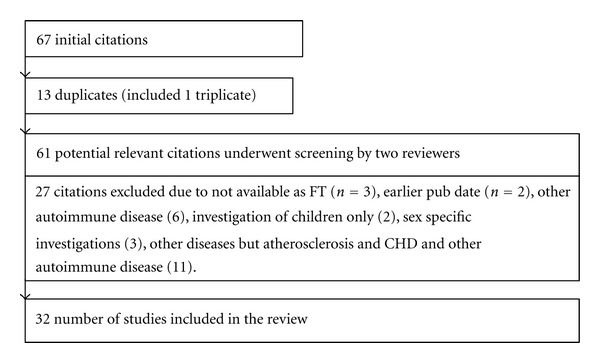
Objective. To investigate the association of lipoprotein(a) and atherosclerosis-related autoimmune diseases, to provide information on possible pathophysiologic mechanisms, and to give recommendations for Lp(a) determination and therapeutic options. Methods. We performed a systematic review of English language citations referring to the keywords "Lp(a)" AND "autoimmune disease" AND "atherosclerosis," "Lp(a)" AND "immune system" OR "antiphospholipid (Hughes) syndrome (APS)" OR "rheumatoid arthritis" OR "Sjögren's syndrome" OR "systemic lupus erythematosus" OR "systemic sclerosis" OR "systemic vasculitis" published between 1991 and 2011 using Medline database. Results. 22 out of 65 found articles were identified as relevant. Lp(a) association was highest in rheumatoid arthritis (RA), followed by systemic lupus erythematosus (SLE), moderate in APS and lowest in systemic sclerosis (SSc). There was no association found between Lp(a) and systemic vasculitis or Sjögren's syndrome. Conclusion. Immune reactions are highly relevant in the pathophysiology of atherosclerosis, and patients with specific autoimmune diseases are at high risk for CVD. Elevated Lp(a) is an important risk factor for premature atherosclerosis and high Lp(a) levels are also associated with autoimmune diseases. Anti-Lp(a)-antibodies might be a possible explanation. Therapeutic approaches thus far include niacin, Lp(a)-apheresis, farnesoid x-receptor-agonists, and CETP-inhibitors being currently under investigation.
目的。研究脂蛋白(a)与动脉粥样硬化相关自身免疫性疾病的关联,提供可能的病理生理机制信息,并给出脂蛋白(a)检测及治疗方案的建议。方法。我们使用Medline数据库,对1991年至2011年间发表的、涉及关键词“脂蛋白(a)”、“自身免疫性疾病”、“动脉粥样硬化”、“脂蛋白(a)”、“免疫系统”或“抗磷脂(休斯)综合征(APS)”、“类风湿关节炎”、“干燥综合征”、“系统性红斑狼疮”、“系统性硬化症”、“系统性血管炎”的英文文献进行了系统综述。结果。在检索到的65篇文章中,22篇被确定为相关。脂蛋白(a)与类风湿关节炎(RA)的关联度最高,其次是系统性红斑狼疮(SLE),在APS中为中度,在系统性硬化症(SSc)中最低。未发现脂蛋白(a)与系统性血管炎或干燥综合征之间存在关联。结论。免疫反应在动脉粥样硬化的病理生理过程中高度相关,特定自身免疫性疾病患者患心血管疾病的风险很高。脂蛋白(a)升高是早发性动脉粥样硬化的重要危险因素,高脂蛋白(a)水平也与自身免疫性疾病有关。抗脂蛋白(a)抗体可能是一种解释。目前的治疗方法包括烟酸、脂蛋白(a)单采术、法尼醇X受体激动剂,以及正在研究中的CETP抑制剂。