Faculty of Biological and Chemical Sciences, Doctoral Program in Biotechnology and Master Program in Biomedical Sciences, Autonomous University of Sinaloa, Culiacán, México.
BMC Med Genet. 2013 Jan 11;14:7. doi: 10.1186/1471-2350-14-7.
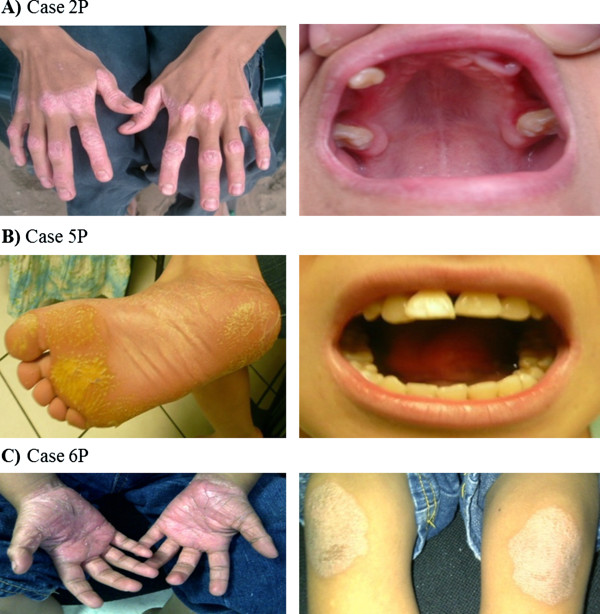
Papillon-Lefèvre Syndrome (PLS) is a type IV genodermatosis caused by mutations in cathepsin C (CTSC), with a worldwide prevalence of 1-4 cases per million in the general population. In México, the prevalence of this syndrome is unknown, and there are few case reports. The diagnosis of twenty patients in the state of Sinaloa highlights the need to characterize this syndrome in Mexicans.
To understand the basis of PLS in Mexicans, the gene expression, enzymatic activity and mutational analysis of CTSC were assayed in nine PLS patients and their relatives. Frequencies of CTSC gene polymorphisms and HLA alleles were determined in these patients, their relatives, and the population.
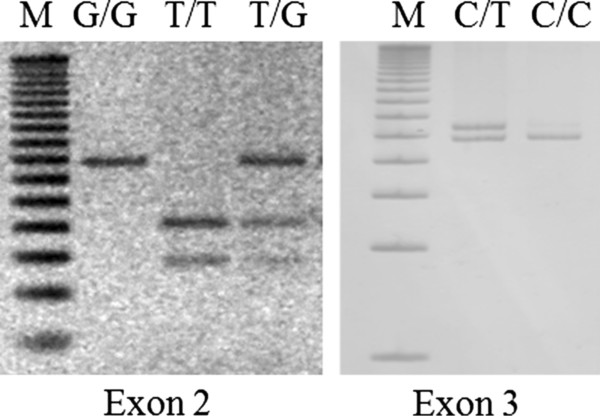
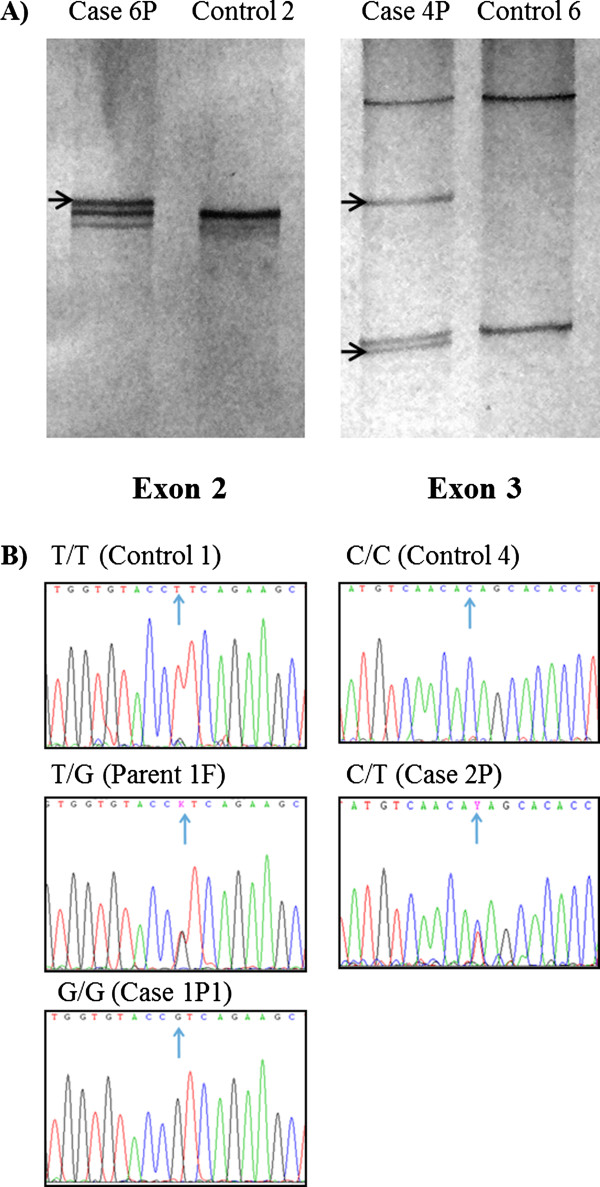
Patients showed normal CTSC gene expression, but a deep reduction (up to 85%) in enzymatic activity in comparison to unrelated healthy individuals. A novel loss-of-function mutation, c.203 T > G (p.Leu68Arg), was found in all patients, and some carried the polymorphism c.458C > T (p.Thr153Ile). Allelic frequencies in patients, relatives and controls were 88.89%, 38.24% and 0.25% for G (c.203 T > G); and 11.11%, 8.82% and 9.00% for T (c.458C > T). HLA-DRB1*11 was found significantly more frequent (P = 0.0071) in patients than controls (33.33% vs. 7.32%), with an estimated relative risk of 6.33.
The novel loss-of function mutation of CTSC gene (c.203 T > G) found in patients correlated with their diminished enzymatic activity, and HLA-DRB1*11 was found to be associated with PLS. The study of more PLS patients may give more insights into the etiology of the disease as well as its prevalence in México.
掌跖角化过度-牙周病综合征(PLS)是一种由组织蛋白酶 C(CTSC)基因突变引起的 IV 型遗传性皮肤病,在普通人群中的患病率为每百万人中有 1-4 例。在墨西哥,这种综合征的患病率尚不清楚,且病例报告较少。在锡那罗亚州诊断出 20 名患者,这突显了在墨西哥人当中对该综合征进行特征描述的必要性。
为了了解墨西哥人患 PLS 的基础,对 9 名 PLS 患者及其亲属进行了 CTSC 基因表达、酶活性和突变分析。测定了这些患者及其亲属和人群中 CTSC 基因多态性和 HLA 等位基因的频率。
患者的 CTSC 基因表达正常,但与无亲缘关系的健康个体相比,酶活性明显降低(高达 85%)。在所有患者中发现了一种新的无功能突变 c.203 T > G(p.Leu68Arg),部分患者还携带了 c.458C > T(p.Thr153Ile)多态性。患者、亲属和对照组中 c.203 T > G(c.203 T > G)的等位基因频率分别为 88.89%、38.24%和 0.25%;c.458C > T(c.458C > T)分别为 11.11%、8.82%和 9.00%。HLA-DRB1*11 在患者中明显更为常见(P = 0.0071),其相对风险估计为 6.33。
在患者中发现的 CTSC 基因突变(c.203 T > G)与酶活性降低相关,HLA-DRB1*11 与 PLS 相关。对更多 PLS 患者的研究可能会深入了解疾病的病因及其在墨西哥的患病率。