Department of Medicine and Clinical Haematology, Launceston General Hospital, Launceston, Tasmania, Australia.
BMJ Open. 2013 Jan 10;3(1):e002025. doi: 10.1136/bmjopen-2012-002025.
This study aims primarily to determine whether whole body MRI (WB-MRI) and Sestamibi Technetium-99m-bone marrow (MIBI) scans in the same patients produce the same estimate of disease load and location, and secondly, to study possible association between the bone disease detected by these scans and the effect on disease outcome and survival. Bone disease occurs in about 90% of multiple myeloma (MM) patients. There are no data comparing the new diagnostic modalities with WB-MRI and MIBI in MM.
A prospective comparative study between WB-MRI and MIBI scans in assessing bone disease and outcome of MM.
Sixty-two consecutive patients with confirmed MM underwent simultaneous WB-MRI (both axial T1 and turbo spin echo short tau inversion recovery (STIR)) and MIBI scans at a single institution from January 2010 to January 2011, and their survival status was determined in January 2012. The median age was 62 years (range 37-88) with a male-to-female ratio of 33 : 29.
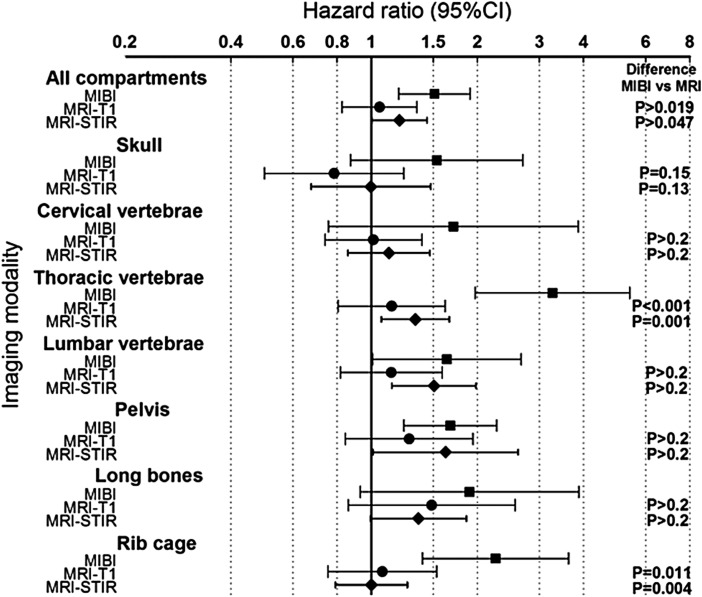
In vertebrae and long bones, MRI scan detected more disease compared with MIBI scan (p<0.001) but there was less difference in the skull (p=0.09). In the ribcage, the MIBI scan detected more lytic lesions of the ribs compared with MRI scan (p<0.001). Thirteen of the 62 patients died during the 24-month follow-up. Increased disease detected in all bones by both scans was associated with increased mortality risk (MIBI p=0.001; MRI-STIR p=0.044; but not MRI-T1 p=0.44). In all combined bone groups, the mean MIBI scan results provided a better prediction of mortality than MRI scan over the follow-up period (MRI-T1 vs MIBI p=0.019; MRI-STIR vs MIBI p=0.047).
Although WB-MRI detected more MM bone disease, MIBI scan predicted overall disease outcome and mortality better than MRI scan. Further studies to define optimum use of these imaging techniques are warranted.
The study was registered prospectively in the Australian and New Zealand Clinical Trials Registry at http://www.ANZCTR.org.au under No: ACTRN12609000761268.
本研究旨在首先确定同一患者的全身磁共振成像(WB-MRI)和锝 99m 亚甲基二膦酸盐 Sestamibi 扫描是否能产生相同的疾病负荷和位置估计,其次,研究这些扫描发现的骨疾病与疾病结果和生存之间的可能关联。多发性骨髓瘤(MM)患者约有 90%发生骨病。目前尚无比较这些新诊断方法与 MM 中 WB-MRI 和 MIBI 的资料。
在单一机构内,于 2010 年 1 月至 2011 年 1 月,对 62 例确诊的 MM 患者同时进行了 WB-MRI(轴位 T1 和涡轮自旋回波短 tau 反转恢复(STIR))和 MIBI 扫描,2012 年 1 月确定了他们的生存状况。中位年龄为 62 岁(范围 37-88 岁),男女比例为 33︰29。
在椎体和长骨中,MRI 扫描比 MIBI 扫描检测到更多的病变(p<0.001),但颅骨的差异较小(p=0.09)。在肋骨中,MIBI 扫描比 MRI 扫描检测到更多的肋骨溶骨性病变(p<0.001)。在 24 个月的随访期间,62 例患者中有 13 例死亡。两种扫描均在所有骨骼中检测到更多的疾病与死亡率升高相关(MIBI,p=0.001;MRI-STIR,p=0.044;但 MRI-T1,p=0.44 未显示差异)。在所有综合骨骼组中,在整个随访期间,MIBI 扫描的平均结果比 MRI 扫描更能预测死亡率(MRI-T1 与 MIBI,p=0.019;MRI-STIR 与 MIBI,p=0.047)。
尽管 WB-MRI 检测到更多的 MM 骨疾病,但 MIBI 扫描比 MRI 扫描更能预测总体疾病结局和死亡率。需要进一步的研究来确定这些影像学技术的最佳应用。
该研究在澳大利亚和新西兰临床试验注册中心(http://www.ANZCTR.org.au)进行了前瞻性注册,编号为 ACTRN12609000761268。