Department of Orthopaedic Surgery, Stanford University School of Medicine, Palo Alto, CA, USA.
J Tissue Eng. 2012;3(1):2041731412466405. doi: 10.1177/2041731412466405. Epub 2012 Nov 23.
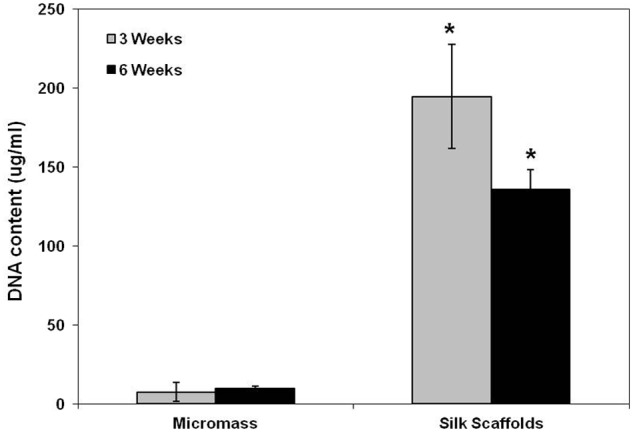
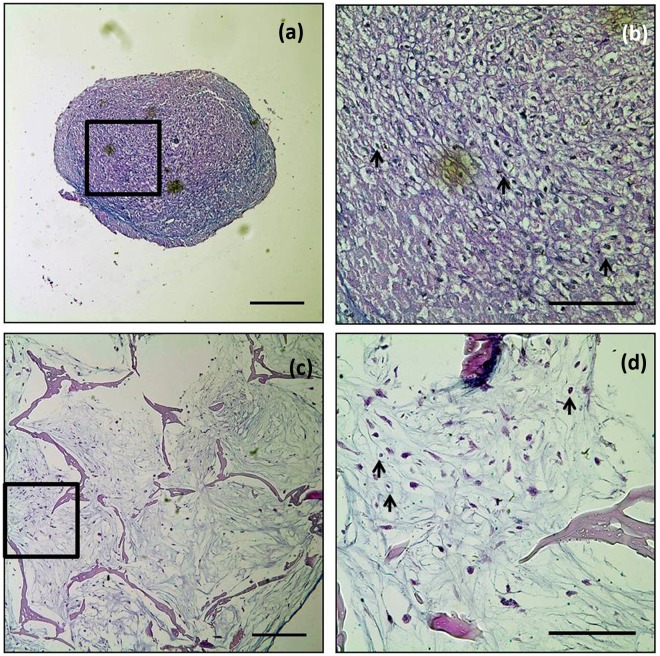
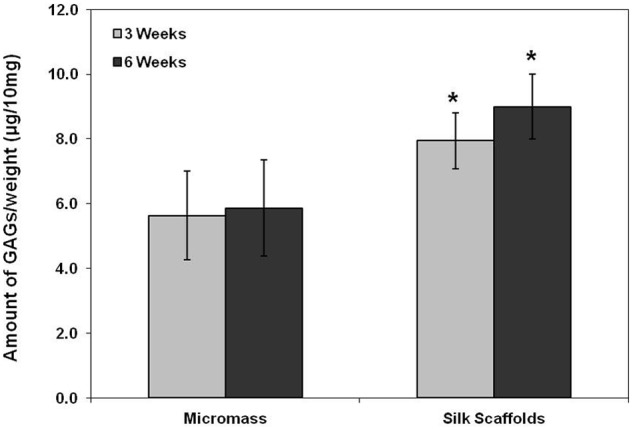
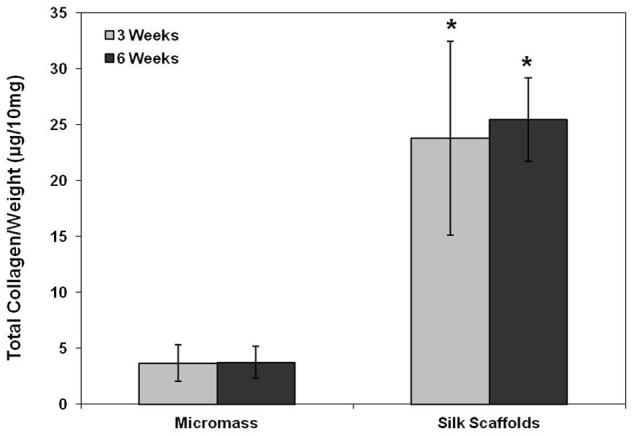
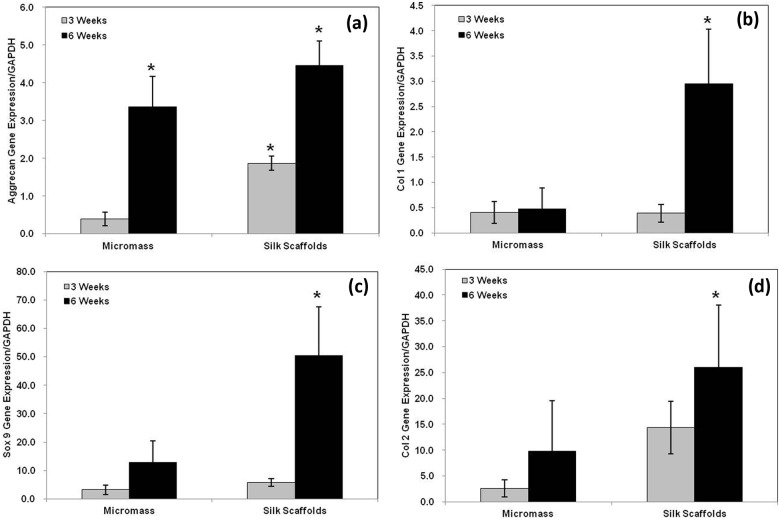
Human adipose-derived stem cells have shown chondrogenic differentiation potential in cartilage tissue engineering in combination with natural and synthetic biomaterials. In the present study, we hypothesized that porous aqueous-derived silk protein scaffolds would be suitable for chondrogenic differentiation of human adipose-derived stem cells. Human adipose-derived stem cells were cultured up to 6 weeks, and cell proliferation and chondrogenic differentiation were investigated and compared with those in conventional micromass culture. Cell proliferation, glycosaminoglycan, and collagen levels in aqueous-derived silk scaffolds were significantly higher than in micromass culture. Transcript levels of SOX9 and type II collagen were also upregulated in the cell-silk constructs at 6 weeks. Histological examination revealed that the pores of the silk scaffolds were filled with cells uniformly distributed. In addition, chondrocyte-specific lacunae formation was evident and distributed in the both groups. The results suggest the biodegradable and biocompatible three-dimensional aqueous-derived silk scaffolds provided an improved environment for chondrogenic differentiation compared to micromass culture.
人脂肪来源干细胞在与天然和合成生物材料结合的软骨组织工程中显示出软骨分化潜能。在本研究中,我们假设多孔水基丝素蛋白支架将适合人脂肪来源干细胞的软骨分化。人脂肪来源干细胞培养至 6 周,研究并比较了细胞增殖和软骨分化与传统微团培养的关系。水基丝素支架中的细胞增殖、糖胺聚糖和胶原水平明显高于微团培养。6 周时,细胞-丝素构建体中的 SOX9 和 II 型胶原的转录水平也上调。组织学检查显示,丝素支架的孔均匀分布着细胞。此外,两组均可见到明显的软骨细胞特有的陷窝形成。结果表明,与微团培养相比,可生物降解和生物相容的三维水基丝素支架为软骨分化提供了更好的环境。