Department of Neurology and Center of Clinical Neuroscience, 1st Faculty of Medicine and General University Hospital, Charles University, Prague, Czech Republic.
PLoS One. 2013;8(1):e53996. doi: 10.1371/journal.pone.0053996. Epub 2013 Jan 8.
To investigate the associations of environmental MS risk factors with clinical and MRI measures of progression in high-risk clinically isolated syndromes (CIS) after the first demyelinating event.
We analyzed 211 CIS patients (age: 28.9±7.8 years) enrolled in the SET study, a multi-center study of high-risk CIS patients. Pre-treatment samples were analyzed for IgG antibodies against cytomegalovirus (anti-CMV), Epstein Barr virus (EBV) early nuclear antigen-1 (EBNA-1), viral capsid antigen (VCA), early antigen-diffuse (EA-D), 25 hydroxy-vitamin D3 and cotinine levels and HLA DRB1*1501 status. The inclusion criteria required evaluation within 4 months of the initial demyelinating event, 2 or more brain MRI lesions and the presence of two or more oligoclonal bands in cerebrospinal fluid. All patients were treated with interferon-beta. Clinical and MRI assessments were obtained at baseline, 6, 12, and 24 months.
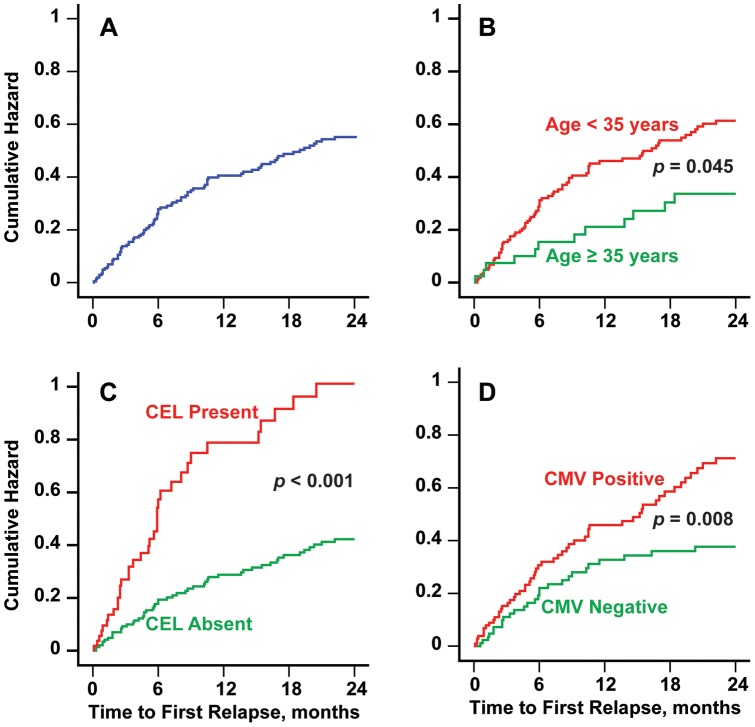
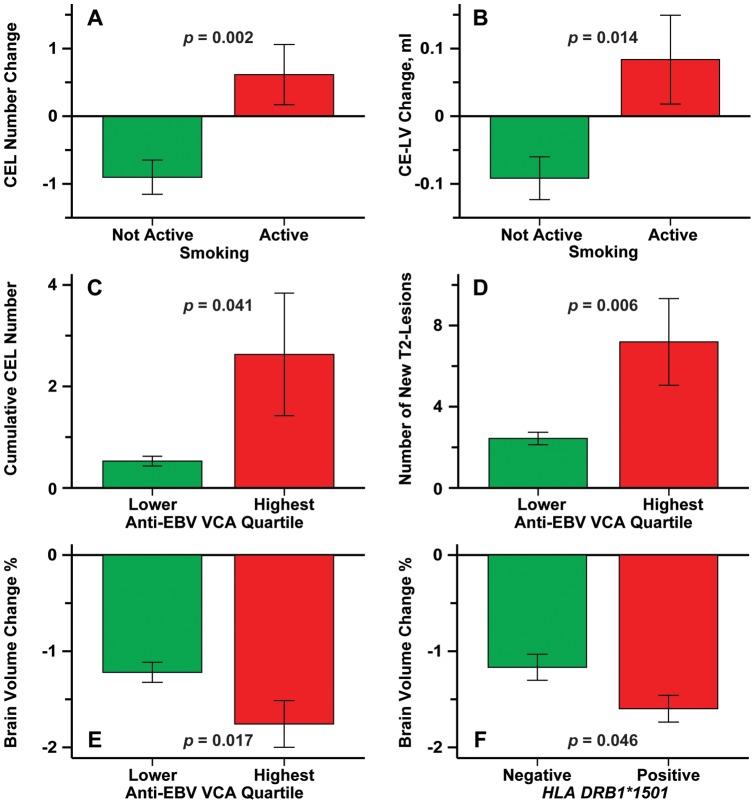
The time to first relapse decreased and the number of relapses increased with anti-CMV IgG positivity. Smoking was associated with increased number and volume of contrast-enhancing lesions (CEL) during the 2-year period. The cumulative number of CEL and T2 lesions during the 2-year period was greater for individuals in the highest quartile of anti-EBV VCA IgG antibodies. The percent loss of brain volume was increased for those in the highest quartile of with anti-EBV VCA IgG antibodies.
Relapses in CIS patients were associated with CMV positivity whereas anti-EBV VCA positivity was associated with progression on MRI measures, including accumulation of CEL and T2 lesions and development of brain atrophy.
探讨环境多发性硬化(MS)危险因素与首次脱髓鞘事件后高危临床孤立综合征(CIS)患者的临床和 MRI 进展指标的相关性。
我们分析了 211 名参与 SET 研究的 CIS 患者(年龄:28.9±7.8 岁),该研究为高危 CIS 患者的多中心研究。对治疗前样本进行巨细胞病毒(抗-CMV)、Epstein-Barr 病毒(EBV)早期核抗原-1(EBNA-1)、病毒衣壳抗原(VCA)、早期抗原弥散(EA-D)、25 羟维生素 D3 和可替宁水平以及 HLA-DRB1*1501 状态的 IgG 抗体分析。纳入标准要求在初次脱髓鞘事件后 4 个月内进行评估,具有 2 个或更多脑部 MRI 病变和脑脊液中存在 2 个或更多寡克隆带。所有患者均接受干扰素-β治疗。在基线、6、12 和 24 个月时进行临床和 MRI 评估。
抗-CMV IgG 阳性患者的首次复发时间提前且复发次数增加。吸烟与 2 年内对比增强病变(CEL)数量和体积增加有关。在最高四分位数的 EBV VCA IgG 抗体患者中,2 年内 CEL 和 T2 病变的累积数量增加。具有 EBV VCA IgG 抗体最高四分位数的患者脑容量的损失百分比增加。
CIS 患者的复发与 CMV 阳性有关,而 EBV VCA 阳性与 MRI 进展指标相关,包括 CEL 和 T2 病变的累积和脑萎缩的发展。