Department of Medicine, Alpert Medical School of Brown University, Rhode Island Hospital, Providence, Rhode Island 02903, USA.
Kidney Int. 2013 May;83(5):804-10. doi: 10.1038/ki.2012.435. Epub 2013 Jan 16.
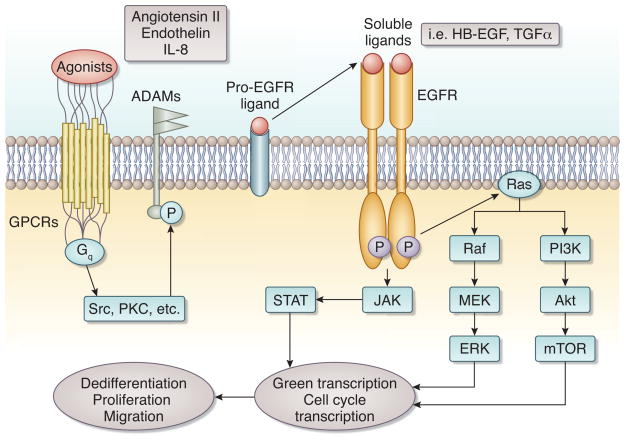
Epidermal growth factor receptor (EGFR) is a receptor tyrosine kinase. Its activation results in beneficial or detrimental consequences, depending on the particular setting. Earlier studies in the animal model of acute kidney injury showed that EGFR activation promotes renal tubular cell proliferation. Activation of EGFR by its exogenous ligands, like EGF, can enhance recovery of renal function and structure following acute kidney injury. However, recent studies indicated that EGFR activation also contributes to development and progression of renal diseases in animal models of obstructive nephropathy, diabetic nephropathy, hypertensive nephropathy, and glomerulonephritis through mechanisms involved in activation of renal interstitial fibroblasts, induction of tubular atrophy, overproduction of inflammatory factors, and/or promotion of glomerular and vascular injury. This review highlights the actions and mechanisms of EGFR in a variety of acute and chronic kidney injuries.
表皮生长因子受体(EGFR)是一种受体酪氨酸激酶。其激活可导致有益或有害的后果,具体取决于特定的情况。急性肾损伤动物模型的早期研究表明,EGFR 的激活可促进肾小管细胞增殖。其外源性配体(如表皮生长因子)激活 EGFR 可增强急性肾损伤后肾功能和结构的恢复。然而,最近的研究表明,EGFR 的激活也通过激活肾间质成纤维细胞、诱导肾小管萎缩、过度产生炎症因子和/或促进肾小球和血管损伤等机制,导致梗阻性肾病、糖尿病肾病、高血压肾病和肾小球肾炎等动物模型中的肾脏疾病的发展和进展。本综述强调了 EGFR 在各种急性和慢性肾损伤中的作用和机制。