Division of Cognitive and Neuropsychology, Institute of Behavioural Sciences, University of Helsinki, Helsinki, Finland.
PLoS One. 2013;8(1):e53061. doi: 10.1371/journal.pone.0053061. Epub 2013 Jan 9.
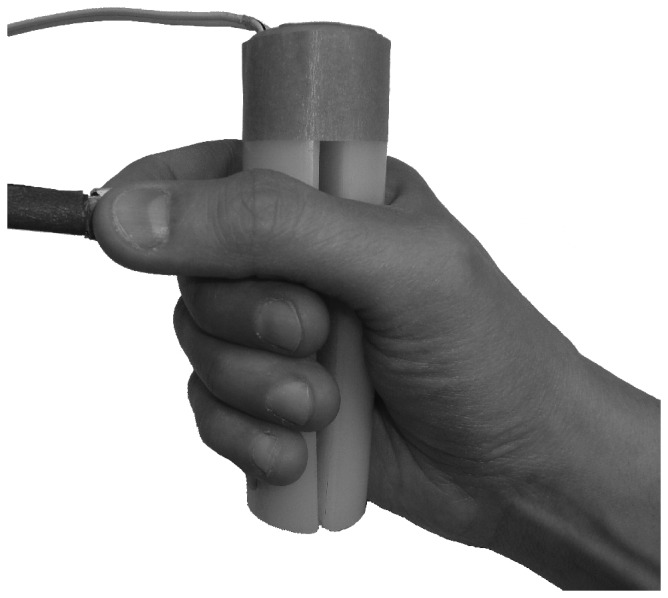
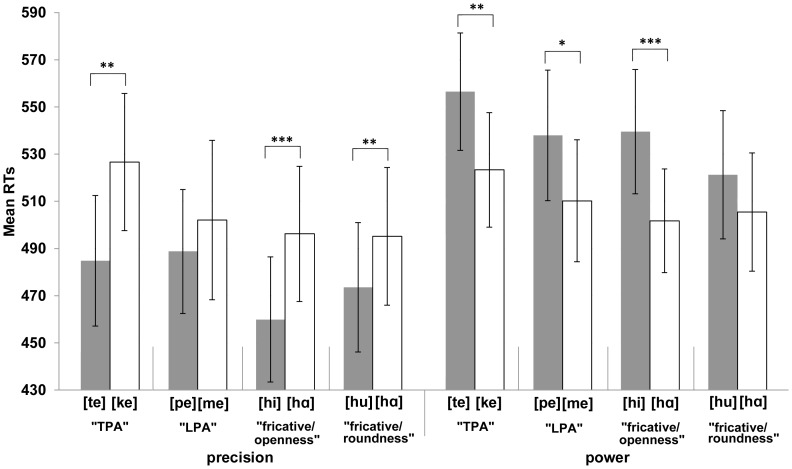
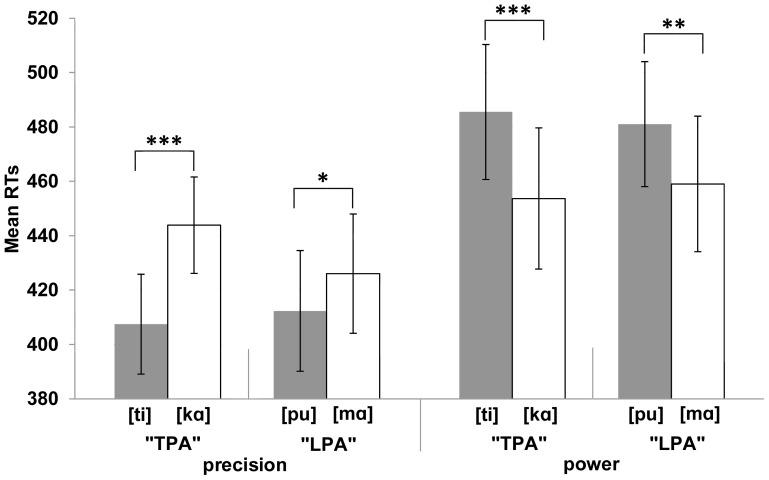
The present study was motivated by a theory, which proposes that speech includes articulatory gestures that are connected to particular hand actions. We hypothesized that certain articulatory gestures would be more associated with the precision grip than with the power grip, and vice versa. In the study, the participants pronounced a syllable and performed simultaneously a precision or power grip that was theorized to be either congruent or incongruent with the syllable. Relatively fast precision grip responses were associated with articulatory gestures in which the tip of the tongue contacted the alveolar ridge ([te]) or the aperture of the vocal tract remained small ([hi]), as well as gestures that required lip protrusion ([pu]). In contrast, relatively fast power grip responses were associated with gestures that were produced by moving the back of the tongue against the velum ([ke]) or in which the aperture of the vocal tract remained large ([hα]). In addition to demonstrating that certain articulatory gestures are systematically connected to different grip types, the study may shed some light on discussion concerning sound symbolism and evolution of speech.
本研究的动机源于一种理论,该理论提出,言语包括与特定手部动作相关联的发音动作。我们假设某些发音动作与精准握力比与力握力更相关,反之亦然。在研究中,参与者发音一个音节,并同时进行被理论上认为与音节一致或不一致的精准握力或力握力。相对较快的精准握力反应与舌尖接触齿龈 ([te]) 或声道开口较小 ([hi]) 的发音动作以及需要唇突出 ([pu]) 的动作相关。相比之下,相对较快的力握力反应与通过将舌后部抵住软腭 ([ke]) 或声道开口保持较大 ([hα]) 产生的动作相关。除了表明某些发音动作与不同的握力类型系统地相关联之外,该研究可能有助于讨论语音的声音象征意义和进化。