Faculty of Health Science Centre, Department of Medicine, University of Witwatersrand, Johannesburg, South Africa.
PLoS One. 2013;8(1):e53494. doi: 10.1371/journal.pone.0053494. Epub 2013 Jan 11.
HIV-infected women are at increased risk for developing cervical cancer. Women living in resource-limited countries are especially at risk due to poor access to cervical cancer screening and treatment. We evaluated three cervical cancer screening methods to detect cervical intraepithelial neoplasia grade 2 and above (CIN 2+) in HIV-infected women in South Africa; Pap smear, visual inspection with 5% acetic acid (VIA) and human papillomavirus detection (HPV).
HIV-infected women aged 18-65 were recruited in Johannesburg. A cross-sectional study evaluating three screening methods for the detection of the histologically-defined gold standard CIN-2 + was performed. Women were screened for cervical abnormalities with the Digene HC2 assay (HPV), Pap smear and VIA. VIA was performed by clinic nurses, digital photographs taken and then later reviewed by specialist physicians. The sensitivity, specificity and predictive valves for CIN-2 + were calculated using maximum likelihood estimators.
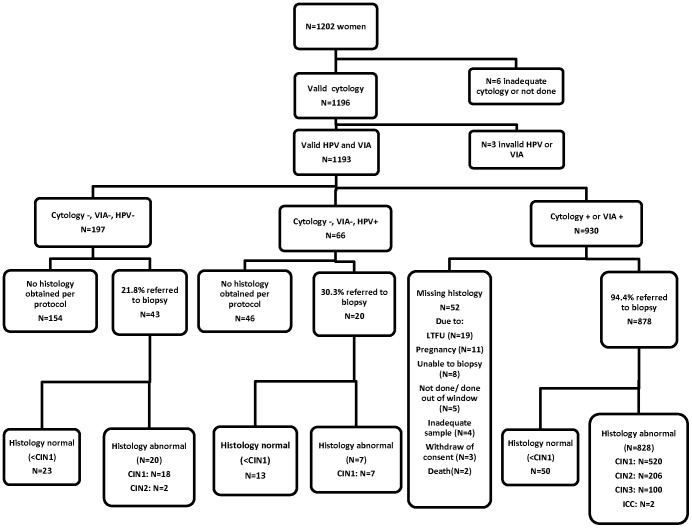
1,202 HIV-infected women participated, with a median age of 38 years and CD4 counts of 394 cells/mm(3). One third of women had a high grade lesion on cytology. VIA and HPV were positive in 45% and 61% of women respectively. Estimated sensitivity/specificity for HPV, Pap smear and VIA for CIN 2+ was 92%/51.4%, 75.8%/83.4% and 65.4/68.5% (nurse reading), respectively. Sensitivities were similar, and specificities appeared significantly lower for the HPV test, cytology and VIA among women with CD4 counts ≤200 cells/mm(3) as compared to CD4 counts >350 cells/mm(3).
Although HPV was the most sensitive screening method for detecting CIN 2+, it was less specific than conventional cytology and VIA with digital imaging review. Screening programs may need to be individualized in context of the resources and capacity in each area.
HIV 感染者发展为宫颈癌的风险增加。由于获得宫颈癌筛查和治疗的机会有限,生活在资源有限国家的妇女尤其面临风险。我们评估了南非 HIV 感染者中三种宫颈癌筛查方法,以检测宫颈上皮内瘤变 2 级及以上(CIN2+);巴氏涂片、5%醋酸视觉检查(VIA)和人乳头瘤病毒检测(HPV)。
在约翰内斯堡招募了 18-65 岁的 HIV 感染者。进行了一项横断面研究,评估了三种筛查方法检测组织学定义的金标准 CIN-2+的效果。女性接受了宫颈异常的 Digene HC2 检测(HPV)、巴氏涂片和 VIA 检查。VIA 由诊所护士进行,拍摄数字照片,然后由专科医生进行复查。使用最大似然估计计算 CIN-2+的灵敏度、特异性和预测值。
共有 1202 名 HIV 感染者参与,中位年龄为 38 岁,CD4 计数为 394 个细胞/mm3。三分之一的女性细胞学检查有高级别病变。VIA 和 HPV 阳性的女性分别占 45%和 61%。HPV、巴氏涂片和 VIA 对 CIN 2+的估计敏感性/特异性分别为 92%/51.4%、75.8%/83.4%和 65.4%/68.5%(护士读数)。VIA 和 HPV 对 CIN 2+的敏感性相似,而在 CD4 计数≤200 个细胞/mm3的女性中,HPV 检测、细胞学和 VIA 的特异性明显低于 CD4 计数>350 个细胞/mm3的女性。
虽然 HPV 是检测 CIN 2+最敏感的筛查方法,但与传统细胞学和 VIA 相比,特异性较低,尤其是数字成像复查时。在每个地区的资源和能力背景下,筛查方案可能需要个体化。