Department of Endocrinology, Nanjing Drum Tower Hospital, Nanjing University School of Medicine, Nanjing, China.
PLoS One. 2013;8(1):e53557. doi: 10.1371/journal.pone.0053557. Epub 2013 Jan 10.
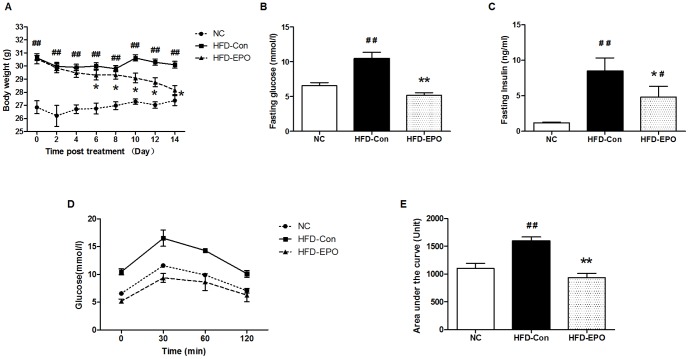
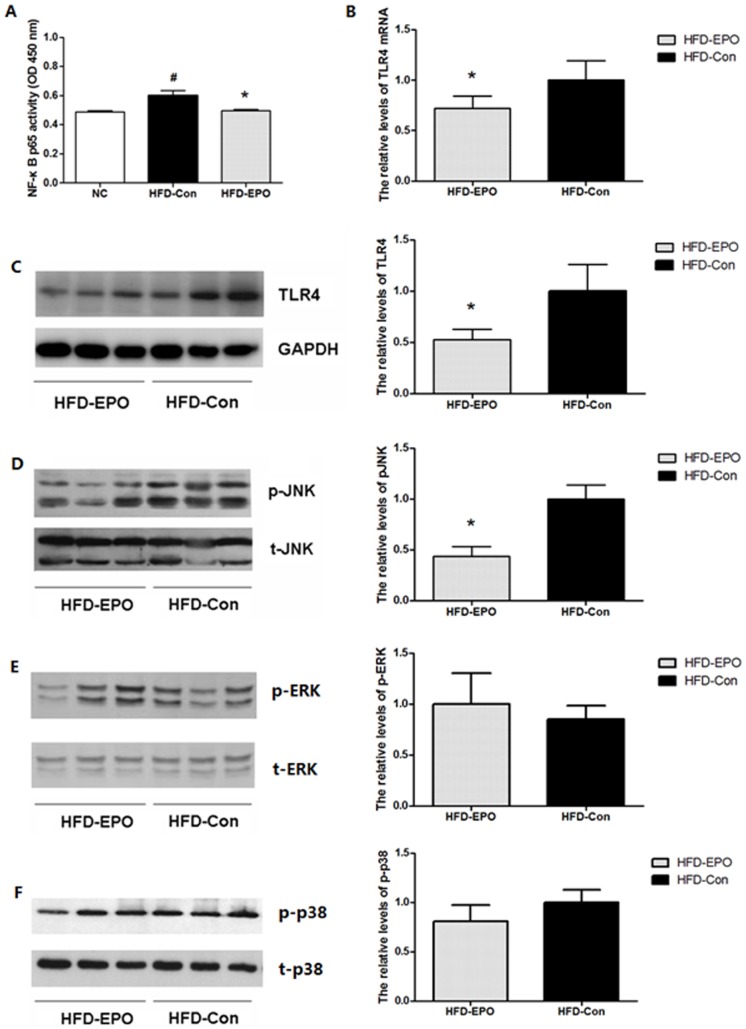
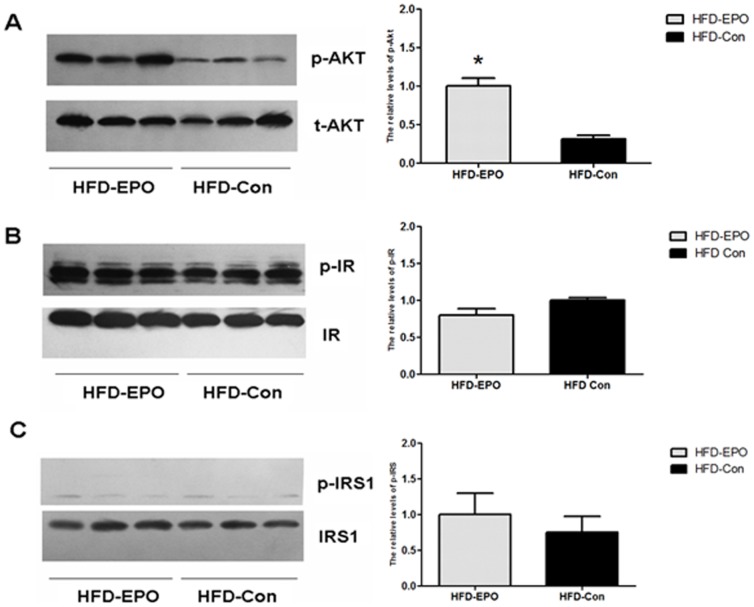
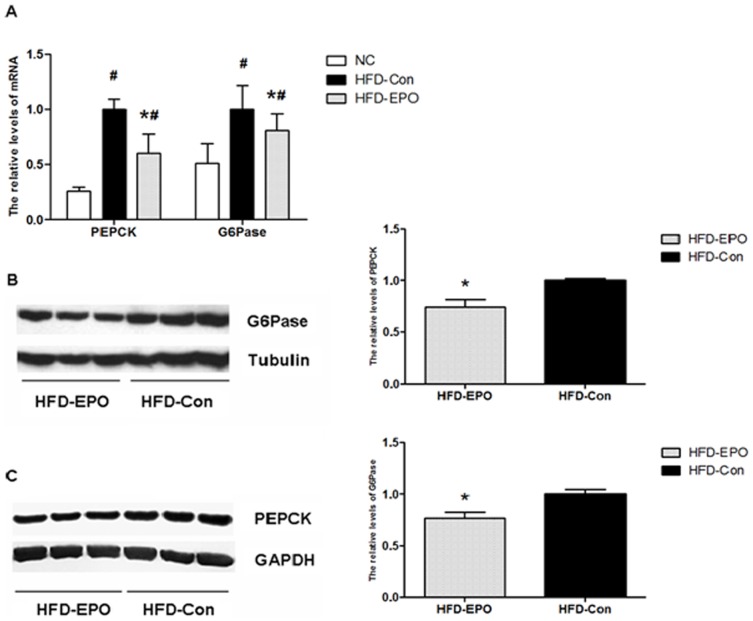
Erythropoietin (EPO) has multiple biological functions, including the modulation of glucose metabolism. However, the mechanisms underlying the action of EPO are still obscure. This study is aimed at investigating the potential mechanisms by which EPO improves glucose tolerance in an animal model of type 2 diabetes. Male C57BL/6 mice were fed with high-fat diet (HFD) for 12 weeks and then treated with EPO (HFD-EPO) or vehicle saline (HFD-Con) for two week. The levels of fasting blood glucose, serum insulin and glucose tolerance were measured and the relative levels of insulin-related phosphatidylinositol 3-kinase (PI3K)/Akt, insulin receptor (IR) and IR substrate 1 (IRS1) phosphorylation were determined. The levels of phosphoenolpyruvate carboxykinase (PEPCK), glucose-6- phosphatase (G6Pase), toll like receptor 4 (TLR4), tumor necrosis factor (TNF)-α and IL-6 expression and nuclear factor-κB (NF-κB) and c-Jun N-terminal kinase (JNK), extracellular-signal-regulated kinase (ERK) and p38 MAPK activation in the liver were examined. EPO treatment significantly reduced the body weights and the levels of fasting blood glucose and serum insulin and improved the HFD-induced glucose intolerance in mice. EPO treatment significantly enhanced the levels of Akt, but not IR and IRS1, phosphorylation, accompanied by inhibiting the PEPCK and G6Pase expression in the liver. Furthermore, EPO treatment mitigated the HFD-induced inflammatory TNF-α and IL-6 production, TLR4 expression, NF-κB and JNK, but not ERK and p38 MAPK, phosphorylation in the liver. Therefore, our data indicated that EPO treatment improved glucose intolerance by inhibiting gluconeogenesis and inflammation in the livers of HFD-fed mice.
促红细胞生成素 (EPO) 具有多种生物学功能,包括调节葡萄糖代谢。然而,EPO 作用的机制仍然不清楚。本研究旨在探讨 EPO 改善 2 型糖尿病动物模型葡萄糖耐量的潜在机制。雄性 C57BL/6 小鼠用高脂肪饮食(HFD)喂养 12 周,然后用 EPO(HFD-EPO)或生理盐水(HFD-Con)处理 2 周。测定空腹血糖、血清胰岛素和葡萄糖耐量水平,并测定胰岛素相关的磷脂酰肌醇 3-激酶(PI3K)/Akt、胰岛素受体(IR)和胰岛素受体底物 1(IRS1)磷酸化的相对水平。测定磷酸烯醇丙酮酸羧激酶(PEPCK)、葡萄糖-6-磷酸酶(G6Pase)、Toll 样受体 4(TLR4)、肿瘤坏死因子(TNF)-α和白细胞介素 6(IL-6)的表达水平以及核因子-κB(NF-κB)和 c-Jun N 端激酶(JNK)、细胞外信号调节激酶(ERK)和 p38 MAPK 在肝脏中的激活。EPO 治疗显著降低了体重、空腹血糖和血清胰岛素水平,并改善了 HFD 诱导的小鼠葡萄糖耐量。EPO 治疗显著增强了 Akt 的磷酸化水平,但不影响 IR 和 IRS1 的磷酸化水平,同时抑制了肝脏中 PEPCK 和 G6Pase 的表达。此外,EPO 治疗减轻了 HFD 诱导的炎症 TNF-α和 IL-6 产生、TLR4 表达、NF-κB 和 JNK,但不影响 ERK 和 p38 MAPK 的磷酸化。因此,我们的数据表明,EPO 治疗通过抑制 HFD 喂养小鼠肝脏中的糖异生和炎症来改善葡萄糖耐量。