Behrendt Tom, Bielitzki Robert, Behrens Martin, Herold Fabian, Schega Lutz
Department of Sport Science, Chair for Health and Physical Activity, Otto-von-Guericke University Magdeburg, Universitätsplatz 2, 39104, Magdeburg, Germany.
Department of Orthopaedics, Rostock University Medical Center, Doberaner Str. 142, 18057, Rostock, Germany.
Sports Med Open. 2022 May 31;8(1):70. doi: 10.1186/s40798-022-00450-x.
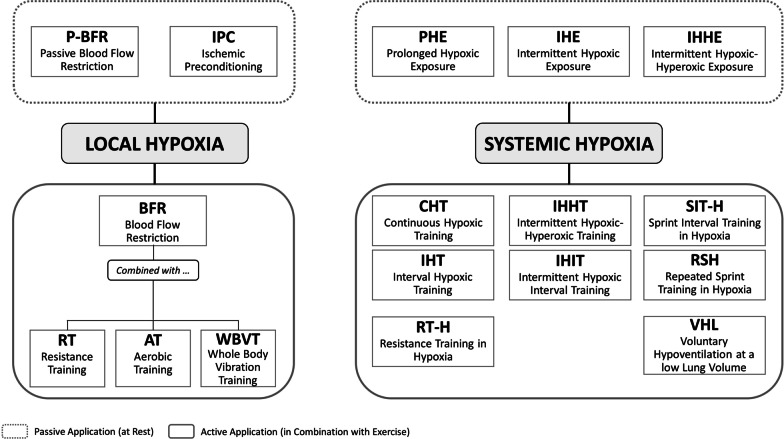
Intermittent hypoxia applied at rest or in combination with exercise promotes multiple beneficial adaptations with regard to performance and health in humans. It was hypothesized that replacing normoxia by moderate hyperoxia can increase the adaptive response to the intermittent hypoxic stimulus.
Our objective was to systematically review the current state of the literature on the effects of chronic intermittent hypoxia-hyperoxia (IHH) on performance- and health-related outcomes in humans.
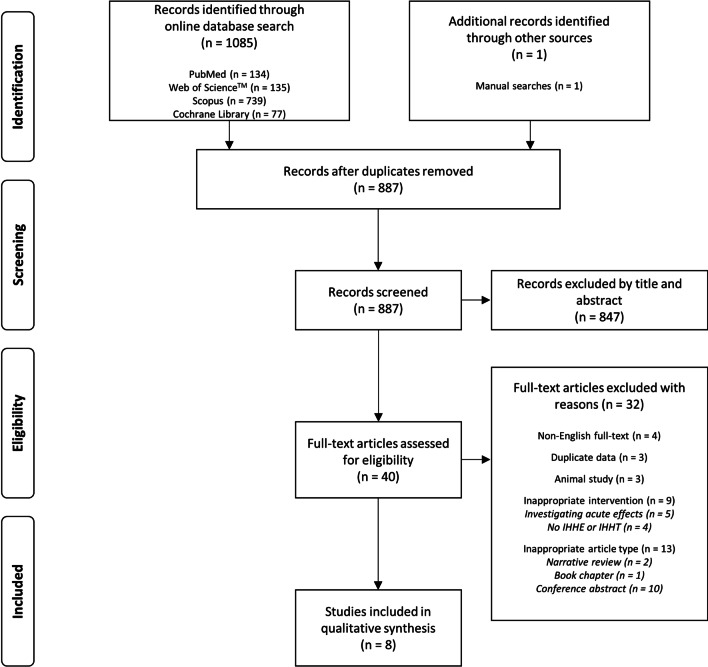
PubMed, Web of Science™, Scopus, and Cochrane Library databases were searched in accordance with PRISMA guidelines (January 2000 to September 2021) using the following inclusion criteria: (1) original research articles involving humans, (2) investigation of the chronic effect of IHH, (3) inclusion of a control group being not exposed to IHH, and (4) articles published in peer-reviewed journals written in English.
Of 1085 articles initially found, eight studies were included. IHH was solely performed at rest in different populations including geriatric patients (n = 1), older patients with cardiovascular (n = 3) and metabolic disease (n = 2) or cognitive impairment (n = 1), and young athletes with overtraining syndrome (n = 1). The included studies confirmed the beneficial effects of chronic exposure to IHH, showing improvements in exercise tolerance, peak oxygen uptake, and global cognitive functions, as well as lowered blood glucose levels. A trend was discernible that chronic exposure to IHH can trigger a reduction in systolic and diastolic blood pressure. The evidence of whether IHH exerts beneficial effects on blood lipid levels and haematological parameters is currently inconclusive. A meta-analysis was not possible because the reviewed studies had a considerable heterogeneity concerning the investigated populations and outcome parameters.
Based on the published literature, it can be suggested that chronic exposure to IHH might be a promising non-pharmacological intervention strategy for improving peak oxygen consumption, exercise tolerance, and cognitive performance as well as reducing blood glucose levels, and systolic and diastolic blood pressure in older patients with cardiovascular and metabolic diseases or cognitive impairment. However, further randomized controlled trials with adequate sample sizes are needed to confirm and extend the evidence. This systematic review was registered on the international prospective register of systematic reviews (PROSPERO-ID: CRD42021281248) ( https://www.crd.york.ac.uk/prospero/ ).
静息时或与运动相结合应用间歇性低氧可促进人类在运动表现和健康方面产生多种有益的适应性变化。据推测,用适度高氧替代常氧可增强对间歇性低氧刺激的适应性反应。
我们的目的是系统回顾关于慢性间歇性低氧 - 高氧(IHH)对人类运动表现和健康相关结局影响的文献现状。
按照PRISMA指南(2000年1月至2021年9月),在PubMed、科学网、Scopus和Cochrane图书馆数据库中进行检索,使用以下纳入标准:(1)涉及人类的原创研究文章;(2)对IHH慢性影响的研究;(3)纳入未暴露于IHH的对照组;(4)发表在同行评审英文期刊上的文章。
在最初找到的1085篇文章中,纳入了8项研究。IHH仅在静息状态下应用于不同人群,包括老年患者(n = 1)、患有心血管疾病(n = 3)和代谢疾病(n = 2)或认知障碍(n = 1)的老年患者,以及患有过度训练综合征的年轻运动员(n = 1)。纳入的研究证实了慢性暴露于IHH的有益效果,表现为运动耐力、峰值摄氧量和整体认知功能的改善,以及血糖水平降低。可以看出慢性暴露于IHH有使收缩压和舒张压降低的趋势。关于IHH是否对血脂水平和血液学参数产生有益影响的证据目前尚无定论。由于所审查的研究在研究人群和结局参数方面存在相当大的异质性,因此无法进行荟萃分析。
根据已发表的文献,可认为慢性暴露于IHH可能是一种有前景的非药物干预策略,用于改善患有心血管和代谢疾病或认知障碍的老年患者的峰值耗氧量、运动耐力和认知表现,以及降低血糖水平、收缩压和舒张压。然而,需要进一步进行足够样本量的随机对照试验来证实和扩展这一证据。本系统评价已在国际前瞻性系统评价注册库(PROSPERO编号:CRD42021281248)(https://www.crd.york.ac.uk/prospero/)上注册。