Chowdhury Parimal, Udupa Kodetthoor B
Department of Physiology & Biophysics, University of Arkansas for Medical Sciences, College of Medicine, 4301 W Markham Street, Little Rock, 72205, Arkansas.
Tob Induc Dis. 2013 Jan 18;11(1):1. doi: 10.1186/1617-9625-11-1.
Nicotine is a risk factor for pancreatitis resulting in loss of pancreatic enzyme secretion. The aim of this study was to evaluate the mechanisms of nicotine-induced secretory response measured in primary pancreatic acinar cells isolated from Male Sprague Dawley rats. The study examines the role of calcium signaling in the mechanism of the enhanced secretory response observed with nicotine exposure.
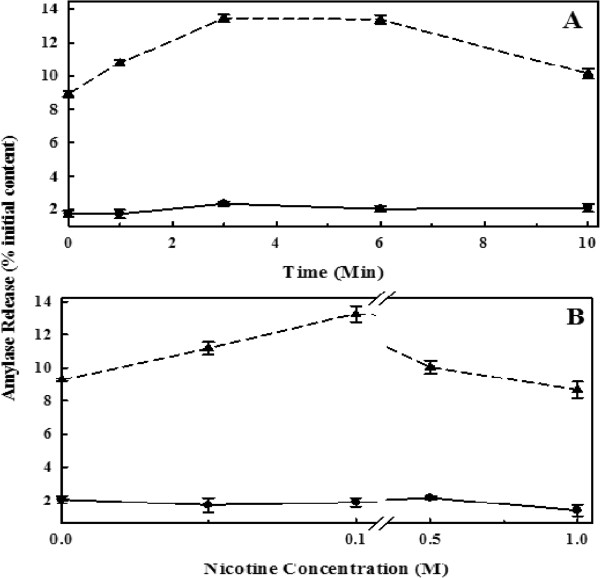
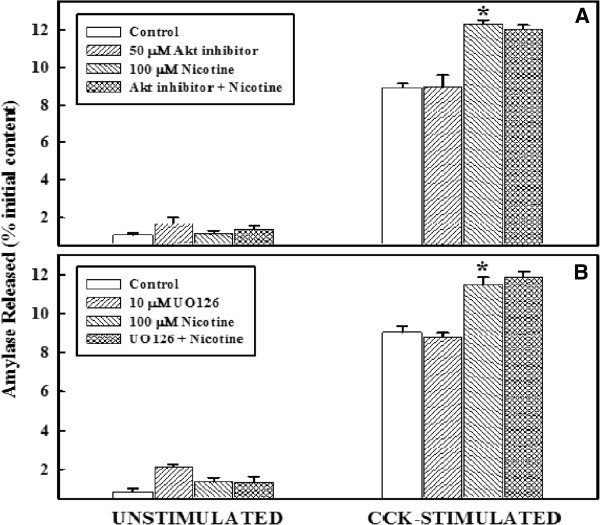
Isolated and purified pancreatic acinar cells were subjected to a nicotine exposure at a dose of 100 μM for 6 minutes and then stimulated with cholecystokinin (CCK) for 30 min. The cell's secretory response was measured by the percent of amylase released from the cells in the incubation medium Calcium receptor antagonists, inositol trisphosphate (IP3) receptor blockers, mitogen activated protein kinase inhibitors and specific nicotinic receptor antagonists were used to confirm the involvement of calcium in this process.
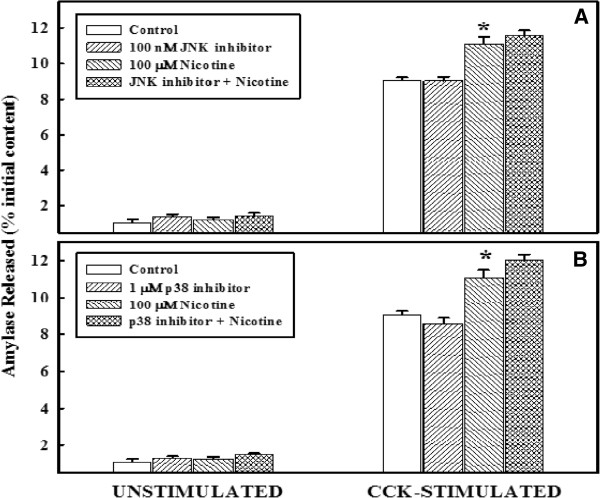
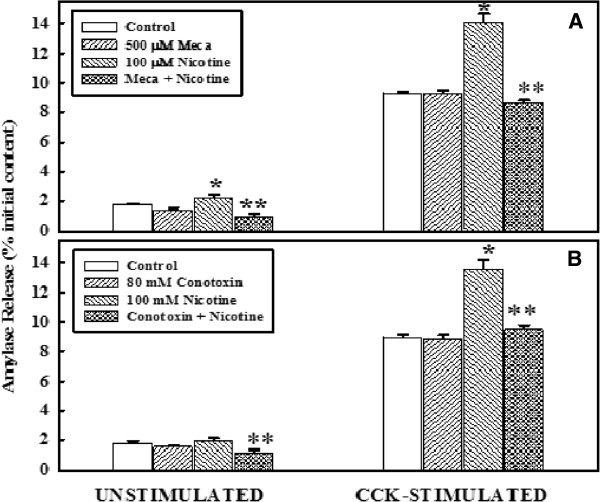
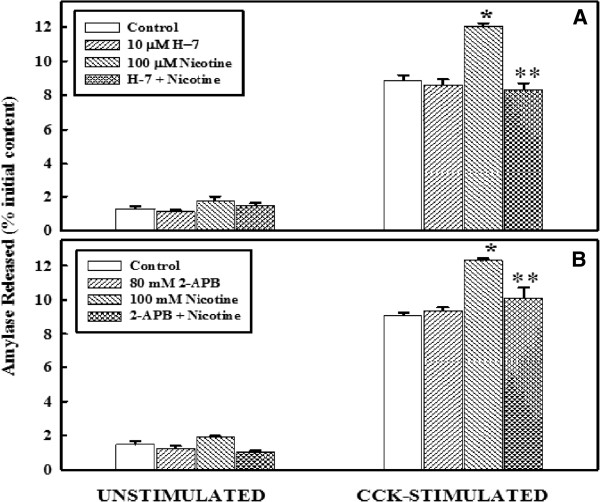
Nicotine exposure induced enhanced secretory response in primary cells. These responses remained unaffected by mitogen activated protein kinases (MAPK's) inhibitors. The effects, however, have been completely abolished by nicotinic receptor antagonist, calcium channel receptor antagonists and inositol trisphosphate (IP3) receptor blockers.
The data suggest that calcium activated events regulating the exocytotic secretion are affected by nicotine as shown by enhanced functional response which is inhibited by specific antagonists… The results implicate the role of nicotine in the mobilization of both intra- and extracellular calcium in the regulation of stimulus-secretory response of enzyme secretion in this cell system. We conclude that nicotine plays an important role in promoting enhanced calcium levels inside the acinar cell.
尼古丁是胰腺炎的一个风险因素,会导致胰腺酶分泌丧失。本研究的目的是评估从雄性斯普拉格-道利大鼠分离的原代胰腺腺泡细胞中尼古丁诱导的分泌反应机制。该研究考察了钙信号在尼古丁暴露时观察到的增强分泌反应机制中的作用。
将分离纯化的胰腺腺泡细胞用100μM的尼古丁处理6分钟,然后用胆囊收缩素(CCK)刺激30分钟。通过孵育培养基中细胞释放淀粉酶的百分比来测量细胞的分泌反应。使用钙受体拮抗剂、肌醇三磷酸(IP3)受体阻滞剂、丝裂原活化蛋白激酶抑制剂和特异性烟碱受体拮抗剂来确认钙在这一过程中的参与。
尼古丁暴露诱导原代细胞分泌反应增强。这些反应不受丝裂原活化蛋白激酶(MAPK)抑制剂的影响。然而,烟碱受体拮抗剂、钙通道受体拮抗剂和肌醇三磷酸(IP3)受体阻滞剂完全消除了这些作用。
数据表明,如特异性拮抗剂抑制增强的功能反应所示,调节胞吐分泌的钙激活事件受尼古丁影响……结果表明尼古丁在该细胞系统中酶分泌的刺激-分泌反应调节中,在细胞内和细胞外钙的动员中发挥作用。我们得出结论,尼古丁在促进腺泡细胞内钙水平升高方面起重要作用。