José Anabel, Sobrevals Luciano, Miguel Camacho-Sánchez Juan, Huch Meritxell, Andreu Núria, Ayuso Eduard, Navarro Pilar, Alemany Ramon, Fillat Cristina
Institut d'Investigacions Biomèdiques August Pi i Sunyer IDIBAPS, Barcelona, Spain.
Oncotarget. 2013 Jan;4(1):94-105. doi: 10.18632/oncotarget.795.
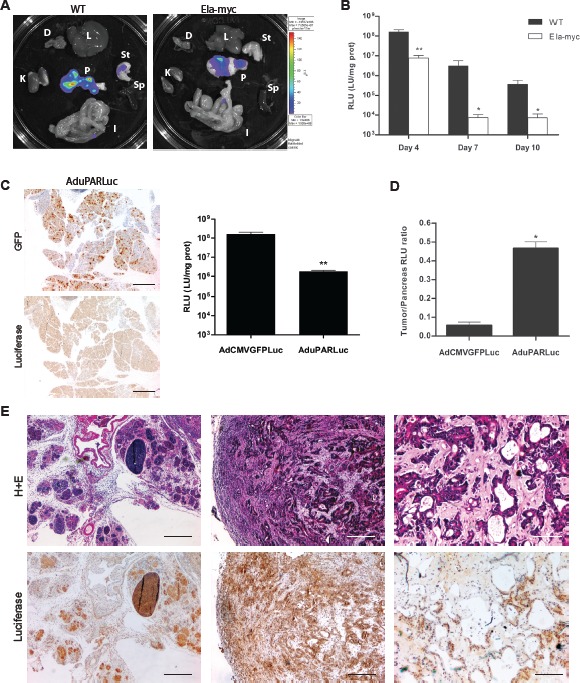
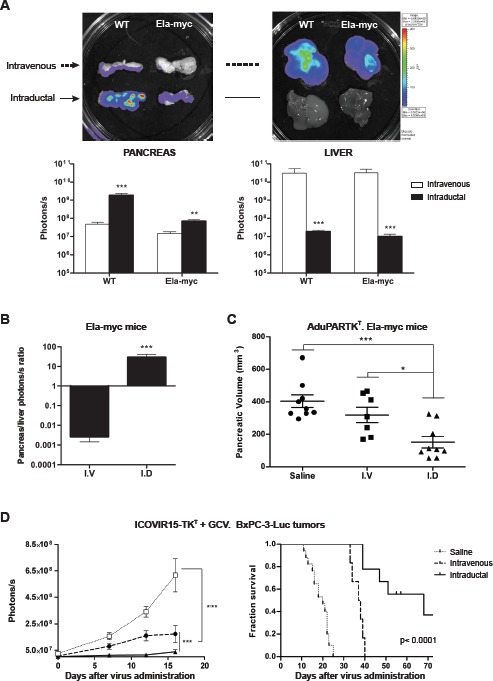
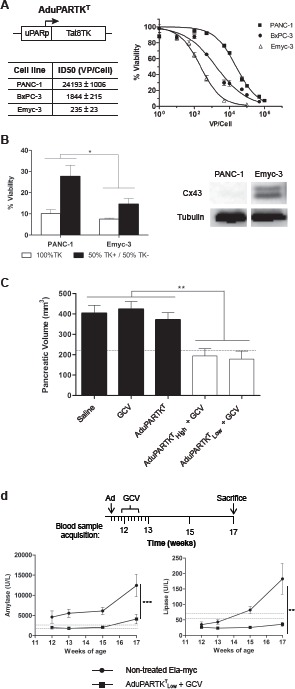
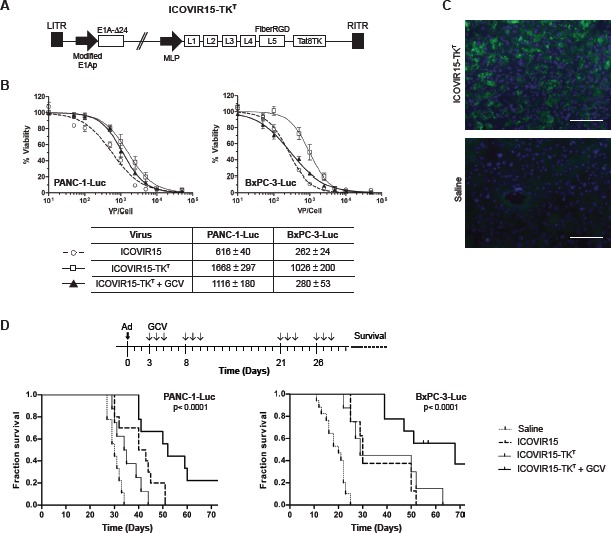
Gene-based anticancer therapies delivered by adenoviruses are limited by the poor viral distribution into the tumor. In the current work we have explored the feasibility of targeting pancreatic tumors through a loco-regional route. We have taken advantage of the ductal network in the pancreas to retrogradelly inject adenoviruses through the common bile duct in two different mouse models of pancreatic carcinogenesis: The transgenic Ela-myc mice that develop mixed neoplasms displaying both acinar-like and duct-like neoplastic cells affecting the whole pancreas; and mice bearing PANC-1 and BxPC-3 orthotopic xenografts that constitute a model of localized human neoplastic tumors. We studied tumor targeting and the anticancer effects of newly thymidine kinase-engineered adenoviruses both in vitro and in vivo, and conducted comparative studies between intraductal or intravenous administration. Our data indicate that the intraductal delivery of adenovirus efficiently targets pancreatic tumors in the two mouse models. The in vivo application of AduPARTKT plus ganciclovir (GCV) treatment induced tumor regression in Ela-myc mice. Moreover, the intraductal injection of ICOVIR15-TKT oncolytic adenoviruses significantly improved mean survival of mice bearing PANC-1 and BxPC-3 pancreatic xenografts from 30 to 52 days and from 20 to 68 days respectively (p less than 0.0001) when combined with GCV. Of notice, both AduPARTKT and ICOVIR15-TKT antitumoral responses were stronger by ductal viral application than intravenously, in line with the 38-fold increase in pancreas transduction observed upon ductal administration. In summary our data show that cytotoxic adenoviruses retrogradelly injected to the pancreas can be a feasible approach to treat localized pancreatic tumors.
腺病毒介导的基于基因的抗癌疗法因病毒在肿瘤内分布不佳而受到限制。在当前的研究中,我们探索了通过局部区域途径靶向胰腺肿瘤的可行性。我们利用胰腺中的导管网络,在两种不同的胰腺癌发生小鼠模型中通过胆总管逆行注射腺病毒:转基因Ela-myc小鼠,其发生混合性肿瘤,显示出影响整个胰腺的腺泡样和导管样肿瘤细胞;以及携带PANC-1和BxPC-3原位异种移植瘤的小鼠,这些异种移植瘤构成了局部人类肿瘤的模型。我们在体外和体内研究了新型胸苷激酶工程化腺病毒的肿瘤靶向性和抗癌作用,并对导管内给药或静脉内给药进行了比较研究。我们的数据表明,在这两种小鼠模型中,腺病毒的导管内给药有效地靶向胰腺肿瘤。在Ela-myc小鼠中,AduPARTKT联合更昔洛韦(GCV)治疗的体内应用诱导了肿瘤消退。此外,当与GCV联合使用时,导管内注射ICOVIR15-TKT溶瘤腺病毒分别显著提高了携带PANC-1和BxPC-3胰腺异种移植瘤小鼠的平均生存期,从30天提高到52天,从20天提高到68天(p小于0.0001)。值得注意的是,导管内病毒应用的AduPARTKT和ICOVIR15-TKT的抗肿瘤反应均比静脉内给药更强,这与导管给药后观察到的胰腺转导增加38倍一致。总之,我们的数据表明,逆行注射到胰腺的细胞毒性腺病毒可能是治疗局部胰腺肿瘤的一种可行方法。