
小鼠苯丙氨酸羟化酶。与人类苯丙氨酸羟化酶的同源性和差异。
Mouse phenylalanine hydroxylase. Homology and divergence from human phenylalanine hydroxylase.
作者信息
Ledley F D, Grenett H E, Dunbar B S, Woo S L
机构信息
Howard Hughes Medical Institute, Baylor College of Medicine, Houston, TX 77030.
出版信息
Biochem J. 1990 Apr 15;267(2):399-405. doi: 10.1042/bj2670399.
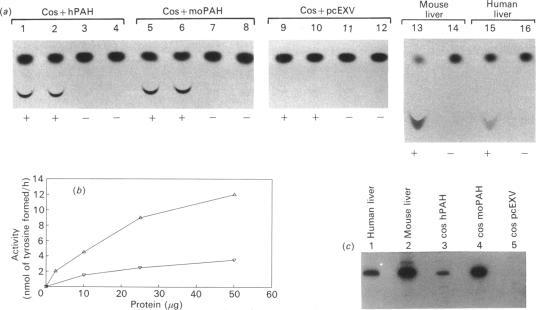
The laboratory mouse represents an important model for the study of phenylalanine metabolism and the pathochemistry of phenylketonuria, yet mouse phenylalanine hydroxylase (PAH) has not been extensively studied. We report the cloning and sequencing of a mouse PAH cDNA, the expression of enzymic activity from the mouse PAH cDNA clone and the identification of mouse PAH and human PAH by two-dimensional PAGE of liver samples. These data confirm the expected homology of mouse PAH and human PAH and suggest differences in the primary sequence and the phosphorylation state of the two enzymes.
实验室小鼠是研究苯丙氨酸代谢和苯丙酮尿症病理化学的重要模型,然而小鼠苯丙氨酸羟化酶(PAH)尚未得到广泛研究。我们报告了小鼠PAH cDNA的克隆和测序、从小鼠PAH cDNA克隆中表达酶活性以及通过肝脏样品的二维聚丙烯酰胺凝胶电泳鉴定小鼠PAH和人PAH。这些数据证实了小鼠PAH和人PAH预期的同源性,并表明这两种酶在一级序列和磷酸化状态上存在差异。

 Zotero 插件